
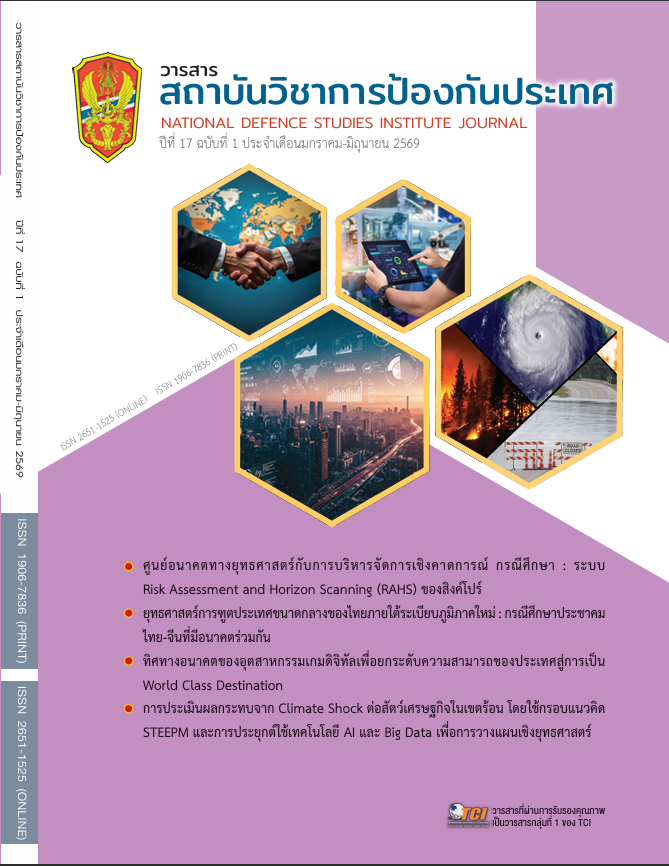
การประเมินผลกระทบจาก Climate Shock ต่อสัตว์เศรษฐกิจในเขตร้อน โดยใช้กรอบแนวคิด STEEPM และการประยุกต์ใช้เทคโนโลยี AI และ Big Data เพื่อการวางแผนเชิงยุทธศาสตร์
Article Sidebar
Main Article Content
บทคัดย่อ
การเปลี่ยนแปลงสภาพภูมิอากาศก่อให้เกิด Climate Shock เช่น ภัยแล้ง น้ำท่วมฉับพลัน และคลื่นความร้อน ซึ่งส่งผลกระทบต่อสัตว์เศรษฐกิจในเขตร้อน การศึกษานี้มีวัตถุประสงค์เพื่อประเมินผลกระทบดังกล่าวโดยใช้กรอบแนวคิด STEEPM (สังคม เทคโนโลยี เศรษฐกิจ สิ่งแวดล้อม การเมือง/นโยบาย และความมั่นคง) ร่วมกับการประยุกต์ใช้ AI และ Big Data เพื่อการวางแผนเชิงยุทธศาสตร์ การวิจัยใช้วิธีทบทวนและสังเคราะห์เอกสารทางวิชาการและกรณีศึกษา โดยมีขอบเขตเน้นประเทศไทยและพื้นที่เขตร้อนที่มีความเปราะบางต่อ Climate Shock
ผลการศึกษาตามกรอบ STEEPM พบว่า ภัยพิบัติส่งผลกระทบต่อรายได้เกษตรกรและความมั่นคงทางอาหาร (Social) ข้อจำกัดด้านโครงสร้างพื้นฐานและการเข้าถึงเทคโนโลยี (Technological) ต้นทุนการผลิตเพิ่มขึ้น (Economic) ความเสี่ยงต่อสุขภาพสัตว์จากสภาพอากาศรุนแรง (Environmental) ความจำเป็นของนโยบายเชิงรุก (Political) ความเสี่ยงต่อเสถียรภาพด้านอาหารและพื้นที่ชายแดน (Military) ข้อค้นพบชี้ว่า AI และ Big Data มีศักยภาพในการพยากรณ์ความเสี่ยง จำแนกพื้นที่เสี่ยง และพัฒนาระบบเตือนภัยล่วงหน้า จึงควรส่งเสริมการพัฒนาฐานข้อมูลระดับชาติ และแพลตฟอร์มเกษตรอัจฉริยะ เพื่อเสริมสร้างความมั่นคงทางอาหารอย่างยั่งยืน
Article Details

อนุญาตภายใต้เงื่อนไข Creative Commons Attribution-NonCommercial-NoDerivatives 4.0 International License.
บทความ ภาพ ตาราง กราฟ ข้อเขียน หรือความคิดเห็นในวารสารฉบับนี้เป็นของผู้เขียนไม่ผูกพันกับสถาบันวิชาการป้องกันประเทศ และทางวิชาการแต่อย่างใด
เอกสารอ้างอิง
กรมอุตุนิยมวิทยา. (2568, 31 ธันวาคม). สรุปสภาวะอากาศทั่วไปในรอบปี พ.ศ. 2568. https://www.tmd.go.th/climate/summaryearly
Ahmed, N., & Shakoor, N. (2025). Advancing agriculture through IoT, Big Data, and AI: A review of smart technologies enabling sustainability. Smart Agricultural Technology, 10, 100848. https://doi.org/10.1016/j.atech.2025.100848
Food and Agriculture Organization. (2023). The State of Food Security and Nutrition in the World 2023. https://openknowledge.fao.org/handle/20.500.14283/cc3017en
Gautam, L. (2025). AI and Big Data Applications in Climate Risk Management: Best Practices from Global Agriculture. Veolia Institute. https://www.institut.veolia.org/sites/g/files/dvc2551/files/document/2025/01/23_VEOLIA_FACTS_27_2025_GB_WEB_L_Gautam.pdf
Godfray, H. C. J., Beddington, J. R., Crute, I. R., Haddad, L., Lawrence, D., Muir, J. F., Pretty, J., Robinson, S., Thomas, S. M., & Toulmin, C. (2010). Food Security: The Challenge of Feeding 9 Billion People. Science, 327(5967), 812-818. https://doi.org/10.1126/science.1185383
HandySense. (2023). B-Farm: Smart Agriculture Platform for Thai Farmers. https://coingeek.com/thailand-launches-ai-agriculture-app-microsoft-ai-tools-aid-farmers/
Intergovernmental Panel on Climate Change. (2023). Climate Change 2023: Impacts, Adaptation, and Vulnerability. Cambridge University Press. https://www.ipcc.ch/report/sixth-assessmentreport-cycle/
Jaipong, P., Sriboonruang, P., Siripipattanakul, S., Sitthipon, T., Kaewpuang, P., & Auttawechasakoon, P. (2022). A Review of Intentions to Use Artificial Intelligence in Big Data Analytics for Thailand Agriculture. Review of Advanced Multidisciplinary Science, Engineering & Innovation, 1(2), 1-8. https://papers.ssrn.com/sol3/papers.cfm?abstract_id=4168434
Namkhan, M., Sukumal, N., & Savini, T. (2022). Impact of climate change on Southeast Asian natural habitats, with focus on protected areas. Global Ecology and Conservation, 39, e02293. https://doi.org/10.1016/j.gecco.2022.e02293
Organisation for Economic Co-operation and Development. (2019). Digital Opportunities for Better Agricultural Policies. OECD Publishing. https://doi.org/10.1787/571a0812-en
Rajchamaha, K., & Makararpong, D. (2023). Dairy Farmers’ Intention to Use High-Precision Area-Level Weather Warning Technology in Dairy Farms in Thailand Through an Application on Mobile Phones. International Journal of Interactive Mobile Technologies (iJIM), 17(18), 85-98. https://doi.org/10.3991/ijim.v17i18.41265
Sayruamyat, S., & Nadee, W. (2020). Acceptance and Readiness of Thai Farmers Toward Digital Technology. In Y.-D. Zhang, J. K. Mandal, C. So-In, & N. V. Thakur (Eds.), Smart Trends in Computing and Communications (pp. 75-82). Springer. https://doi.org/10.1007/978-981-15-0077-0_8
Thornton, P. K., & Herrero, M. (2015). Adapting to climate change in the mixed crop and livestock farming systems in sub-Saharan Africa. Nature Climate Change, 5(9), 830-836. https://doi.org/10.1038/nclimate2754
United Nations Framework Convention on Climate Change. (2024). Thailand National Adaptation Plan (NAP). https://unfccc.int/sites/default/files/resource/NAP_THAILAND_2024.pdf
Wheeler, T., & Braun, J. V. (2013). Climate Change Impacts on Global Food Security. Science, 341(6145), 508-513. https://doi.org/10.1126/science.1239402
Wolfert, S., Ge, L., Verdouw, C., & Bogaardt, M.-J. (2017). Big Data in Smart Farming-A review. Agricultural Systems, 153, 69-80. https://doi.org/10.1016/j.agsy.2017.01.023
World Bank. (2023). Thailand Climate Risk Country Profile. https://climateknowledgeportal. worldbank.org/country/thailand/climate-data-projections
World Food Programme. (2024). Global Report on Food Crises 2024. https://www.wfp.org/publications/global-report-food-crises-grfc
Zealousys. (2024, January 15). The Future of Agriculture in the Netherlands: A Tech-Driven Vision. https://www.zealousys.com/blog/the-future-of-agriculture-in-the-netherlands-a-tech-driven-vision/
