
From Silence to the Last Straw: The Awakening of Thai Nationalism in Response to Perceived Threats to State Sovereignty
Article Sidebar
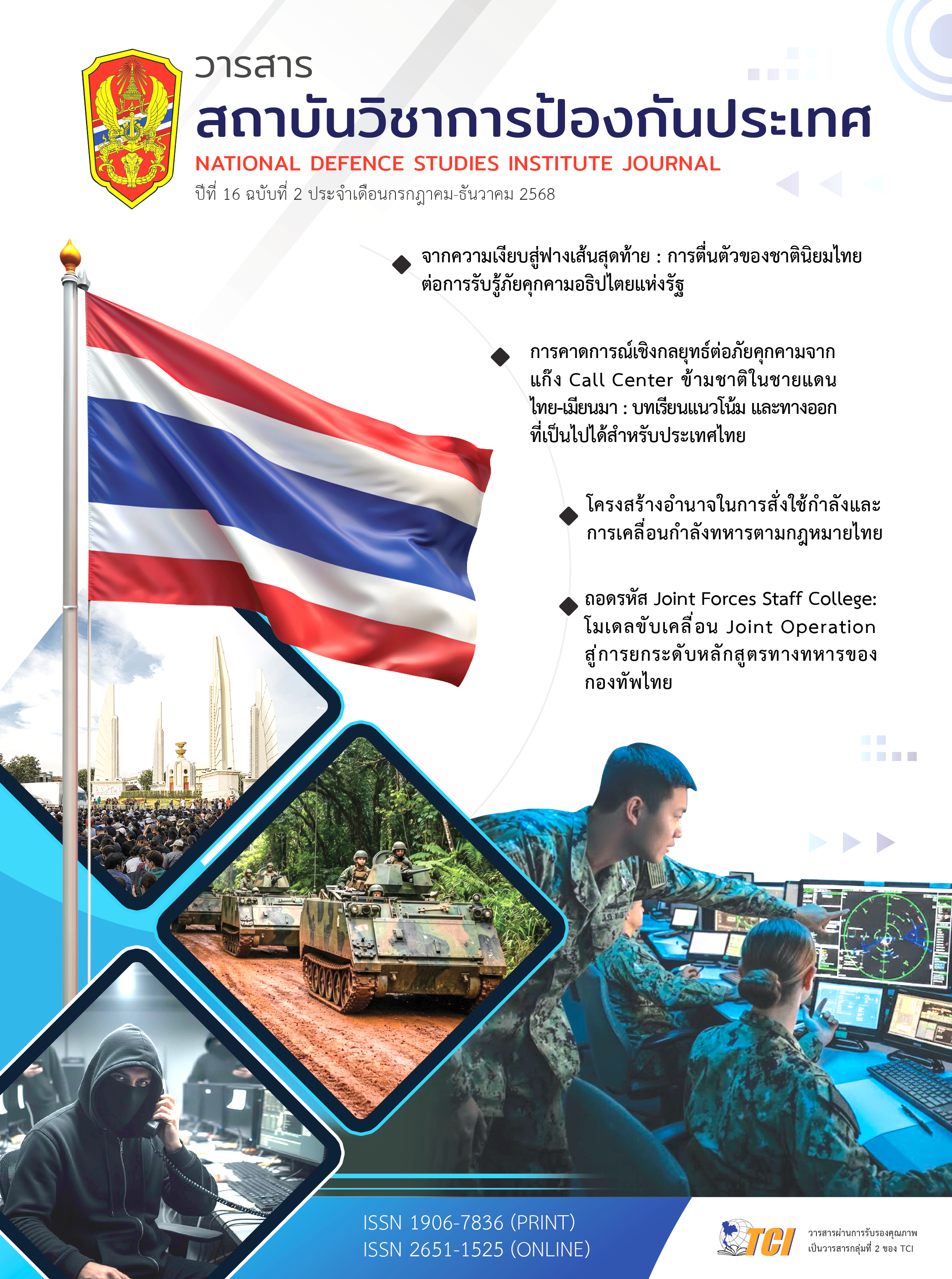
Main Article Content
Abstract
This article aims to analyze the phenomenon of the leaked “audio conversation” between Thai and Cambodian leaders which became a major trigger event driving political change and civic mobilization in Thailand in 2025. The analysis integrates Nationalism, Social Movement Theory, and Digital Political Communication to propose a new explanatory framework called “Dignity-Based Nationalism.”
This framework identifies a mechanism of “Triggered and Self-Reliant Mobilization under Leaderless Conditions” in four stages: 1) Silence, when citizens although dissatisfied with government policies remained patient under a majority government; 2) Awareness and Shame, when the leaked audio on Facebook became a trigger event that challenged national dignity and spread rapidly through digital media; 3) Distrust of Leadership, which led to political party withdrawal and mobilization by civil society; and 4) Defense of National Dignity, expressed through collective actions such as donations, providing supplies, and emotional mobilization online. These stages demonstrate that although citizens began with silence and tolerance, once national dignity was challenged, they developed awareness, lost trust in leadership, and ultimately united to defend the nation— reflecting the shared Thai identity captured in the phrase: “Thailand stays calm, yet in war does not fear.”
Article Details

This work is licensed under a Creative Commons Attribution-NonCommercial-NoDerivatives 4.0 International License.
The articles, images, tables, graphs, written content, and opinions published in this journal are solely those of the authors and do not necessarily reflect the views or positions of the National Defence Studies Institute or its academic affiliates.
References
กันจอมพลัง. (2568, 28 มิถุนายน). สนับสนุนมูลนิธิ กันจอมพลัง ช่วยสู้ [Facebook post]. Facebook. https://www.facebook.com/gunjompalang1/posts/1335754551444592
จิราภรณ์ ศรีแจ่ม. (2568, 5 มิถุนายน). 3 เรื่องที่ยัง “ไม่ชัดเจน” ปมพิพาทชายแดนไทย-กัมพูชา ระลอกล่าสุด. BBC ไทย. https://www.bbc.com/thai/articles/cn4qp0l5091o
บีบีซีไทย. (2568, 12 พฤศจิกายน). เหตุปะทะที่ชายแดนไทย-กัมพูชาวันนี้ เรารู้แล้วว่าอะไรบ้าง. https://www.bbc.com/thai/articles/cvgmj2pxjl20
Anderson, B. (2006). Imagined communities: Reflections on the origin and spread of nationalism (Rev. ed.). Verso.
Boyd, D. (2010). Social network sites as networked publics: Affordances, dynamics, and implications. In Z. Papacharissi (Ed.), A networked self: Identity, community, and culture on social network sites (pp. 39-58). Routledge.
Breuilly, J. (2021). Nationalism and the state (2nd ed.). University of Chicago Press.
Castells, M. (2009). Communication power. Oxford University Press.
Castells, M. (2012). Networks of outrage and hope: Social movements in the Internet age. Polity.
Chatterjee, P. (1993). The nation and its fragments: Colonial and postcolonial histories. Princeton University Press.
Entman, R. M. (2007). Framing bias: Media in the distribution of power. Journal of Communication, 57(1), 163-173.
Financial Times. (2025, August 30). Feud between former god brothers fuels Thailand-Cambodia border conflict. https://www.ft.com/content/77836473-4809-4178-bad5-dc2b0b8acae2
Gellner, E. (1983). Nations and nationalism. Blackwell.
McAdam, D. (1982). Political process and the development of black insurgency, 1930-1970. University of Chicago Press.
McCarthy, J. D., & Zald, M. N. (1977). Resource mobilization and social movements: A partial theory. American Journal of Sociology, 82(6), 1212-1241.
Nattan Casey Plewissara. (2025). The Leaked Call Shaking Thai Politics: Translated. The Asia Cable.
https://www.theasiacable.com/p/the-leaked-call-shaking-thai-politics
NBT UBON. (2568, 7 สิงหาคม). ทหารรับมอบสิ่งของบริจาคจากศูนย์ช่วยเหลือฯ [Facebook post]. Facebook. https://www.facebook.com/NBTPRD2/posts/1285909733577076
Sianturi, K. (2023). Public policy in the digital era: transformation of political communication. Edunity: Social and Education Studies, 2(12), 1423-1436. http://doi.org/10.57096/edunity.v2i12.183
Smelser, N. J. (1962). Theory of collective behavior. Free Press.
Smith, A. D. (2013). Nationalism: Theory, ideology, history (2nd ed.). Polity Press.
Snow, D. A., & Benford, R. D. (1988). Ideology, frame resonance, and participant mobilization. International Social Movement Research, 1(1), 197-217.
Strangio, S. (2025, July 28). The roots of the Thailand-Cambodia border conflict. The Diplomat.
https://thediplomat.com/2025/07/the-roots-of-the-thailand-cambodia-border-conflict
Teekah, E. (2025, December 22). Thailand-Cambodia conflict. Britannica. https://www.britannica.com/event/Thailand-Cambodia-Conflict
The Guardian. (2025, August 2). Online hate and rising vitriol: Deep divisions amid shaky peace between Thailand and Cambodia. https://www.theguardian.com/world/2025/aug/02/online-hate-and-rising-vitriol-deep-divisions-amid-shaky-peace-between-thailand-and-cambodia
The Standard Team. (2568, 20 สิงหาคม). เปิดคำชี้แจง ‘แพทองธาร’ คดีคลิปสนทนา ฮุน เซน. The Standard. http://thestandard.co/paetongtarn-hunsen-negotiation-technique
Thongchai Winichakul. (1994). Siam mapped: A history of the geo-body of a nation. University of Hawaii Press.
Tilly, C. (1978). From mobilization to revolution. Addison-Wesley.
Touraine, A. (1985). An introduction to the study of social movements. Social Research, 52(4), 749-787.
Vaccari, C., & Chadwick, A. (2020). Deepfakes and disinformation: Exploring how citizens think about the threat of political deepfakes. Journalism Studies, 21(4), 425-442.
WorkpointOfficial. (2568, 23 มิถุนายน). เพลงแผ่นดินของเรา [YouTube]. https://www.youtube.com/watch?v=uB91FBsEY14
