
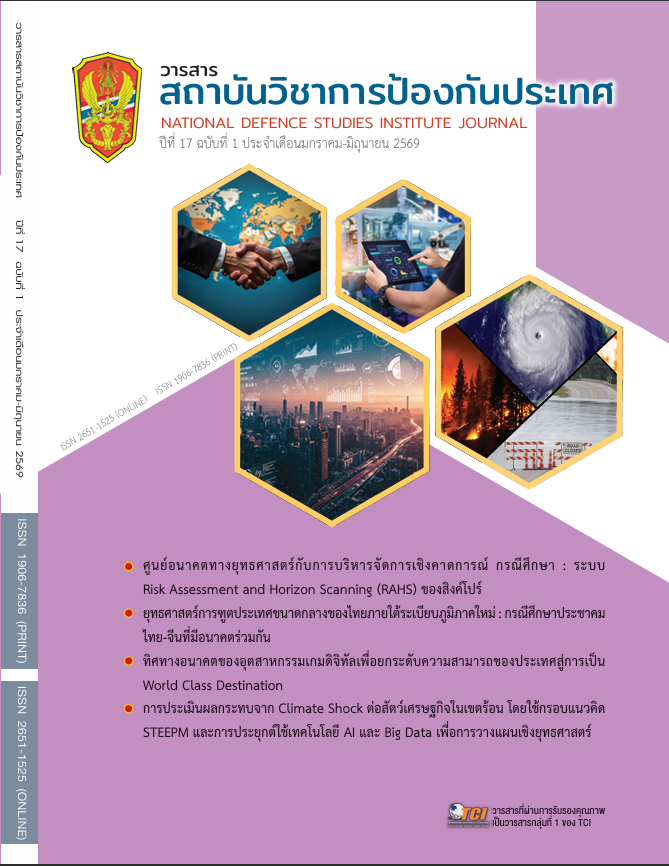
ยุทธศาสตร์การทูตประเทศขนาดกลางของไทยภายใต้ระเบียบภูมิภาคใหม่ : กรณีศึกษาประชาคมไทย–จีนที่มีอนาคตร่วมกัน
Article Sidebar
Main Article Content
บทคัดย่อ
บทความวิชาการนี้ มีวัตถุประสงค์เพื่อวิเคราะห์ยุทธศาสตร์การทูตของประเทศไทยในฐานะประเทศขนาดกลาง ที่มีอิทธิพลท่ามกลางบริบทของการเปลี่ยนแปลงระเบียบภูมิภาคในศตวรรษที่ 21 โดยใช้กรณีศึกษาความสัมพันธ์ไทย–จีน ภายใต้กรอบประชาคมที่มีอนาคตร่วมกัน การศึกษาใช้แนวทางการวิเคราะห์เชิงคุณภาพผ่านการทบทวนวรรณกรรม เกี่ยวกับทฤษฎีการทูตประเทศขนาดกลาง การวิเคราะห์เอกสารนโยบายและแถลงการณ์ร่วมระหว่างไทยและจีน รวมถึงการศึกษาพฤติกรรมการทูตของไทยในมิติต่าง ๆ ได้แก่ การเชื่อมโยงยุทธศาสตร์การพัฒนา ความร่วมมือทางเศรษฐกิจและความมั่นคง และบทบาทในเวทีพหุภาคี ผลการวิเคราะห์พบว่า ไทยได้ดำเนินกลยุทธ์การทูต แบบหลากมิติที่สะท้อนลักษณะสำคัญของประเทศขนาดกลาง ได้แก่ 1) กลยุทธ์การรักษาสมดุลที่แสดงออก ผ่านการมีส่วนร่วมทางเศรษฐกิจกับจีนอย่างแข็งขันควบคู่ไปกับการรักษาความหลากหลายของพันธมิตรทางความมั่นคง 2) การเป็นสะพานเชื่อมระหว่างจีนกับภูมิภาคเอเชียตะวันออกเฉียงใต้ผ่านกลไกอาเซียน และ 3) การทูตเฉพาะด้าน ในประเด็นที่ไทยมีความเข้มแข็ง เช่น ความมั่นคงทางอาหารและเกษตรกรรมยั่งยืน การท่องเที่ยวเชิงสุขภาพ การส่งเสริมหลักประกันสุขภาพถ้วนหน้า และการใช้ซอฟต์พาวเวอร์ผ่านการแลกเปลี่ยนทางวัฒนธรรมและการท่องเที่ยวในระดับภูมิภาค อย่างไรก็ตาม ไทยเผชิญความท้าทาย สำคัญในการรักษาความเป็นอิสระทางยุทธศาสตร์ท่ามกลาง การแข่งขันระหว่างมหาอำนาจที่รุนแรงขึ้น โดยเฉพาะแรงกดดันในการเลือกข้างระหว่างจีนและสหรัฐอเมริกา ความกังวลเกี่ยวกับการพึ่งพาจีนทางเศรษฐกิจมากเกินไป และข้อจำกัดด้านทรัพยากรและความน่าเชื่อถือทางการเมือง บทความนี้มีข้อเสนอแนะให้ไทยเสริมสร้างความโปร่งใส ในโครงการความร่วมมือขนาดใหญ่ กระจายความเสี่ยงทางเศรษฐกิจและความมั่นคง พัฒนาขีดความสามารถด้านการทูตและการวิเคราะห์กลยุทธ์ เสริมสร้างความเป็นเอกภาพภายในอาเซียน และพัฒนาการทูตเฉพาะด้าน ในประเด็นที่สอดคล้องกับจุดแข็งของประเทศ
Article Details

อนุญาตภายใต้เงื่อนไข Creative Commons Attribution-NonCommercial-NoDerivatives 4.0 International License.
บทความ ภาพ ตาราง กราฟ ข้อเขียน หรือความคิดเห็นในวารสารฉบับนี้เป็นของผู้เขียนไม่ผูกพันกับสถาบันวิชาการป้องกันประเทศ และทางวิชาการแต่อย่างใด
เอกสารอ้างอิง
Beeson, M. (2011). Can Australia save the world? The limits and possibilities of middle power diplomacy. Australian Journal of International Affairs, 65(5), 563-577. https://doi.org/10.1080/10357718.2011.613148
Carr, A. (2014). Is Australia a middle power? A systemic impact approach. Australian Journal of International Affairs, 68(1), 70-84. https://doi.org/10.1080/10357718.2013.840264
Cooper, A. F., Higgott, R. A., & Nossal, K. R. (1993). Relocating middle powers: Australia and Canada in a changing world order. UBC Press.
Gilley, B., & O’Neil, A. (Eds.). (2014). Middle powers and the rise of China. Georgetown University Press.
Haacke, J. (2019). The concept of hedging and its application to Southeast Asia: A critique and a proposal for a modified conceptual and methodological framework. International Relations of the Asia-Pacific, 19(3), 375-417. https://doi.org/10.1093/irap/lcy010
Hewison, K. (2018). Thailand: An old relationship renewed. The Pacific Review, 31(1), 116-130. https://doi.org/10.1080/09512748.2017.1357652
Hiep, L. H. (2013). Vietnam’s hedging strategy against China since normalization. Contemporary Southeast Asia, 35(3), 333-368. https://doi.org/10.1355/cs35-3b
Jordaan, E. (2003). The concept of a middle power in international relations: Distinguishing between emerging and traditional middle powers. Politikon, 30(2), 165-181. https://doi.org/10.1080/0258934032000147282
Kuik, C. C. (2008). The essence of hedging: Malaysia and Singapore’s response to a rising China. Contemporary Southeast Asia, 30(2), 159-185. https://doi.org/10.1355/CS30-2A
Kuik, C. C. (2016). How do weaker states hedge? Unpacking ASEAN states’ alignment behavior towards China. Journal of Contemporary China, 25(100), 500-514. https://doi.org/10.1080/10670564.2015.1132714
Ministry of Foreign Affairs of the Kingdom of Thailand. (2025, February 8). Joint Statement between the Government of the Kingdom of Thailand and the Government of the People’s Republic of China on Advancing the Comprehensive Strategic Cooperative Partnership and Building a Thailand-China Community with a Shared Future for Enhanced Stability, Prosperity, and Sustainability through a Forward-looking and People-Centred Vision. https://www.mfa.go.th/en/content/joint-statement-th-ch-2025-en?cate=5d5bcb4e15e39c306000683c
Patience, A. (2014). Imagining middle powers. Australian Journal of International Affairs, 68(2), 210-224.
https://doi.org/10.1080/10357718.2013.840557
Ping, J. H. (2005). Middle power statecraft: Indonesia, Malaysia and the Asia-Pacific. Ashgate.
Raditio, K. H. (2024, September 9). Deciphering Xi Jinping’s Community of Shared Future for Mankind. E-International Relations. https://www.eir.info/2024/09/09/deciphering-xi-jinpings-community-of-sharedfuture-for-mankind/
Wongsurawat, W. (2020). Disturbing the inequality of PRC influence on the position of ethnic Chinese in Thailand in the New Era. In Chinese People's Diplomacy and Developmental Relations with East Asia (pp. 146-161). Routledge.
Yao, Y. (2022). Opportunities, challenges and countermeasures for Chinese enterprises investing in Thailand in post-epidemic era. In Proceedings of the 2022 2nd International Conference on Enterprise Management and Economic Development (ICEMED 2022), 1169-1174. https://doi.org/10.2991/aebmr.k.220603.189
