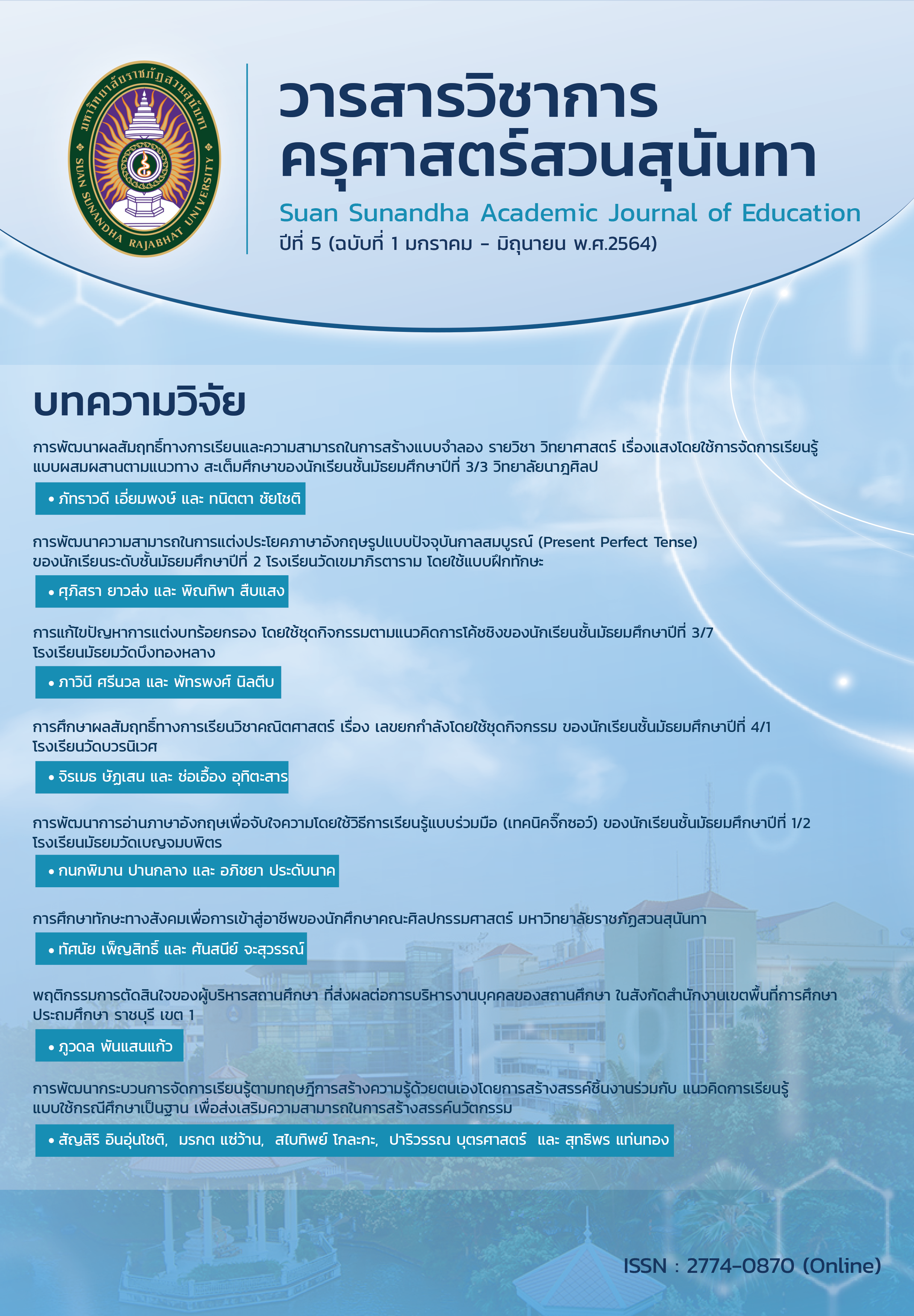
The Development of Learning Achievement and Model Construction Abilities in the Science Lesson on the Topic of Lights through Blended Learning Based on STEM Education of Mathayomsuksa 3/3 Students at the College of Dramatic Arts
Keywords:
Blended Learning based on STEM Education, model construction abilities, learning achievementAbstract
This action research aimed 1) to compare the students’ learning achievement and the students’ ability to construct a model on the topic of lights in the science lesson by using the blended learning based on STEM education and 2) to compare the model construction skills on the topic of lights in the science lesson before and after using the blended learning based on STEM education. The sample group was ten Mathayomsuksa 3/3 students at the College of Dramatic Arts. The participants were selected with the purposive sampling method. The research instruments were lesson plans, pre-test and post-test of learning achievement, and model construction ability test. The mean, standard deviation, and score difference were used to analyze the data. The research revealed that 1) The learning achievement of students after using the lesson plans of Lights by using blended learning based on STEM education was higher at the mean of 13.30 (S.D. = 2.11) than the pre-test which was at the mean of 5.50 (S.D. = 1.08). 2) The model construction abilities of students after participating in the lesson plans of Lights by using the blended learning based on STEM education from the post-test was higher at the mean of 13.5 (S.D. = 2.01) than the pre-test which was at the mean of 4.20 (S.D. = 0.79).
References
กระทรวงศึกษาธิการ. (2552). หลักสูตรแกนกลางการศึกษาขั้นพื้นฐาน พุทธศักราช 2551. กรุงเทพฯ : โรงพิมพ์ชุมนุมสหกรณ์การเกษตรแห่งประเทศไทย จำกัด.
กระทรวงศึกษาธิการ. (2553). หลักสูตรแกนกลางการศึกษาขั้นพื้นฐาน พุทธศักราช 2551 (พิมพ์ครั้งที่ 3). กรุงเทพฯ : โรงพิมพ์ชุมนุมสหกรณ์การเกษตรแห่งประเทศไทย จำกัด.
กระทรวงศึกษาธิการ. (2560). ตัวชี้วัดและหลักสูตรแกนกลาง กลุ่มสาระการเรียนรูวิทยาศาสตร์ (ฉบับปรับปรุง พ.ศ. 2560) ตามหลักสูตรแกนกลางการศึกษาขั้นพื้นฐาน พุทธศักราช 2551. สำนักคณะกรรมการศึกษาขั้นพื้นฐาน กระทรวงศึกษาธิการ, กรุงเทพมหานคร : โรงพิมพ์ชุมนุมสหกรณ์การเกษตรแห่งประเทศไทย จํากัด
จันทร์พร พรหมมาศ และคณะ (2558). ผลการจัดการเรียนรู้วิชาเคมี เรื่อง สารชีวโมเลกุล ด้วยการเรียนรู้โดยใช้แบบจำลอง เป็นฐานเพื่อพัฒนามโนทัศน์ทางวิทยาศาสตร์และความสามารถในการสร้างแบบจำลองทางวิทยาศาสตร์ สำหรับ นักเรียนชั้นมัธยมศึกษาปีที่ 6. วารสารศึกษาศาสตร์. 2(26), 42-55.
ทิศนา แขมมณี. (2550). ศาสตร์การสอน. (พิมพ์ครั้งที่6) . กรุงเทพมหานคร: ด้านสุทธาการพิมพ์.
พรทิพย์ ศิริภัทราชัย. (2556). STEM Education กับการพัฒนาทักษะในศตวรรษที่21. นักบริหาร, 33(2), 49 –56.
นัสรินทร์ บือซา. (2558). ผลการจัดการเรียนรู้ตามแนวคิดสะเต็มศึกษา (STEM Education) ที่มีต่อผลสัมฤทธิ์ทางการเรียน ชีววิทยาความสามารถในการแก้ปัญหาและความพึงพอใจต่อการจัดการเรียนรู้ของนักเรียนชั้นมัธยมศึกษาปีที่ 5 (วิทยานิพนธ์ปริญญามหาบัณฑิต). สงขลา: มหาวิทยาลัยสงขลานครินทร์.
บุญเรียง ขจรศิลป์. (2544). วิธีวิจัยทางการศึกษา (พิมพ์ครั้งที่ 5). กรุงเทพฯ: พี.เอ็น.การพิมพ์. พรทิพย์ ศิริภัทราชัย. (2556). STEM Education กับการพัฒนาทักษะในศตวรรษที่ 21. กรุงเทพฯ: มหาวิทยาลัย ศรีนครินทรวิโรฒ. ถ่ายเอกสาร
เสกสรร สรรสรพิสุทธิ์. (2558). เสวนาวิชาการสะเต็มศึกษา:เรียนรู้เพื่อแก้ปัญหาพัฒนานวัตกรรมนำสู่อาชีพ. จาก http://www.stemedthailand.org/
อุปการ จีระพันธุ์. (2556). หลักสูตรการออกแบบและเทคโนโลยี. สถาบันส่งเสริมการสอนวิทยาศาสตร์และเทคโนโลยี (สสวท.)
Downloads
Published
How to Cite
Issue
Section
License
Copyright (c) 2021 Faculty of Education, Suan Sunandha Rajabhat University

This work is licensed under a Creative Commons Attribution-NonCommercial-NoDerivatives 4.0 International License.