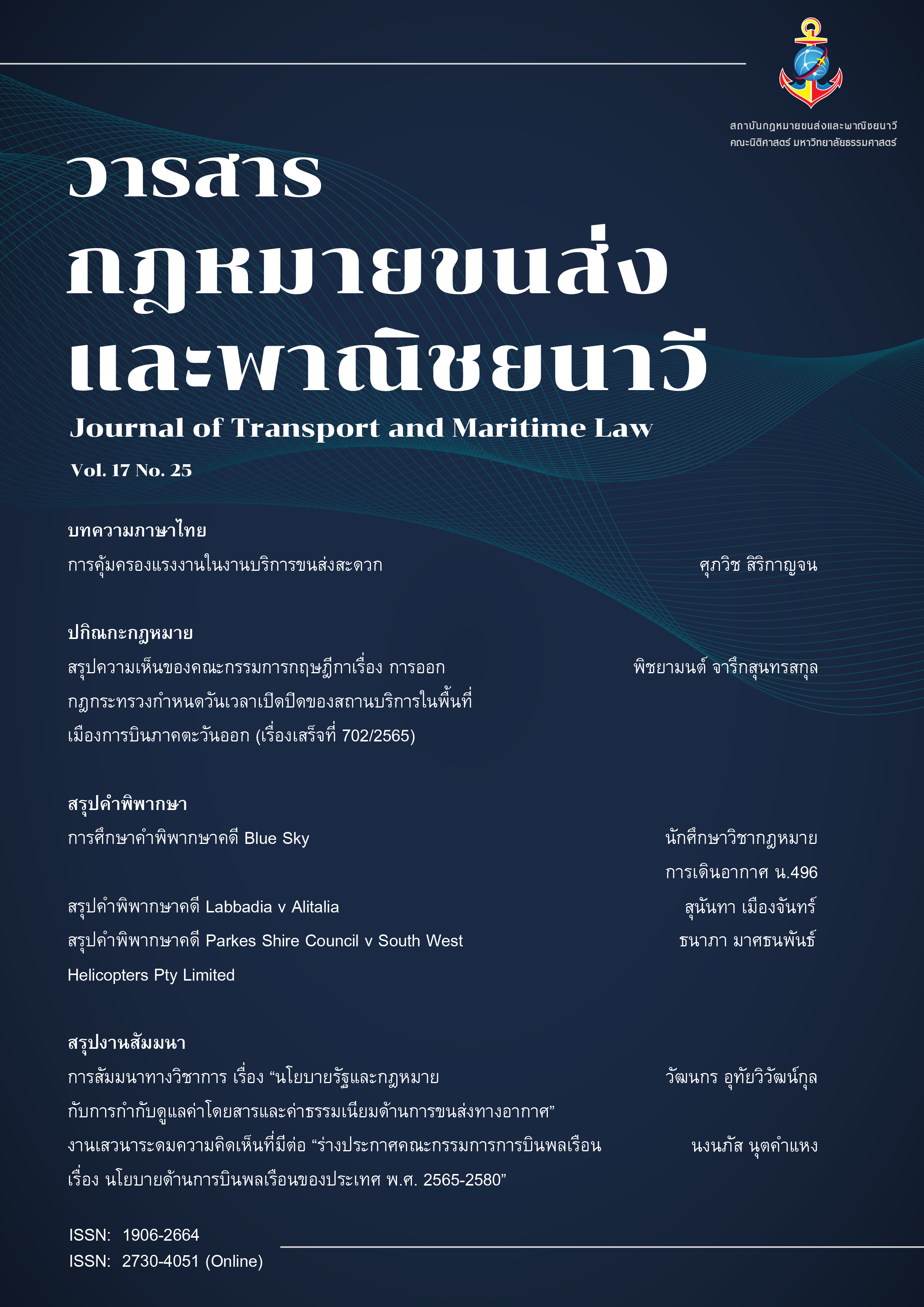
การคุ้มครองแรงงานในงานบริการขนส่งสะดวก
คำสำคัญ:
งานบริการขนส่งสะดวก, เศรษฐกิจแพลตฟอร์ม, เศรษฐกิจแบ่งปัน, แรงงานชั่วคราว, ไรเดอร์บทคัดย่อ
งานบริการขนส่งสะดวกเกิดขึ้นพร้อมกับแนวคิดว่าด้วยเศรษฐกิจแพลตฟอร์ม หรือธุรกิจดิจิทัลแพลตฟอร์ม หรือเศรษฐกิจแบ่งปัน หรือเศรษฐกิจชั่วคราว โดยสื่อถึงการที่ผู้ให้บริการแพลตฟอร์มจัดตั้งแพลตฟอร์มดิจิทัลขึ้นเพื่อเป็นตัวกลางในการเชื่อมต่ออุปสงค์ของผู้บริโภคกับอุปทานจากผู้ผลิตสินค้าหรือผู้ให้บริการผ่านงานบริการขนส่ง การให้บริการนี้เพิ่มศักยภาพในการประกอบกิจการ อาทิ ลดต้นทุนการผลิต ยกระดับการให้บริการแก่ผู้บริโภค และ
ยังสามารถรวบรวมข้อมูลเพื่อต่อยอดทางธุรกิจได้ นอกจากนี้ การให้บริการยังตอบโจทย์ผู้บริโภคเพราะสามารถอำนวยความสะดวกในการดำเนินชีวิตและสอดคล้องกับรูปแบบการใช้ชีวิตที่มุ่งเน้นความเป็นส่วนตัว จนเป็นผลให้งานบริการขนส่งสะดวกเติบโตอย่างก้าวกระโดด กระทั่งเป็นส่วนหนึ่งในการขับเคลื่อนเศรษฐกิจพร้อมกับสร้างโอกาสแก่ผู้ใช้แรงงาน
ผู้ใช้แรงงานในงานบริการขนส่งสะดวกถูกเรียกว่า “แรงงานชั่วคราว” เพื่อบ่งถึงลักษณะของการใช้แรงงานที่ไม่มีนายจ้าง ไม่สังกัดองค์กรหรือหน่วยงานและมีอิสระในการเลือกทำงานด้วยตนเอง กล่าวคือ ผู้ใช้แรงงานสามารถเข้าถึงงานและเลือกรับงานได้ มีช่วงเวลาการทำงานที่ยืดหยุ่นสามารถกำหนดช่วงเวลาการทำงานด้วยตนเอง ได้รับค่าตอบแทนที่สามารถแข่งขันในตลาดแรงงานได้ และคาดการรายรับจากการทำงานได้โดยง่าย อย่างไรก็ดี ปรากฏการณ์ข้างต้นย่อมสร้างความคลุมเครือในสถานะทางกฎหมายของผู้ใช้แรงงานว่ามีสถานะเป็นลูกจ้างของผู้ให้บริการแพลตฟอร์มตามสัญญาจ้างแรงงานหรือเป็นผู้รับจ้างตามสัญญาจ้างทำของ ตลอดจนความไม่ชัดเจนในสิทธิและหน้าที่ระหว่างผู้ให้บริการแพลตฟอร์มและผู้ใช้แรงงานตามกฎหมาย และความจำเป็นทางกฎหมายเพื่อกำหนดมาตรฐานในทางปฏิบัติเพื่อคุ้มครองผู้ใช้แรงงาน
เอกสารอ้างอิง
กฎหมาย
รัฐธรรมนูญเเห่งราชอาณาจักรไทย พุทธศักราช 2560.
ประมวลกฎหมายแพ่งและพาณิชย์
ประมวลกฎหมายวิธีพิจารณาความแพ่ง
พระราชบัญญัติคุ้มครองแรงงาน พ.ศ.2541
พระราชบัญญัติความปลอดภัย อาชีวอนามัย และสภาพแวดล้อมในการทำงาน พ.ศ.2554.
พระราชบัญญัติเงินทดแทน พ.ศ. 2537.
พระราชบัญญัติจัดตั้งศาลแรงงานและวิธีพิจารณาคดีแรงงาน พ.ศ.2522.
พระราชบัญญัติแรงงานสัมพันธ์ พ.ศ.2518.
กฎกระทรวงฉบับที่ 7 เเก้ไขเพิ่มเติมโดยกฎกระทรวงฉบับที่ 13 ออกตามความในพระราชบัญญัติคุ้มครองแรงงานฯ.
คำพิพากษา
คำพิพากษาศาลฎีกาที่ 228/2501.
คำพิพากษาศาลฎีกาที่ 1176/2510.
คำพิพากษาศาลฎีกาที่ 6252/2540.
หนังสือ
กิตติศักดิ์ ปรกติ, ความเป็นมาและหลักการใช้ นิติวิธี ในระบบซิวิลลอว์และคอมมอนลอว์ (พิมพ์ครั้งที่ 5, สำนักพิมพ์วิญญูชน 2560).
เกษมสันต์ วิลาวรรณ, คำอธิบายกฎหมายแรงงาน (พิมพ์ครั้งที่ 29, สำนักพิมพ์วิญญูชน 2564).
ไผทชิต เอกจริยกร, คำอธิบายจ้างแรงงาน จ้างทำของ รับขน (พิมพ์ครั้งที่ 15,วิญญูชน 2562).
พงษ์รัตน์ เครือกลิ่น, คำอธิบายกฎหมายแรงงานเพื่อการบริหารทรัพยากรมนุษย์ (พิมพ์ครั้งที่ 12, สำนักพิมพ์นิติธรรม 2563).
วิจิตรา (ฟุ้งลัดดา) วิเชียรชม, คำอธิบายกฎหมายแรงงาน (พิมพ์ครั้งที่ 7,วิญญูชน 2563).
วิจัย
สถาบันวิจัยและให้คำปรึกษาแห่งมหาวิทยาลัยธรรมศาสตร์, ‘การลดความเหลื่อมล้ำและสร้างความเป็นธรรม: นัยของการเปลี่ยนแปลงทางเทคโนโลยีกับความเหลื่อมล้ำ-บทเรียนจากเศรษฐกิจแพลตฟอร์ม’ (วิทยาลัยการเมืองการปกครอง สถาบันพระปกเกล้า 2562) 1-3.
เอกสารอิเล็กทรอนิกส์
กองสวัสดิการแรงงาน กรมสวัสดิการและคุ้มครองแรงงาน, ‘สวัสดิการแรงงาน’, (e-Labour บริการประชาชน) 2565, <https://lb.mol.go.th/%E0%B8%84%E0%B8%99%E0%B8%97%E0%B8%B3%E0%B8%87%E0%B8%B2%E0%B8%99/%E0%B8%AA%E0%B8%B4%E0%B9%88%E0%B8%87%E0%B8%97%E0%B8%B5%E0%B9%88%E0%B8%A5%E0%B8%B9%E0%B8%81%E0%B8%88%E0%B9%89%E0%B8%B2%E0%B8%87%E0%B8%84%E0%B8%A7%E0%B8%A3%E0%B8%A3%E0%B8%B9%E0%B9%89/%E0%B8%AA%E0%B8%A7%E0%B8%B1%E0%B8%AA%E0%B8%94%E0%B8%B4%E0%B8%81%E0%B8%B2%E0%B8%A3%E0%B9%81%E0%B8%A3%E0%B8%87%E0%B8%87%E0%B8%B2%E0%B8%99> สืบค้นเมื่อ 8 กันยายน 2565.
ชนฐิตา ไกรศรีกุล, ‘เป็นแรงงานหรือไม่เป็นแรงงาน?: ปัญหาการจ้างงานระหว่างบริษัทกับไรเดอร์ที่ยังไร้คำตอบ’,(the Matter, 1 พฤษภาคม 2564) <https://thematter.co/social/are-food-delivery-driver-be-employee/141758> สืบค้นเมื่อ 8 กันยายน 2565.
ธนาคารกรุงเทพ, ‘เจาะกลยุทธ์สู้ศึกชิงเจ้าตลาด Food Delivery’ (SME in focus ธนาคารกรุงเทพ, 10 กุมภาพันธ์ 2563) <https://www.bangkokbanksme.com/en/food-delivery-marketing-strategy> สืบค้นเมื่อ 13 ตุลาคม 2564.
ประชาชาติธุรกิจ, ‘ส่องรายได้ “คนขับฟู้ดดีลิเวอรี่” เจ้าไหนเงินดีสุด’(ประชาชาติธุรกิจ,15 พฤษภาคม 2564) <https://www.prachachat.net/ict/news-670152/> สืบค้นเมื่อ 8 กันยายน 2565.
ประชาไท, ‘ชวนรู้จักปัญหา ‘ไรเดอร์’ มุมแรงงานสัมพันธ์ที่ยังคลุมเครือ และแนวแก้ไข-คุ้มครองในทางกฎหมายที่อาจต้องถกอีกยาว’, (ประชาไท, 13 สิงหาคม 2564) <https://prachatai.com/journal/2021/08/94442> สืบค้นเมื่อ 8 กันยายน 2565.
ปราโมทย์ ยอดแก้ว, ‘การตลาดดิจิทัลกับการเปลี่ยนเเปลงวิถีชีวิตใหม่ในสังคมไทย’(2564) 1 วารสารสังคมวิจัยและพัฒนา 16 <https://he02.tci-thaijo.org/index.php/JMARD/article/download/250125/170059/> สืบค้นเมื่อ 8 กันยายน 2565.
วจนา วรรลยางกูร และ สมคิด พุทธศรี, ‘อรรคณัฐ วันทนะสมบัติ: ทุกข์ของแรงงานในความคลุมเครือของ ‘เศรษฐกิจแพลตฟอร์ม’’, (The101.world), 8 พฤษภาคม 2563) <https://www.the101.world/akkanut-wantanasombut-interview/> สืบค้นเมือวันที่ 8 กันยายน 2565.
สมประวิณ มันประเสริฐ, ‘Platform Economy…คำตอบของระบบเศรษฐกิจไทยที่ให้โอกาสเท่าเทียมกัน?’ (The Standard, 10 เมษายน 2564) <https://thestandard.co/platform-economy/> สืบค้นเมื่อ 8 กันยายน 2565.
สราวุธ ไพฑูรย์พงษ์, ‘เศรษฐกิจแพลตฟอร์ม กับมาตรฐานแรงงาน’ (สถาบันวิจัยเพื่อพัฒนาประเทศไทย, 18 กันยายน 2563) <https://tdri.or.th/2020/09/social-security-for-digital-platform-workers/> สืบค้นเมื่อ 8 กันยายน 2565.
สุมาพร (ศรีสุนทร) มานะสันต์, ‘Gig Economy ภาษีและแรงงานดิจิทัล’,(กรุงเทพธุรกิจ, 14 เมษายน 2564).
<https://www.bangkokbiznews.com/news/932368>สืบค้นเมื่อ 8 กันยายน 2565.
สัมภาษณ์
สัมภาษณ์ทางโทรศัพท์ ปุณนิภัทร์ วิรุฒอรรคพงษ์, Head of Rider Marketing and Operations, LINE MAN Wongnai, (23 ธันวาคม 2564).
Court verdict
Dynamex Operations West, Inc. vs. The Superior Court of Los Angeles County (2018), Supreme Court of California <https://scocal.stanford.edu/opinion/dynamex-operations-west-inc-v-superior-court-34584> accessed 8 September 2022.
Uber BV and others v Aslam and others <https://www.supremecourt.uk/cases/docs/uksc-2019-0029-judgment.pdf> accessed 8 September 2022.
Law
Assembly Bill No.5 (2019), From California Legislative Information <https://leginfo.legislature.ca.gov/faces/billNavClient.xhtml?bill_id=201920200AB5> accessed 8 September 2022.
Assembly Bill No.2257 (2020), From California Legislative Information <https://leginfo.legislature.ca.gov/faces/billTextClient.xhtml?bill_id=201920200AB2257> accessed 8 September 2022.
Directive (EU) 2019/1152 of The European Parliament and of The Council of 20 June 2019 on transparent and predictable working conditions in the European Union, From <https://eur-lex.europa.eu/legal-content/en/TXT/?uri=CELEX:32019L1152> accessed 8 September 2022.
Employment Act 1968, From Singapore Statutes Online <https://sso.agc.gov.sg/Act/EmA1968> accessed 8 September 2022.
Employment Rights Act 1996, Chapter 3 <https://www.legislation.gov.uk/ukpga/1996/18/part/XIV/chapter/III/enacted> accessed 8 September 2022.
Report
ILO Flagship Report, ‘World Employment and Social Outlook 2021: The role of digital labour:platforms in transforming the world of work’, (International Labour Office 2021), <https://www.ilo.org/wcmsp5/groups/public/---dgreports/---dcomm/---publ/documents/publication/wcms_771749.pdf> accessed 8 September 2022.
Online source
Alex Veen, Tom Barratt and Caleb Goods, ‘New deal for Uber drivers in UK, but Australia’s gig workers must wait’, (The University of Sydney, 30 March 2021) <https://www.sydney.edu.au/news-opinion/news/2021/03/30/deal-for-uber-drivers-in-uk-but-australias-gig-workers-must-wait.html> accessed 8 September 2022.
Chartered Institute of Personnel and Development (CIPD), ‘Self-employed Contractor: Understanding the Law’, (Chartered Institute of Personnel and Development 2021), <https://www.cipd.co.uk/Images/self-employed-contractors-guide-web_tcm18-70390.pdf> 7-9 accessed 8 September 2022.
Congress Education and Labor Committee, (edlabour) <https://edlabor.house.gov/imo/media/doc/Section%20by%20Section%20-%20PRO%20Act.pdf> accessed 8 September 2022.
Dirk Jan Rutgers, Inge de Laat, Stephanie Dekker, Annemarth Hiebendaal and Annemeijne Zwager
Rutgers Posch Visée Endedijk NV, ‘The Employment Law Review: Netherlands’ (The Law Reviews) 18 March 2021 <https://thelawreviews.co.uk/title/the-employment-law-review/netherlands> accessed 8 September 2022.
Emma Charlton, ‘What is the gig economy and what’s the deal for gig workers?’ (World Economic Forum: Work Force and Employment, 26 May 2021), <https://www.weforum.org/agenda/2021/05/what-gig-economy-workers/> accessed 9 September 2022.
Everee, ‘AB5’s ABC test explained’ (Everee, 15 October 2020) <https://www.everee.com/blog/ab5-abc-test/> accessed 8 September 2022.
Expert Panel Forbes Coaches Council, ‘12 Ways The Gig Economy May Evolve In 2020 And How It Will Impact The Business World’, (Forbes,13 December 2019) <https://www.forbes.com/sites/forbescoachescouncil/2019/12/13/12-ways-the-gig-economy-may-evolve-in-2020-and-how-it-will-impact-the-business-world/?sh=45a97193527f> accessed 8 September 2021.
Hylda Wiarda (Bronsgeest Deur Advocaten) and Christine Daniels (Bronsgeest Deur Advocaten), ‘Netherlands: Uber Drivers Are Employees: New Ruling From The Netherlands’, (Mondaq) 24 September 2021) <https://www.mondaq.com/withholding-tax/1114562/uber-drivers-are-employees-new-ruling-from-the-netherlands> accessed 8 September 2022.
Indranil Roy, Maren Hauptmann and Yves Van Durme, ‘The alternative workforce: It's now mainstream’(Deloitte Insights, 11 April 2019) <https://www2.deloitte.com/us/en/insights/focus/human-capital-trends/2019/alternative-workforce-gig-economy.html> accessed 8 September 2021.
International Labour Organization (ILO), ‘Subjects covered by International Labour Standards’, (International Labour Organization) <https://www.ilo.org/global/standards/subjects-covered-by-international-labour-standards/lang--en/index.htm> accessed 8 September 2022.
Merriam-Webster,‘Gig Worker’, Merrium-Webster <https://www.merriam-webster.com/dictionary/gig%20worker> accessed 8 September 2021.
Norton Rose Fullbright, ‘Doing business in the gig economy: A global guide for employers’, (Norton Rose Fullbright) December 2020 <https://www.nortonrosefulbright.com/nl-nl/knowledge/publications/87afaec5/doing-business-in-the-gig-economy-a-global-guide-for-employers> accessed 8 September 2022.
Richard Harroch, ‘Startup Financing: 5 Key Funding Options For Your Company’, (Forbes) 22 December 2019 <https://www.forbes.com/sites/allbusiness/2019/12/22/startup-financing-key-options/?sh=738f4592a844> accessed 8 September 2022.
UK Government, ‘Employee: Employment status’, (GOV.UK) <https://www.gov.uk/employment-status/employee> accessed 8 September 2022.
UK Government, ‘Self employed: Employment status’, (GOV.UK) <https://www.gov.uk/employment-status/selfemployed-contractor> accessed 8 September 2022.
ดาวน์โหลด
เผยแพร่แล้ว
ฉบับ
ประเภทบทความ
สัญญาอนุญาต

อนุญาตภายใต้เงื่อนไข Creative Commons Attribution-NonCommercial-NoDerivatives 4.0 International License.
ผลงานที่ตีพิมพ์ในวารสารกฎหมายขนส่งและพาณิชยนาวีเป็นลิขสิทธิ์ของวารสารกฎหมายขนส่งและพาณิชยนาวี มหาวิทยาลัยธรรมศาสตร์ และวารสารกฎหมายขนส่งและพาณิชยนาวี มหาวิทยาลัยธรรมศาสตร์ สงวนสิทธิในการเผยแพร่ผลงานที่ตีพิมพ์ในแบบรูปเล่มและทางสื่ออิเล็กทรอนิกส์อื่นใด
บทความหรือข้อความคิดเห็นใด ๆ ที่ปรากฏในวารสารกฎหมายขนส่งและพาณิชยนาวีเป็นความรับผิดชอบของผู้เขียนโดยเฉพาะ โครงการสถาบันกฎหมายขนส่งและพาณิชยนาวี คณะนิติศาสตร์ มหาวิทยาลัยธรรมศาสตร์ และบรรณาธิการไม่จําเป็นต้องเห็นด้วยหรือร่วมรับผิดชอบ

