
Development of Composite Wax Filament for Fused Deposition Modeling in the Jewelry Industry
Development of Composite Wax Filament for Fused Deposition Modeling in the Jewelry Industry
คำสำคัญ:
Composite wax filament, Fused Deposition Modeling, Jewelry prototypingบทคัดย่อ
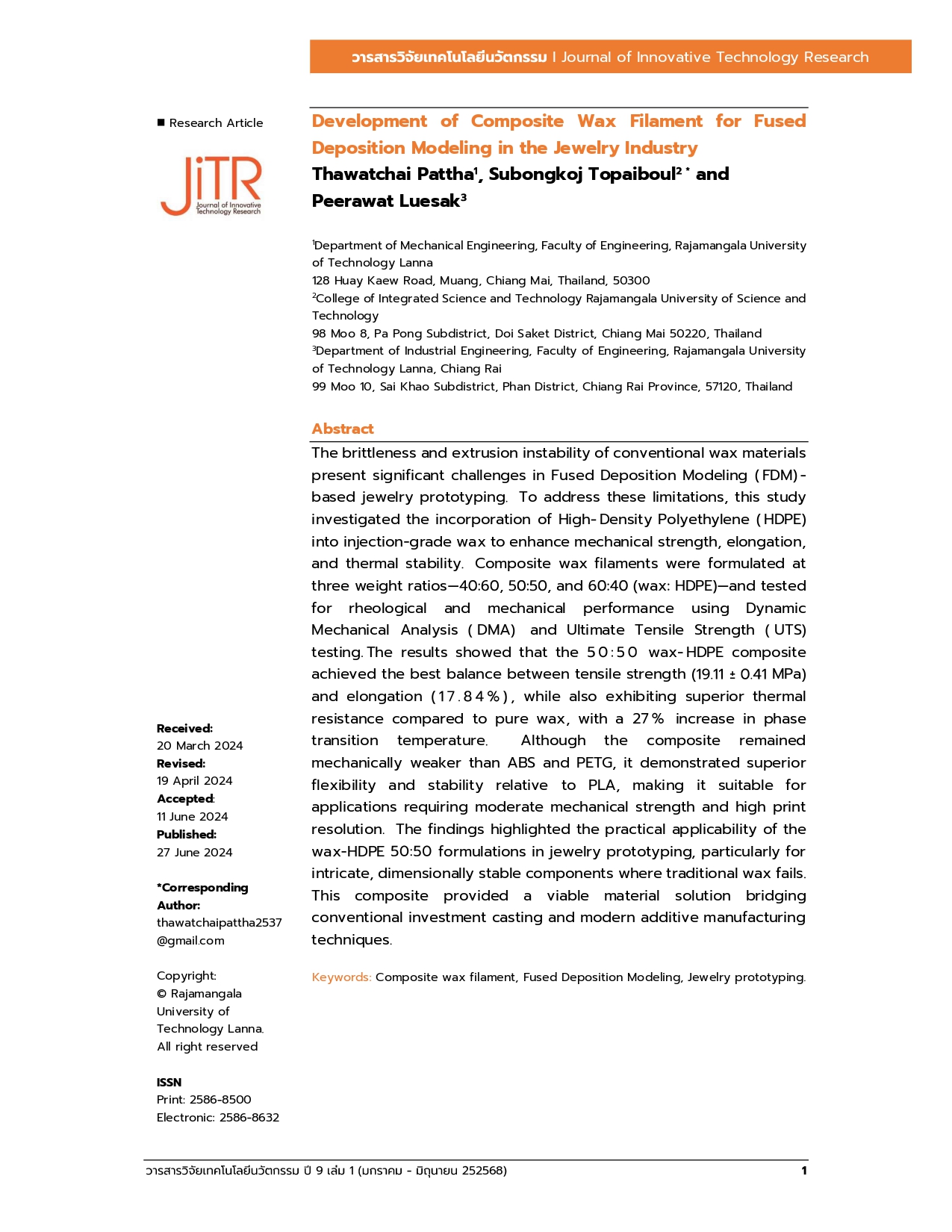
The brittleness and extrusion instability of conventional wax materials present significant challenges in Fused Deposition Modeling (FDM)-based jewelry prototyping. To address these limitations, this study investigated the incorporation of High-Density Polyethylene (HDPE) into injection-grade wax to enhance mechanical strength, elongation, and thermal stability. Composite wax filaments were formulated at three weight ratios—40:60, 50:50, and 60:40 (wax: HDPE)—and tested for rheological and mechanical performance using Dynamic Mechanical Analysis (DMA) and Ultimate Tensile Strength (UTS) testing.The results showed that the 50:50 wax-HDPE composite achieved the best balance between tensile strength (19.11 ± 0.41 MPa) and elongation (17.84%), while also exhibiting superior thermal resistance compared to pure wax, with a 27% increase in phase transition temperature. Although the composite remained mechanically weaker than ABS and PETG, it demonstrated superior flexibility and stability relative to PLA, making it suitable for applications requiring moderate mechanical strength and high print resolution. The findings highlighted the practical applicability of the wax-HDPE 50:50 formulations in jewelry prototyping, particularly for intricate, dimensionally stable components where traditional wax fails. This composite provided a viable material solution bridging conventional investment casting and modern additive manufacturing techniques.
เอกสารอ้างอิง
Ahmad, M. N., & Yahya, A. (2023). Effects of 3D Printing Parameters on Mechanical Properties of ABS Samples. Designs, 7(6), 136. https://doi.org/10.3390/designs7060136
Ahmadifar, M., Benfriha, K., Shirinbayan, M., & Tcharkhtchi, A. (2021). Additive Manufacturing of Polymer-Based Composites using Fused Filament Fabrication (FFF): A Review. Applied Composite Materials, 28(5), 1335–1380. https://doi.org/10.1007/s10443-021-09933-8
Bisin, R., Verga, A., Bruschi, D., & Paravan, C. (2021, August 9). Strategies for Paraffin-Based Fuels Reinforcement: 3D Printing and Blending with Polymers. AIAA Propulsion and Energy 2021 Forum. AIAA Propulsion and Energy 2021 Forum, VIRTUAL EVENT. https://doi.org/10.2514/6.2021-3502
Cheng, K.-C., Huang, C.-Y., Lu, H.-T., Chen, J.-C., Ho, C.-F., Wang, A.-C., & Chen, K.-Y. (2024). High Efficiency Producing Technology Applied in Metal Optical Lens by 3D Wax Printing Combined with Investment Casting. Processes, 12(11), 2442. https://doi.org/10.3390/pr12112442
Dalloul, F., Mietner, J. B., & Navarro, J. R. G. (2022). Production and 3D Printing of a Nanocellulose-Based Composite Filament Composed of Polymer-Modified Cellulose Nanofibrils and High-Density Polyethylene (HDPE) for the Fabrication of 3D Complex Shapes. Fibers, 10(10), 91. https://doi.org/10.3390/fib10100091
Dolgov, N., Akimov, A., & Nikishechkin, P. (2023). Evaluation of the Effectiveness of the use of Additive Wax Printing Technologies for Obtaining Wax Models for Lost-Wax Casting in Custom Production Based on Simulation Modeling. E3S Web of Conferences, 389, 01065. https://doi.org/10.1051/e3sconf/202338901065
Forstner, T., Cholewa, S., & Drummer, D. (2024). Influence of Wax Addition on Feedstock Processing Behavior in Additive Manufacturing of Metals by Material Extrusion. Progress in Additive Manufacturing, 9(3), 625–632. https://doi.org/10.1007/s40964-024-00671-4
Freeman, T. B., Nabutola, K., Spitzer, D., Currier, P. N., & Boetcher, S. K. S. (2018). 3D-Printed PCM/HDPE Composites for Battery Thermal Management. Volume 8B: Heat Transfer and Thermal Engineering, V08BT10A041. https://doi.org/10.1115/IMECE2018-86081
Goh, G. D., Yap, Y. L., Tan, H. K. J., Sing, S. L., Goh, G. L., & Yeong, W. Y. (2020). Process–Structure–Properties in Polymer Additive Manufacturing Via Material Extrusion: A Review. Critical Reviews in Solid State and Materials Sciences, 45(2), 113–133. https://doi.org/10.1080/10408436.2018.1549977
Karantonas, S. (2022). A Comprehensive Guide to Wax Types. https://www.steliosk.co.uk/blog/a-comprehensive-guide-to-wax-types-for-jewellers
Liu, W., Liu, X., Liu, Y., Wang, J., Evans, S., & Yang, M. (2023). Unpacking Additive Manufacturing Challenges and Opportunities in Moving Towards Sustainability: An Exploratory Study. Sustainability, 15(4), 3827. https://doi.org/10.3390/su15043827
Mukhtarkhanov, M., Shehab, E., & Ali, Md. H. (2022). Process Parameter Optimization for 3D Printed Investment Casting Wax Pattern and Its Post-Processing Technique. Applied Sciences, 12(14), 6847. https://doi.org/10.3390/app12146847
Prianto, E., Herianto, & Kusumawan Herliansyah, M. (2023). Wax Printing Technology as a Printing Model for Craft Goods Based on Additive Manufacturing. E3S Web of Conferences, 465, 02052. https://doi.org/10.1051/e3sconf/202346502052
Rahmalina, D., Zada, A. R., Soefihandini, H., Ismail, I., & Suyitno, B. M. (2023). Analysis of the Thermal Characteristics of the Paraffin Wax/High-Density Polyethylene (HDPE) Composite as a Form-Stable Phase Change Material (FSPCM) for Thermal Energy Storage. Eastern-European Journal of Enterprise Technologies, 1(6 (121)), 6–13. https://doi.org/10.15587/1729-4061.2023.273437
Rueda, M. M., Auscher, M.-C., Fulchiron, R., Périé, T., Martin, G., Sonntag, P., & Cassagnau, P. (2017). Rheology and Applications of Highly Filled Polymers: A Review of Current Understanding. Progress in Polymer Science, 66, 22–53. https://doi.org/10.1016/j.progpolymsci.2016.12.007
Sásik, R., Bašt’ovanský, R., Hoč, M., Madaj, R., & Spišák, P. (2020). The Comparison of Selected Strength Indicators of Manufactured Prototypes Produced by Metal Additive Manufacturing (3D Printing) System. In Š. Medvecký, S. Hrček, R. Kohár, F. Brumerčík, & V. Konstantová (Eds.), Current Methods of Construction Design (pp. 501–508). Springer International Publishing. https://doi.org/10.1007/978-3-030-33146-7_57
Schirmeister, C. G., Hees, T., Dolynchuk, O., Licht, E. H., Thurn-Albrecht, T., & Muelhaupt, R. (2021). Digitally tuned multidirectional all-polyethylene composites via controlled 1D nanostructure formation during extrusion-based 3D printing. ACS Applied Polymer Materials, 3(3), 1675–1686.
Szabó, L., Deák, G., Nyul, D., & Kéki, S. (2022). Flexible Investment Casting Wax Patterns for 3D-Printing: Their Rheological and Mechanical Characterizations. Polymers, 14(21), 4744. https://doi.org/10.3390/polym14214744
Tewo, R. K., Rutto, H. L., Focke, W., Seodigeng, T., & Koech, L. K. (2019). Formulations, Development, and Characterization Techniques of Investment Casting Patterns. Reviews in Chemical Engineering, 35(3), 335–349. https://doi.org/10.1515/revce-2017-0068
Topaiboul, S., Saingam, A., & Toonkum, P. (2021). Preliminary Study of Unmodified Wax Printing using FDM 3D-Printer for Jewelry. Engineering and Applied Science Research, 48, 704711. https://doi.org/10.14456/EASR.2021.71
Vidakis, N., Petousis, M., Michailidis, N., Mountakis, N., Argyros, A., Spiridaki, M., Moutsopoulou, A., Papadakis, V., & Charitidis, C. (2023). High-Density Polyethylene/Carbon Black Composites in Material Extrusion Additive Manufacturing: Conductivity, Thermal, Rheological, and Mechanical Responses. Polymers, 15(24), 4717. https://doi.org/10.3390/polym15244717
Zhilin, S. G., Bogdanova, N. A., & Komarov, O. N. (2022). Influence of Packing and Parameters of Uniaxial Compaction of Spherical Wax Elements on Stress-Strain State of Compact. Metallurgist, 66(7–8), 970–981. https://doi.org/10.1007/s11015-022-01409-9
Zhou, L., Miller, J., Vezza, J., Mayster, M., Raffay, M., Justice, Q., Al Tamimi, Z., Hansotte, G., Sunkara, L. D., & Bernat, J. (2024). Additive Manufacturing: A Comprehensive Review. Sensors, 24(9), 2668. https://doi.org/10.3390/s24092668
ดาวน์โหลด
เผยแพร่แล้ว
รูปแบบการอ้างอิง
ฉบับ
ประเภทบทความ
สัญญาอนุญาต
ลิขสิทธิ์ (c) 2025 สถาบันวิจัยและพัฒนา มหาวิทยาลัยเทคโนโลยีราชมงคลล้านนา

อนุญาตภายใต้เงื่อนไข Creative Commons Attribution-NonCommercial-NoDerivatives 4.0 International License.
กองบรรณาธิการขอสงวนสิทธิ์ในการปรับปรุงแก้ไขตัวอักษรและค่าสะกดต่าง ๆ ที่ไม่ถูกต้อง และต้นฉบับที่ได้รับการตีพิมพ์ในวารสารเทคโนโลยีและนวัตกรรม ถือเป็นกรรมสิทธิ์ของสถาบันวิจัยและพัฒนา มหาวิทยาลัยเทคโนโลยีราชมงคลล้านนา และผลการพิจารณาคัดเลือกบทความตีพิมพ์ในวารสารให้ถือเป็นมติของกองบรรณาธิการเป็นที่สิ้นสุด




