ปัจจัยที่ส่งผลต่อการตัดสินใจใช้ Generative AI เพื่อการเรียนของนักศึกษา กรณีศึกษาคณะแพทยศาสตร์ศิริราชพยาบาล
Article Sidebar
Main Article Content
บทคัดย่อ
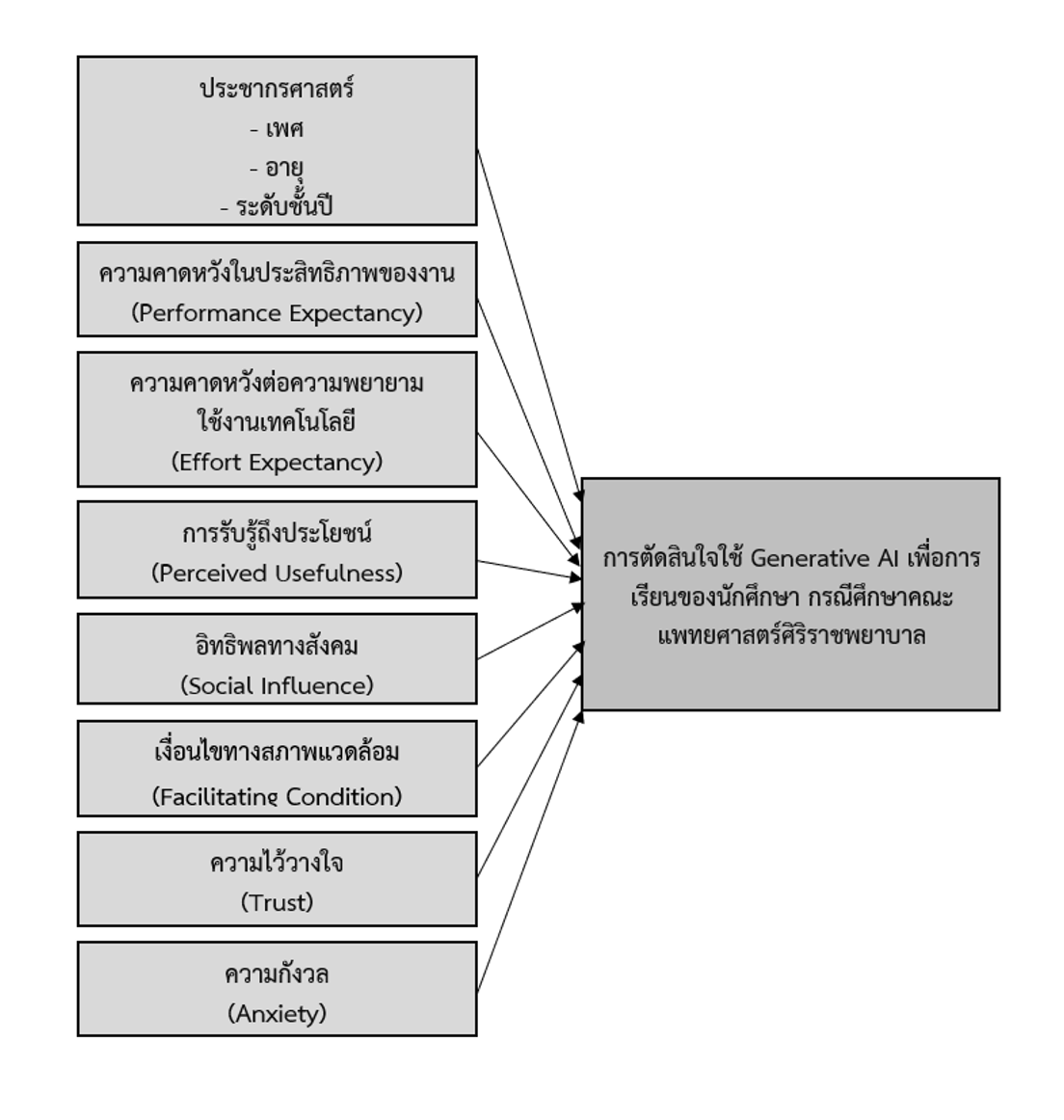
บทนำ: การพัฒนาเทคโนโลยีปัญญาประดิษฐ์โดยเฉพาะ Generative AI กำลังเปลี่ยนแปลงรูปแบบการเรียนรู้ในวงการศึกษาทางการแพทย์ซึ่งเน้นความแม่นยำและจริยธรรมสูง แม้จะมีศักยภาพในการเพิ่มประสิทธิภาพการเรียนรู้ แต่การประยุกต์ใช้ในการศึกษาแพทย์ยังมีคำถามและข้อกังวลมากมาย วัตถุประสงค์ของการวิจัย: เพื่อศึกษาปัจจัยที่ส่งผลต่อการตัดสินใจใช้ Generative AI เพื่อการเรียนของนักศึกษาแพทย์ คณะแพทยศาสตร์ศิริราชพยาบาล โดยประยุกต์ใช้แบบจำลองทฤษฎี UTAUT ร่วมกับแนวคิดเรื่องความไว้วางใจและความกังวล ระเบียบวิธีวิจัย: การวิจัยเชิงปริมาณนี้ใช้วิธีการวิจัยเชิงสำรวจผ่านแบบสอบถามออนไลน์ กลุ่มตัวอย่างคือนักศึกษาแพทย์ศิริราชที่มีประสบการณ์ใช้ Generative AI จำนวน 412 คน วิเคราะห์ข้อมูลด้วยการถดถอยเชิงพหุคูณแบบ Stepwise Regression ผลการวิจัย: ปัจจัยที่มีอิทธิพลต่อการตัดสินใจใช้ Generative AI เรียงตามลำดับความสำคัญ ได้แก่ การรับรู้ถึงประโยชน์มีอิทธิพลเชิงบวกมากที่สุด รองลงมาคือความไว้วางใจ เงื่อนไขทางสภาพแวดล้อมมีอิทธิพลเชิงลบ ความคาดหวังในประสิทธิภาพ ความกังวล และอิทธิพลทางสังคมมีอิทธิพลเชิงบวก โดยปัจจัยทั้งหมดอธิบายความแปรปรวนของการตัดสินใจใช้ได้ร้อยละ 65.7 ทั้งนี้เพศชายมีแนวโน้มตัดสินใจใช้มากกว่าเพศหญิงอย่างมีนัยสำคัญทางสถิติ ขณะที่อายุและชั้นปีไม่มีผลต่อการตัดสินใจ สรุป: นักศึกษาแพทย์ให้ความสำคัญกับประโยชน์และความน่าเชื่อถือของเทคโนโลยีเป็นหลัก สถาบันการศึกษาควรเน้นการสื่อสารประโยชน์ที่ชัดเจน สร้างความไว้วางใจ และพัฒนาระบบสนับสนุนที่เหมาะสม เพื่อให้การนำ AI มาใช้เกิดประสิทธิภาพสูงสุดในการพัฒนาการศึกษาทางการแพทย์
Downloads
Article Details
เอกสารอ้างอิง
Ajzen, I. (1991). The theory of planned behavior. Organizational Behavior and Human Decision Processes, 50(2), 179–211. https://doi.org/10.1016/0749-5978(91)90020-T
Alkhaaldi, S. M. I., Kassab, C. H., Dimassi, Z., Oyoun Alsoud, L., Al Fahim, M., Al Hageh, C., & Ibrahim, H. (2023). Medical student experiences and perceptions of ChatGPT and artificial intelligence: Cross-sectional study. JMIR Medical Education, 9, e51302. https://doi.org/10.2196/51302
Byrnes, J. P., Miller, D. C., & Schafer, W. D. (1999). Gender differences in risk taking: A meta-analysis. Psychological Bulletin, 125(3), 367–383. https://doi.org/10.1037/0033-2909.125.3.367
Cambre, M. A., & Cook, D. L. (1985). Computer anxiety: Definition, measurement and correlates.Journal of Educational Computing Research, 1(1), 37–54.
Davis, F. D. (1989). Perceived usefulness, perceived ease of use, and user acceptance of information technology. MIS Quarterly, 13(3), 319–340. https://doi.org/10.2307/249008
Fishbein, M., & Ajzen, I. (1975). Belief, attitude, intention, and behavior: An introduction to theory and research. Addison-Wesley.
Igbaria, M., & Parasuraman, S. (1989). A path analytic study of individual characteristics, computer anxiety and attitudes toward microcomputers. Journal of Management, 15(3), 373–388.https://doi.org/10.1177/014920638901500302
Indan, R., Andika, R., Ridwan, M., & Dharma, R. (2016). The effect of usefulness, ease of use, risk, and trust on behavioral intention in the use of internet banking. UPI YPTK Journal of Business and Economic, 1(1), 1–15.
Kotler, P., & Keller, K. L. (2016). Marketing management (15th ed.). Pearson Education.
Kung, T. H., Cheatham, M., Medenilla, A., Sillos, C., De Leon, L., Elepaño, C., Madriaga, M.,Aggabao, R., Diaz-Candido, G., Maningo, J., & Tseng, V. (2023). Performance of ChatGPT on USMLE: Potential for AI-assisted medical education using large language models. PLOS Digital Health, 2(2), e0000198. https://doi.org/10.1371/journal.pdig.0000198
Sallam, M., Barakat, M., Sallam, M., Alkhazaleh, R., Al-Mahzoum, K., Al-Tammemi, A. B., Salim, N. A., AlHadidi, F., Mahafzah, A., Jardaneh, L., Al-Zubi, M., Alsanafi, M., & Malaeb, D. (2024). Anxiety among medical students regarding generative artificial intelligence models: A pilot descriptive study. Computers, 13(4), 31. https://doi.org/10.3390/computers13040031
Sharma, V., Saini, U., Pareek, V., L, S., & Kumar, S. (2023). Artificial intelligence (AI) integration in medical education: A pan-India cross-sectional observation of acceptance and understanding among students. Scripta Medica, 54(4), 343–352. https://doi.org/10.5937/scriptamed54-46267
Tyton Partners. (2023). Time for class 2023: Understanding and responding to generative AI in learning. https://tytonpartners.com/library/time-for-class-2023/
Venkatesh, V., Morris, M. G., Davis, G. B., & Davis, F. D. (2003). User acceptance of information technology: Toward a unified view. MIS Quarterly, 27(3), 425–478.https://doi.org/10.2307/30036540
