FACTORS AFFECTING RELATIONSHIP QUALITY OF CUSTOMERS USING CONSUMER GOODS DELIVERY SERVICES IN THAILAND
Article Sidebar
Main Article Content
Abstract
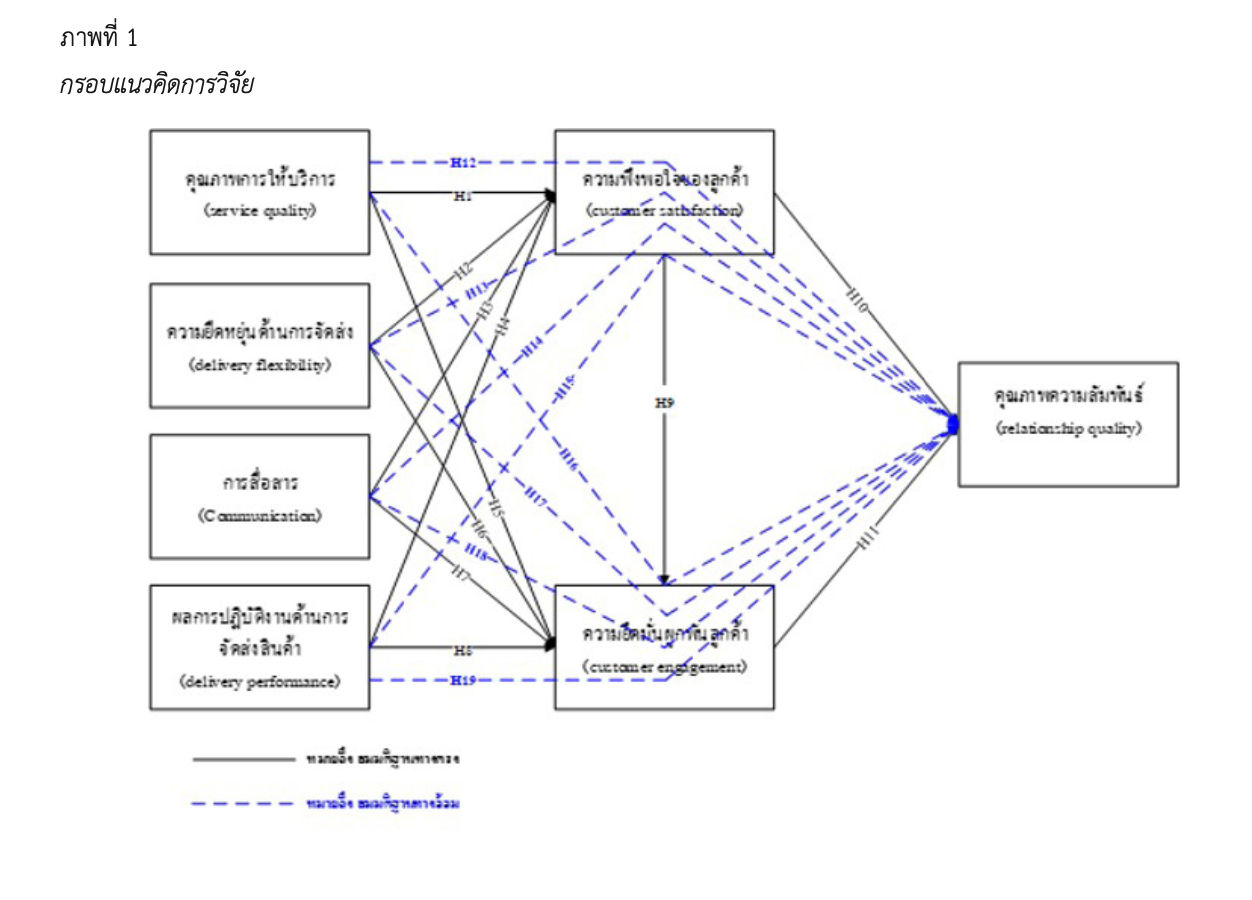
In this dissertation, the researcher develops (1) a causal relationship model of the factors affecting the relationship quality of the customers using consumer goods delivery services in Thailand The researcher investigates (2) the congruence of the causal relationship model of factors affecting the relationship quality of the customers under study with the empirical data. In this quantitative research investigation, a questionnaire was used as an instrument to collect data from full-time employees receiving goods or customers using the services from delivery employees of juristic organizations providing consumer goods delivery services in Thailand, the total being 620 From Convenience Sampling The statistics used in the hypothesis test was the structural equation model analysis.
Findings are as follows: 1) Service quality, delivery flexibility, communication, and delivery performance exhibited a positive influence on customer satisfaction. And quality, delivery flexibility, communication, delivery performance, and customer satisfaction exhibited a positive influence on customer engagement. Customer satisfaction and customer engagement exhibited a positive influence on the relationship quality of the customers using the services. Service quality, delivery flexibility, and delivery performance exhibiting a positive indirect influence on the relationship quality through customer satisfaction and communication did not exhibit an indirect influence on the relationship quality through customer satisfaction. Service quality, delivery flexibility, communication, and delivery performance exhibited a positive indirect influence on relationship quality through customer engagement. 2) The investigation of the congruence of the causal relationship model of factors affecting the relationship quality found that the adjusted structural equation model exhibited congruence with the empirical data at a good level considered from Chi-square (c2) = 196.141, degree of freedom (df) = 336, p-value = 1.000, and relative Chi-square (c2/df) = 0.584. The congruence of the root mean square error of approximation (RMSEA) was 0.000, comparative fit index (CFI) = 1.000, Tucker-Lewis index (TLI) = 1.000, and standardized root mean squared residual (SRMR) = 0.011.
Downloads
Article Details
References
รณรงค์ พูลพิพัฒน์, สำนักงานนโยบายและยุทธศาสตร์การค้า, กระทรวงพาณิชย์, (2565, 15 เมษายน). จับชีพจรโลจิสติกส์ไทยฉบับเดือน. http://www.tpso.moc.go.th/th/node/11480
Arnett, D. B., German, S. D., & Hunt, S. D. (2003). The Identity Salience Model of Relationship Marketing Success: The Case of Nonprofit Marketing. Journal of Marketing, 67(2), 89-105.
Hair, J. F., Jr., Black, W. C., Babin, B. J., & Anderson, R. E. (2014). Multivariate data analysis (7 ed.). Harow, Essex: Pearson.
Hooper, D., Coughlan, J., & Mullen, M. R. (2008). Structural equation modelling: Guidelines for determining model fit. Electronic journal of business research methods, 6(1), 53‑60.
Hunt, Arnett Dennis, B., & Madhavaram, S. (2006). The explanatory foundations of relationship marketing theory. Journal of Business & Industrial Marketing, 21(2), 72-87.
Lai, K.-h., Pang, Y., Wong, C. W. Y., Lun, Y. H. V., & Ng, Y. N. E. (2019). Are trade and transport logistics activities mutually reinforcing? Some empirical evidences from ASEAN countries. Journal of Shipping and Trade, 4(1), 2.
Lai, K., & Kelley, K. (2011). Accuracy in parameter estimation for targeted effects in structural equation modeling: Sample size planning for narrow confidence intervals. Psychological Methods, 16(2), 127.
Lomax, R. G., & Schumacker, R. E. (2004). A beginner's guide to structural equation modeling: psychology press.
Majercak, P. (2020). Saving logistics transportation costs in the era of globalization for firms. Paper presented at the SHS Web of Conferences.
Thaichon, P., & Quach, T. N. (2015). From Marketing Communications to Brand Management: Factors Influencing Relationship Quality and Customer Retention. Journal of Relationship Marketing, 14(3), 197-219.
U-tantada, S., Yolles, M., Mujtaba, B. G., & Shoosanuk, A. (2019 a). Influential Driving Factors for Corporate Performance: A Case of Small and Medium Enterprises in Thailand. KASEM BUNDIT JOURNAL, 20 (Feburary), 157-172.
U-tantada, S., Yolles, M., Shoosanuk, A., & Mujtaba, B. G. (2019b). Strategic SMEs as Influential Drivers for the Market Economy: Modeling SMEs using Cultural Agency Theory. International Review of Research in Emerging Markets and the Global Economy, 5(1), 1435-1452.
U-tantada, S., Yolles, M., Shoosanuk, A., & Mujtaba, B. G. (2020). Green Market Orientation and Market Capability Influence on Competitiveness and Performance of Green SME Cultural Agency. International Review of Research in Emerging Markets and the Global Economy, 6(1), 1453-1475.
