COMPUTING SCIENCE AND LEARNING EXPERIENCES FOR EARLY CHILDHOOD CHILDREN
Article Sidebar
Main Article Content
Abstract
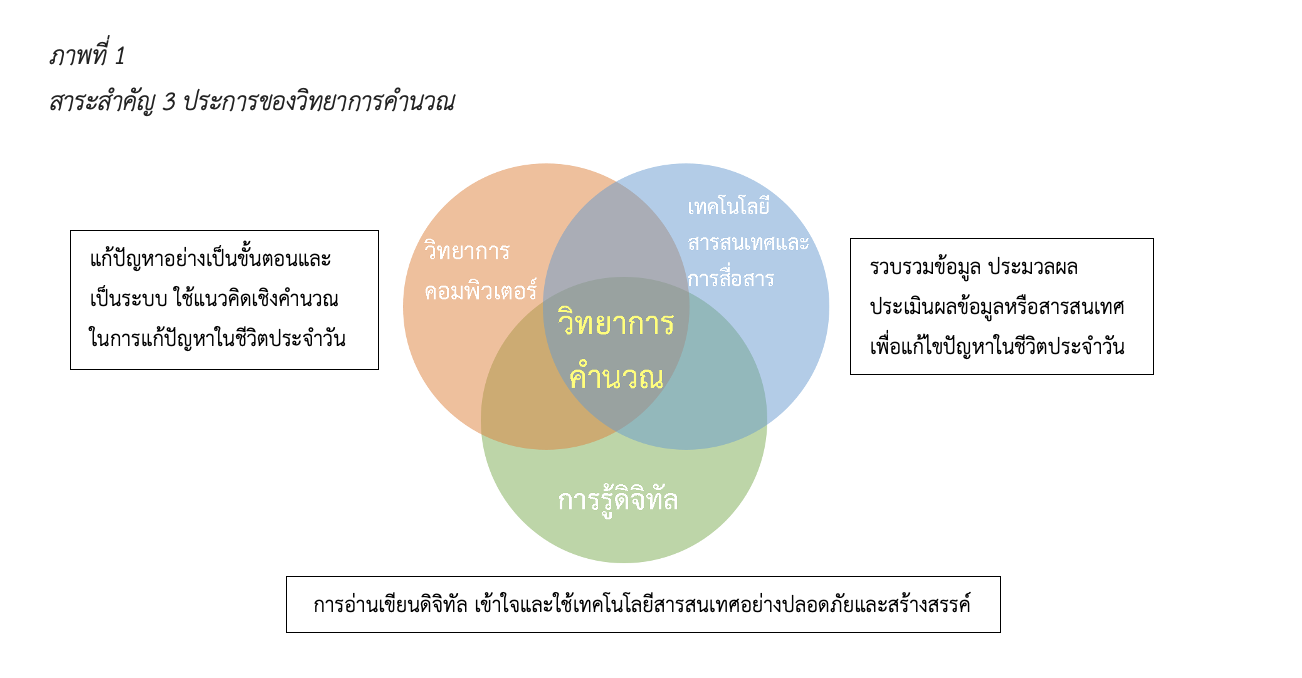
Humans are naturally able to learn their own languages for everyday communication. In today’s era where technology have changes rapidly; however, these languages may not be enough for 21st century life. Digital language learning is therefore very important to the new generation. Thailand has integrated computing science into the early childhood education curriculum and the basic education curriculum to provide the foundation and develop Thai children’s abilities for critical thinking, systematically problem solving. In addition, they can synthesize and create a set of instructions for working with computer technology. Early childhood children must have the foundation of science, mathematics and languages that can be used to further their learning in computing science focusing on 2 parts. The first part is computation thinking that has 4 key concepts: (1) decomposition, (2) pattern recognition, (3) abstraction, and (4) algorithms. The second part is programming with unplugged coding. Teachers provide learning experiences for early childhood children to do activities on their own through daily routines, easy cooking, listening to music, patterns movement or playing board games to give them the right and suitable experiences for developing and continuing in digital learning in a high level.
Downloads
Article Details
References
กระทรวงศึกษาธิการ. (2562). คู่มือการใช้หลักสูตรรายวิชาพื้นฐานวิทยาศาสตร์ สาระเทคโนโลยี (วิทยาการคำนวณ) กลุ่มสาระวิทยาศาสตร์. สถาบันส่งเสริมการสอนวิทยาศาสตร์และเทคโนโลยี.
กระทรวงศึกษาธิการ. (ม.ป.ป.). หลักสูตรอบรมการจัดประสบการณ์การเรียนรู้วิทยาการคำนวณ ระดับอนุบาล. สำนักวิชาการและมาตรฐานการศึกษา สำนักงานคณะกรรมการการศึกษาขั้นพื้นฐาน.
กัลยา โสภณพนิช. (2564, 18 มกราคม). การประชุมทางไกล ชี้แจงการดำเนินโครงการขับเคลื่อนการจัดการเรียนรู้วิทยาการคำนวณและCoding [Video]. Youtube. https://www.youtube.com/watch?v=X3Zmji4Khvw&t=292s.
บ้านนักวิทยาศาสตร์น้อย ประเทศไทย. (ม.ป.ป.) คอมพิวเตอร์และอุปกรณ์อิเล็กทรอนิกส์ วิทยาการคำนวณในชีวิตประจำวัน. https://www.littlescientistshouse.com/theme_domar/custom/images/pages/download/files/childhood/exploration_card/calculation.pdf.
มติชน. (2562, 18 กันยายน). ไขข้อสงสัย Coding กับวิทยาการคำนวณ ตัวช่วยจัดระบบการคิดของเด็กไทยยุค 4.0. https://www.matichon.co.th/advertorial/news_1675631.
ยืน ภู่วรวรรณ. (2561, 24 มกราคม). วิทยาการคำนวณคืออะไร. https://school.dek-d.com/blog/kidcoding/computational-science/
วัชรพัฒน์ ศรีคำเวียง. (2561, 18 ธันวาคม). วิทยาการคำนวณ. https://www.scimath.org/ lessontechnology/ item/8808-computing-science.
สถาบันส่งเสริมการสอนวิทยาศาสตร์และเทคโนโลยี. (2564, 14 ธันวาคม). เด็กปฐมวัยกับการคิดเชิงคำนวณ. Facebook. https://www.facebook.com/watch/?v=397682952047805.
Coding Thailand. (2021). วิทยาการคำนวณ Coding Thailand by Grit Connect. https://codingthailand.org/computer-science.
Hong Ji-yeon & Shin Kap-cheon. (2562). Unplugged Coding สนุกกับวิทยาการคำนวณ (พิริยาพร ค้าเจริญดี, ผู้แปล, (พิมพ์ครั้งที่ 1). นานมีบุ๊คส์.
Metin. S. (2020, August 18). Activities – based unplugged coding during the preschool period. International Journal of Technology and Design Education. 32, 149-165. http://doi.ord/10.1007/s10798-020-09616-8.
University of York. (n.d.) What is computational thinking? https://online.york.ac.uk/what-is-computational-thinking/
Victoria, K. (2022, December 6). What is computational thinking? https://teachyourkidscode.com/what-is-computational-thinking/
Wing, J. M. (2006). Computation Thinking. Communication of AMC, 49(3), 33-35.
