THE TECHNOLOGY ACCEPTANCE OF E-WALLET AMONG CONSUMERS IN GENERATION Y AND Z
Article Sidebar
Main Article Content
Abstract
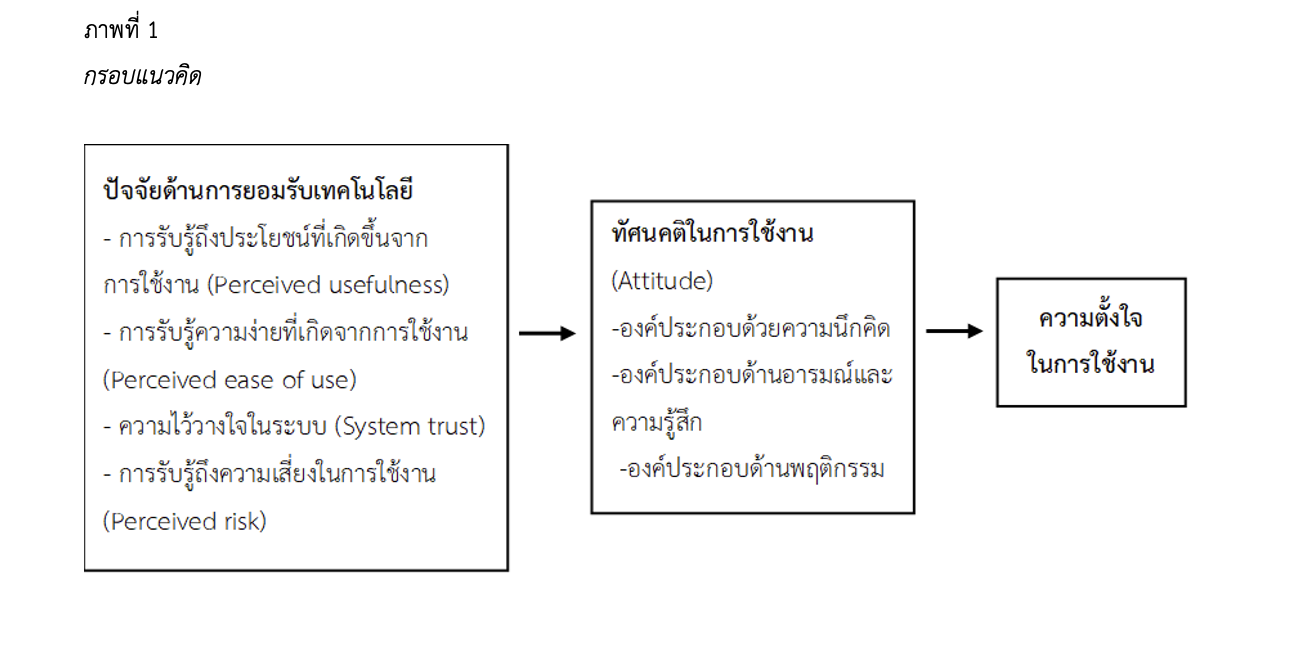
This study is a Quantitative Research that focuses on Technology Acceptance, customer’s Attitude, and Intention to use E-Wallet among consumers in generation Y and Z in Thailand. Questionnaires were distributed to a sample of 400 E-Wallet consumers. Statistical analysis was used for this study including frequency, percentage, mean, standard deviation, Pearson’s Correlation coefficient, and multiple regressions.
The result reveals that:
most of the respondents are females, aged between 18-22 years old. Most of them are undergraduate student. The average income is 5,001 – 15,000 baht. The Respondents mostly use E-Wallet twice a week between 12.01 am. – 06.00 pm. to purchase food products at the convenience stores. The spending rate is 100-500 bath per each purchase by using E-Wallet application called “TrueMoney Wallet”.
As for the hypothesis testing, it was found that some factors such as Perceived Usefulness, Perceived Ease of Use, and Perceived risk have meaningfully affected to Attitude and also the Intention to use E-Wallet at a significant level of 95 percent. The Study also provides suggestions for E-Wallet providers to enhance financial innovation by emphasizing four key crucial factors which are Perceived Usefulness, Perceived Ease of Use, Perceived Risk, and Perceived Trust.
Downloads
Article Details
References
จิรภา รุ่งเรืองศักดิ์. (2558). การศึกษาการยอมรับและการรับรู้ความเสี่ยงที่ส่งผลต่อความไว้วางใจใน การใช้บริการระบุ ตำแหน่ง (Location-based Services: LBS) ของผู้ใช้บริการในเขต กรุงเทพมหานคร. [วิทยานิพนธ์ปริญญามหาบัณฑิต ไม่ได้ตีพิมพ์]. มหาวิทยาลัยกรุงเทพ.
จิรวัฒน์ วงศ์ธงชัย. (2555). ปัจจัยด้านการรับรู้ที่มีผลต่อการยอมรับเทคโนโลยีบาร์โค้ดสองมิติของผู้ใช้งานกลุ่มเจเนอเรชั่นวาย. [วิทยานิพนธ์ปริญญามหาบัณฑิต ไม่ได้ตีพิมพ์]. มหาวิทยาลัยสุรนารี.
ชยาภรณ์ กิติสิทธิชัย. (2559). ปัจจัยที่มีผลต่อการยอมรับเทคโนโลยีการใช้งานกระเป๋าเงินอิเล็กทรอนิกส์ (E-Wallet) ในการซื้อสินค้าของผู้บริโภคในจังหวัดกรุงเทพมหานคร. [วิทยานิพนธ์ปริญญามหาบัณฑิต ไม่ได้ตีพิมพ์]. มหาวิทยาลัยกรุงเทพ.
ธรรมทัช ทองอร่าม. (2560, 24 พฤศจิกายน). ประชากรไทย GenY ใหญ่สุด พฤติกรรมสร้างโอกาส-ความเสี่ยง. ฐานเศรษฐกิจ.
นิธินาถ วงศ์สวัสดิ์ และ ปวีณา คำพุกกะ. (2557). ความตั้งใจใช้บริการของผู้ซื้อขายหลักทรัพย์ผ่านอินเทอร์เน็ต. วารสารสมาคมนักวิจัย, 19(2), 12-32.
พัชสิรี ชมภูคำ และ ณัฐธิดา จักรภีร์ศิริสุข. (2563). ปัจจัยที่มีอิทธิพลต่อความพึงพอใจและแรงจูงใจในการทำงาน: กรณีศึกษาเปรียบเทียบคนเจเนอเรชัน Y และเจเนอเรชัน Z ในเขตกรุงเทพมหานคร. จุฬาลงกรณ์ธุรกิจปริทัศน์, 42(3), 1-18.
เฟลชแมน ฮิลลาร์ด. (2563). เฟลชแมน ฮิลลาร์ด เปิดสำรวจ เจาะลึกความคิดผู้บริโภคหลังวิกฤต COVD-19 เผย "มุมมอง" และ "ความเข้าใจ" ของผู้คนที่มีต่อโลกเปลี่ยนไปอย่างสิ้นเชิง.
วัชรากร ร่วมรักษ์. (2560,24 พฤศจิกายน). Mobile Wallet กระเป๋าเงินดิจิทัลในยุคสังคมไร้เงินสด. https://cutt.ly/C2BdqGB
Ajzen, I., & Fishbein, M. (1980). Understanding attitudes and predicting social behavior. Prentice-Hall.
Davis, F. D. (1989). Perceived usefulness, perceived ease of use, and user acceptance of information technology. MIS quarterly, 13(3), 319-340.
Yamane, T. (1967). Statistics: An introductory analysis. Harper & Row.
