CONSUMER ATTITUDES TOWARDS MARKETING COMMUNICATION STRATEGIES OF SKINCARE PRODUCTS THROUGH THE TIKTOK APPLICATION
Article Sidebar
Main Article Content
Abstract
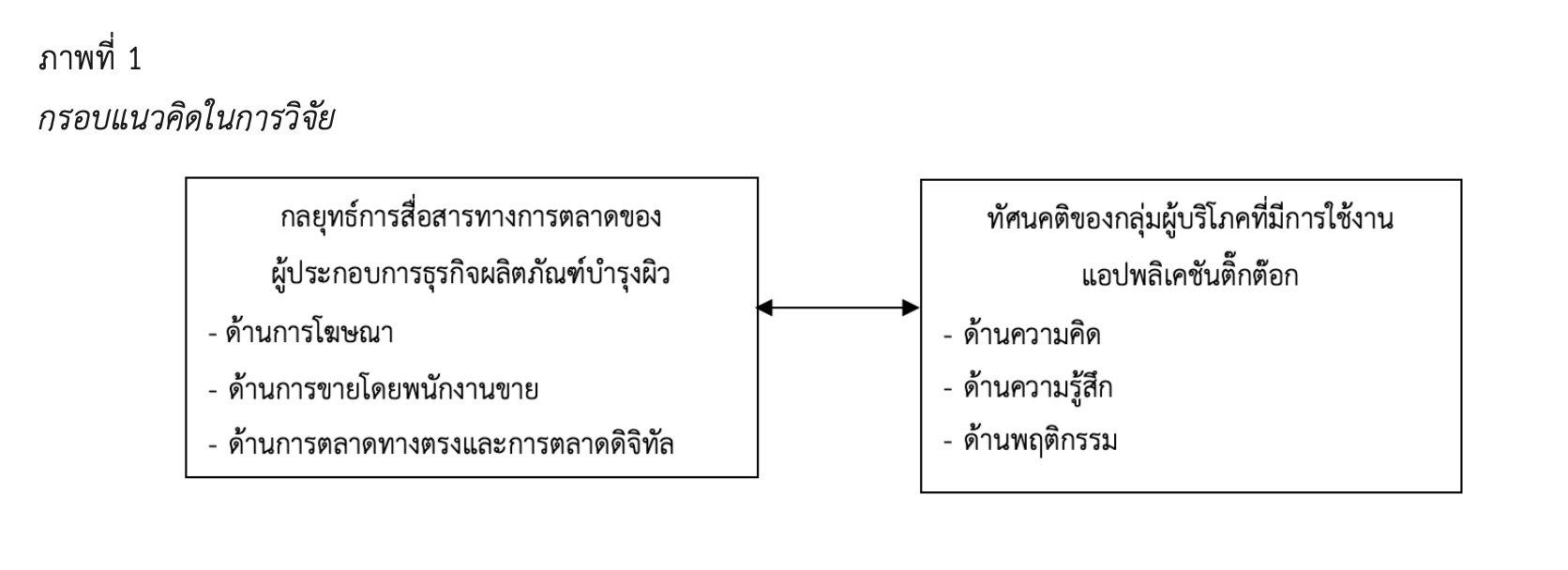
The purposes of this study were to study consumer attitudes toward marketing communication strategies of skincare products via the TikTok application using a qualitative research model. The study involved 12 key informants who were selected purposively. Data was collected through semi-structured interviews, and the data was analyzed using Content Analysis.
The results of the research found that: 1) Creative Advertising Strategies: This category focuses on leveraging the tools available within the TikTok application to create interesting and diverse advertising content. It involves utilizing low-level influencers or individuals to review skincare products or services and communicate engaging content to discourage consumers from skipping ads. This approach aims to create a positive perception of the advertisements. 2) Sales Strategy by Salesperson: This strategy involves advertising with clear and informative content. It emphasizes the importance of raising consumer awareness about access channels to skincare products. By doing so, it enables consumers to remember and recognize the brand, ultimately influencing their future purchase decisions and consumption of the products or services. 3) Direct Marketing and Digital Marketing Strategies: In this category, entrepreneurs use consumer inquiries or expressed opinions to create advertisements that can be directly communicated back to the consumers. This approach encourages consumers to provide advice and express more opinions through video clips, leading to a greater sense of engagement and a stronger feeling of belonging to the brand.
Downloads
Article Details
References
กานต์พิชญ์ กิจเพ็ง, ปาริชาติ สุริยาพร และ วรรณี สุนทรีย์ประสิทธิ์. (2563). การใช้เครื่องมือทางการตลาดดิจิทัลเพื่อสื่อสารแบรนด์และการขยายช่องทางการจำหน่ายของธุรกิจออนไลน์ในประเทศไทย. วารสารวิชาการมหาวิทยาลัยหอการค้าไทย, 35(2), 50-62.
จิรวรรณ จันทร์กลางคันธารา และ ภัทร์ชัย ทองสุทธิสกุล. (2562). การนำเครื่องมือทางการตลาดดิจิทัลเพื่อสร้างความเชื่อมั่นในแบรนด์และการเพิ่มช่องทางการจำหน่ายสินค้าในธุรกิจออนไลน์. วารสารวิจัยมหาวิทยาลัยพะเยา, 13(2), 49-61.
ชาย โพธิสิตา. (2564). ศาสตร์และศิลป์แห่งการวิจัยเชิงคุณภาพ (พิมพ์ครั้งที่ 9). อมรินทร์ พริ้นติ้งแอนด์พับลิชชิ่ง.
สิรินิธิ์ วิรยศิริ. (2566). สถิติการเติบโตของแอปพลิเคชันติ๊กต๊อกภายในระยะเวลาสองปี. การประชุมวิชาการระดับชาติ ปีที่ 6 (น. 12-14). สำนักพิมพ์เกียรติคุณ.
อภิชาติ ทองสุทธิสกุล, อลิสรา บรรณสายเลิศ, และ เสฎฐ์ธนา พงษ์กิจกนกเดช. (2564). ผู้บริโภคมีทัศนคติเชิงบวกต่อการรับรู้โฆษณาบนแอปพลิเคชัน TikTok โดยเห็นและรับรู้ถึงคลิปวิดีโอโฆษณาภายในแอปนี้ได้. วารสารวิจัยมหาวิทยาลัยหอการค้าไทย, 36(1), 37-52.
Belch, G. E., & Belch, M. A. (2021). Advertising and Promotion: An Integrated Marketing Communications Perspective. McGraw-Hill Education.
Chaffey, D., Ellis-Chadwick, F., Johnston, K., & Mayer, R. (2019). Digital Marketing. Pearson.
Chen, L., & Lin, M. (2021). The Impact of Ad Content and User Engagement on Consumer Attitudes: A Study of TikTok and YouTube. Journal of Interactive Advertising, 21(1), 16-30.
InsightERA. (2022, June 14). Thailand’s Top Social by Generation Usage. https://www.insightera.co.th/thailand-top-social-2022/.
Kim, S., & Kim, Y. (2022). Consumer attitudes towards influencer marketing on TikTok: The role of parasocial interaction and brand trust. Journal of Interactive Advertising, 22(1), 50-66.
Kotler, P., Keller, K. L., Brady, M., Goodman, M., & Hansen, T. (2017). Marketing Management. Pearson.
Kotler, P., & Armstrong, G. (2018). Principles of Marketing. United Kingdom: Pearson Education Limited.
Kumar, V., Zhang, Y., & Luo, A. (2020). "The dynamics of consumer attitude formation and change in the era of online reviews. Journal of Marketing Research, 57(1), 71-89.
Roberts, H., & Lee, S. (2022). Understanding the effectiveness of brand-sponsored challenges on TikTok: An empirical investigation. Journal of Advertising Research, 62(1), 92-107.
Schiffman & Wisenblit. (2015). Consumer Behavior. England: Pearson Education Limited.
Shi, X., & Chen, C. (2021). Consumer attitudes towards price increases: Evaluation and emotions in response to price changes of products or services. Journal of Consumer Psychology, 45(2), 123-145.
Smith, A., & Johnson, B. (2018). Understanding consumer attitudes: A theoretical and empirical review. Journal of Consumer Psychology, 28(3), 414-435.
Smith, J. D., & Johnson, A. B. (2019). Exploring user behavior on social media platforms. Journal of Communication Studies, 27(3), 123-145.
Smith, P. R., & Zook, Z. (2018). Marketing Communications: Integrating Offline and Online with social media. Kogan Page.
Zhang, J., & Kim, D. (2022). Annoying or engaging? The Effects of Ad Intrusiveness on Consumer Attitudes: A Comparative Study of TikTok and YouTube. Journal of Marketing Communications, 28(2), 150-167
