NETWORKING OF MUSLIM COMMUNITY PARTICIPATION IN NONG CHOK AND BANGKOK FOR SUSTAINABLE ZERO WASTE MANAGEMENT
Article Sidebar
Main Article Content
Abstract
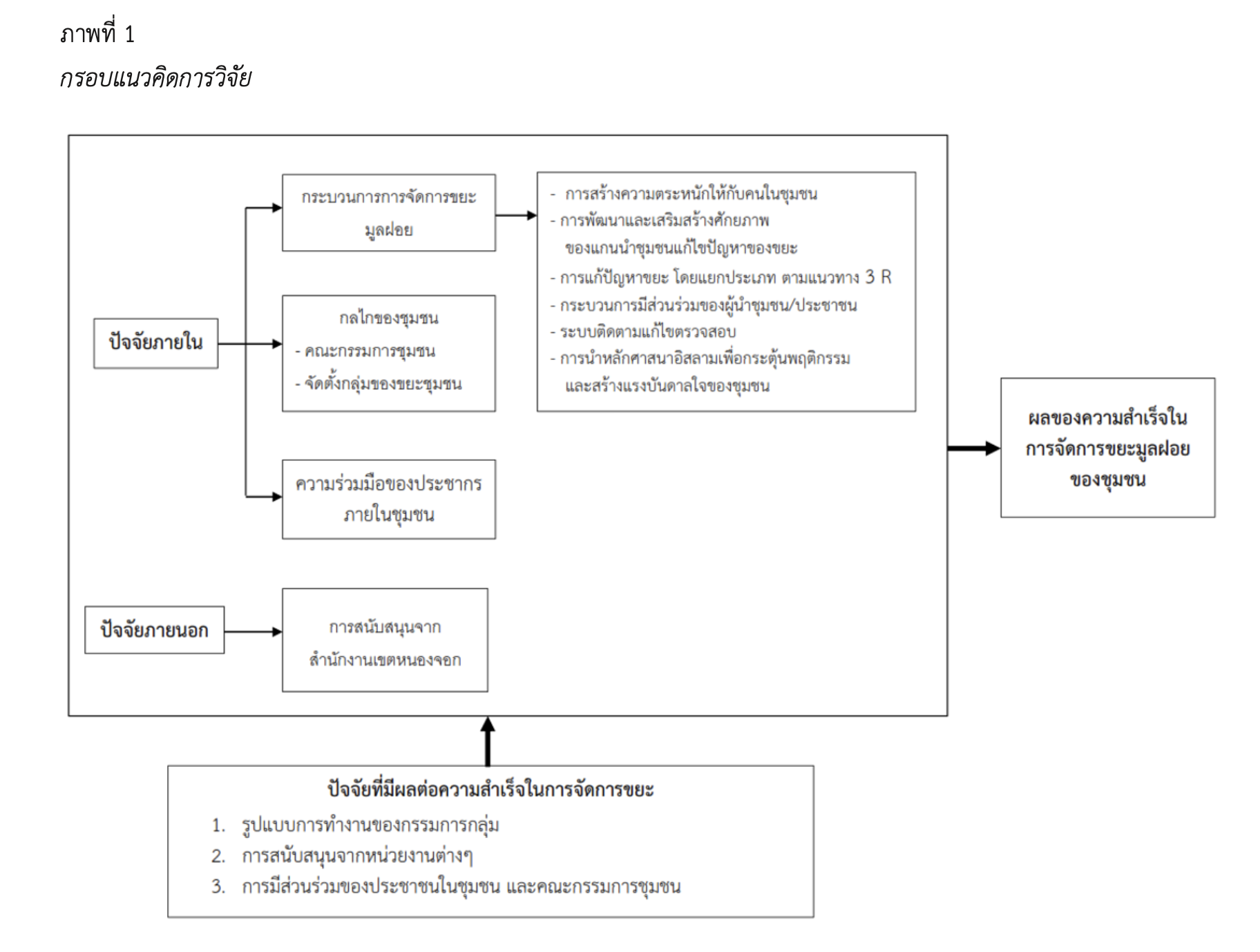
Introduction: Waste management is an important policy in developing the Bangkok area to solve the problem of waste volume and to create an understanding of people in the area by focusing on studying the community's system to create understanding and sustainability. The research project is to create a network of Muslim community participation in the Nong Chok District, Bangkok. Research objectives: 1. To disseminate the implementation of zero-waste management of the prototype Phaen Din Thong Khoi Ruddin, Nong Chok District 2. To study and create a prototype community model to become a center of sustainability in the Nong Chok area) 3. To create a network of participation of five Muslim communities in the Nong Chok area for sustainable zero-waste management by learning through the prototype community. Methodology: was action research by learning through the prototype community to create a network of participation by organizing a seminar to provide knowledge of all five communities in the Nong Chok area, Bangkok, by learning through the prototype community in the context related to waste management to be consistent with all dimensions of the community. In the 5 communities as follows: Darul Mina, Lam Salit Thong, Phudung Phan, Riap Khlong 13, Nuruddin Ban Ko, by collecting data by dividing the research team, interviewing, and going to the area to provide knowledge to each community. Results: found that there was a separation in the application of the prototype community's proposals, both in terms of waste management in various forms and creating waste management standards, leading to the development of qualifications for entering the next award submission. Conclusion: the research results can be used to develop five leading communities to be consistent with each community's different community dimensions.
Article Details
References
Christensen, T. (Ed.). (2011). Solid waste technology and management. John Wiley & Sons.
LaGrega, M. D., Buckingham, P. L., & Evans, J. C. (2010). Hazardous waste management. Waveland Press.
McIntyre, A. (2007). Participatory action research. Sage publications.
Muttamara, S., Visvanathan, C., & Alwis, K. U. (1994). Solid waste recycling and reuse in Bangkok. Waste Management & Research, 12(2), 151-163.
Newton, D. E. (2008). Waste management: A reference handbook. Bloomsbury Publishing USA.
Panichayapichet, P. (2022, December 8) Thailand and greenhouse gas emissions. Greenhouse Gas Management Organization. Reduce global warming with LESS.
Policy and Planning Division, Environmental Office of Bangkok. (n.d.). Love the community, love theenvironment. Kaewjao Chom Media and Publications Center,
Pollution Control Department, Ministry of Natural Resources and Environment. (n.d.). Guide to makingcompost from waste. (Composting). https://www.pcd.go.th/publication/5001.
Rudnik, E. (2019). Compostable polymer materials. Newness.
Tanghirun, P. (2020). The Meaning and Significance of Shura in Islam. Journal of Eastern
University of Management and Technology. 17(1), 529-542.
Worapongpat, and Brorewongtrakhul, (2022). The development of online social media
technology for agricultural tourism, rai khing rice mill community enterprise group. Journal of Management Science, Udon Thani Rajabhat University, 4(4), 1-9.
Yeesoontes, W., Kladvaiyanate, P., Kasemsap, C., Ratanamaneichat, C., Mahamud, T., & Chaiponoi, S. (2025). Community Waste Management in Nong Chok
District, Bangkok. Interdisciplinary Academic and Research Journal, 5(1), 285-294.
