INFLUENCING FACTORS TO PURCHASING INTENTION FOR DIGITAL LOTTERY TICKETS OF THE GOVERNMENT LOTTERY OFFICE VIA APPLICATION PAOTANG
Article Sidebar
Main Article Content
Abstract
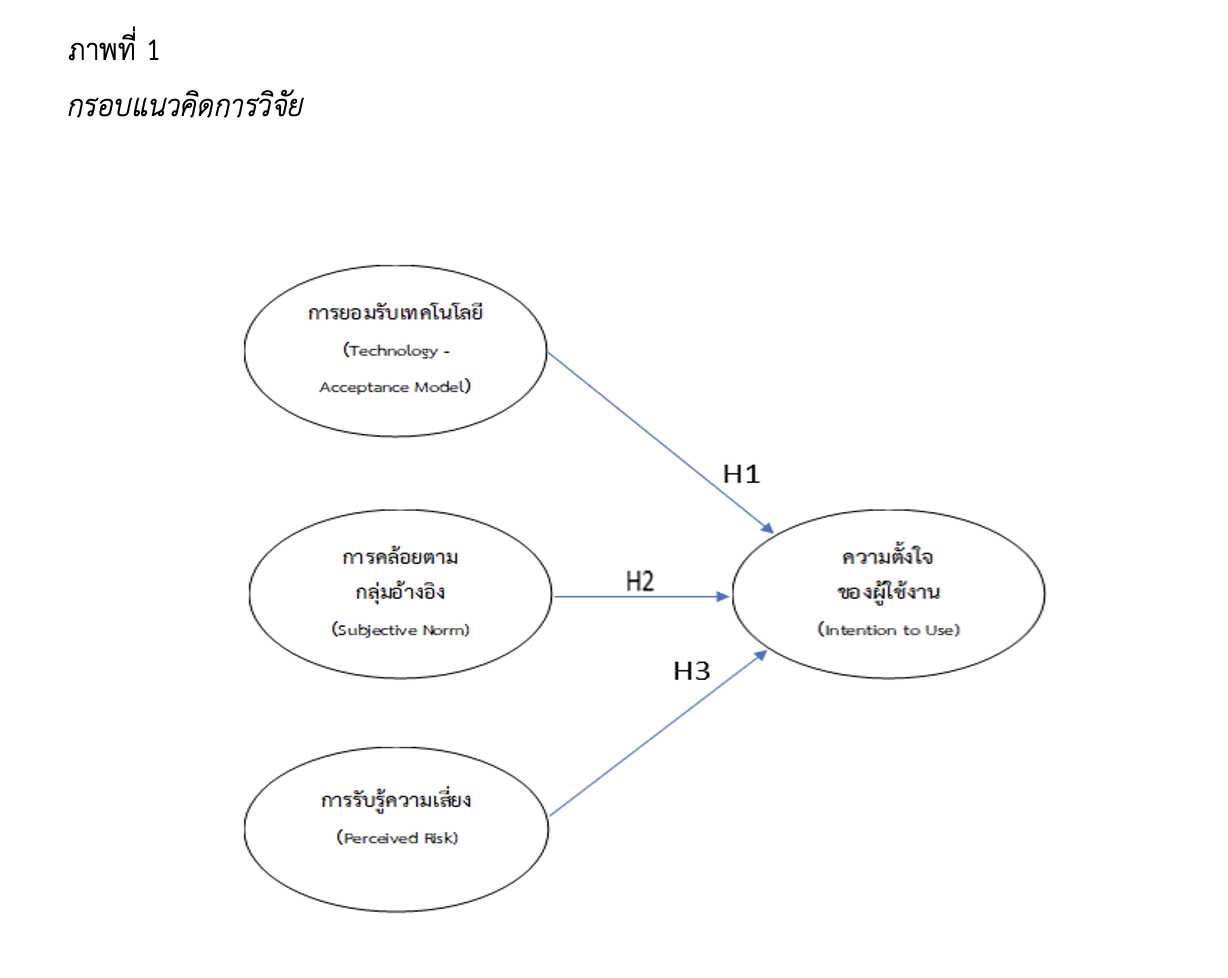
Introduction: In today's digital era, the Thai government has developed a digital lottery system through the "Pao Tang" application to address the problem of overpriced lottery tickets and create transparency in the distribution system. This study aims to analyze key factors influencing the intention to purchase digital lottery tickets issued by the Government Lottery Office, focusing on the influence of technology acceptance, reference groups, and perceived risk on citizens' behavior toward digital government services in the Thai social context. Research Objectives: 1) To assess the levels of technology acceptance, conformity to reference groups, perceived risk, and purchase intention of digital lottery tickets via the Pao Tang app; 2) To analyze the influence of these factors on user intention; and 3) To propose direct influence pathways affecting usage intention. Methodology: A mixed-methods approach was employed. Data were collected from 384 individuals who had previously purchased digital lottery tickets through the Pao Tang app, using purposive sampling. Questionnaires and in-depth interviews were used as research tools. Quantitative data were analyzed using Structural Equation Modeling (SEM) through Smart PLS 3.0.
Research Findings: The average scores of the four variables were at a high level: technology acceptance (3.84), reference groups (3.63), perceived risk (3.58), and usage intention (3.52). All three independent factors had a statistically significant direct influence on usage intention, with path coefficients of 0.483, 0.524, and 0.637, respectively. The in-depth interview findings supported these results. Conclusion: Technology acceptance, reference groups, and perceived risk play crucial roles in shaping users’ intention to purchase digital lottery tickets via the Pao Tang application.
Downloads
Article Details
References
Vanichbuncha, K. (2009). Statistics for research (4th Ed.). Chulalongkorn University Book Center.
Kaewthan, J. (2014). Factors affecting the acceptance of electronic payment services via smartphone: A case study in Bangkok and Pathum Thani. [Unpublished Master’s thesis]. Thammasat University.
Rungreuangsak, J. (2015). A study of acceptance and perceived risk affecting trust in the use of location-based services (LBS) among users in Bangkok. [Unpublished Master’s thesis]. Bangkok University.
Sakon Nakhon Public Relations Office. (2022, May 18). Guidelines for solving the problem of overpriced lottery tickets. https://sakonnakhon.prd.go.th/th/content/category
Government Lottery Office. (2022, January 16). History of the issuance of Thai government lottery. https://www.glo.or.th/not-found-404?nid=53%2F
The Gambling Problem Study Center. (2015, May 15). Gambling in a changing world. http://thaigcd.ddc.moph.go.th/eid_knowledge_butolism_060324.html
Srisawat. (2022, October 17). Buy online lottery for 80 baht on the Paotang app. https://www.sawad.co.th
AbuShanab, E., & Pearson, J. (2007). Internet banking in Jordan: The unified theory of acceptance and use of technology (UTAUT) perspective. Journal of Systems and Information Technology, 9(1), 78–97. https://doi.org/10.1108/13287260710718812
Ajzen, I. (2002). Perceived behavioral control, self‐efficacy, locus of control, and the theory of planned behavior. Journal of Applied Social Psychology, 32(4), 665–683. https://doi.org/10.1111/j.1559-1816.2002.tb00236.x
Chen, L., Ellis, S., & Suresh, N. C. (2016). A supplier development adoption framework using expectancy theory. International Journal of Operations & Production Management, 36(5), 592–615. https://doi.org/10.1108/IJOPM-10-2014-0466
Chin, D. N. (2001). Empirical evaluation of user models and user-adapted systems. User Modeling and User-Adapted Interaction, 11(3), 181–194. https://doi.org/10.1023/A:1011262510227
Cochran, W. G., Mosteller, F., & Tukey, J. W. (1953). Statistical problems of the Kinsey report. Journal of the American Statistical Association, 48(264), 673–716. https://doi.org/10.1080/01621459.1953.10501199
Davis, F. D., Bagozzi, R. P., & Warshaw, P. R. (1989). User acceptance of computer technology: A comparison of two theoretical models. Management Science, 35(8), 982–1003. https://doi.org/10.1287/mnsc.35.8.982
De Oliveira, M. J., & Huertas, M. K. Z. (2015). Does life satisfaction influence the intention (We-Intention) to use Facebook?. Computers in Human Behavior, 50, 205–210. https://doi.org/10.1016/j.chb.2015.04.035
Gultom, S. (2020). The influence of attitude and subjective norm on citizen’s intention to use e-government services. Journal of Security and Sustainability Issues, 9(5), 173–186. https://doi.org/10.9770/jssi.2020.9.5(15)
Hossain, Md. A. (2019). Effects of uses and gratifications on social media use: The Facebook case with multiple mediator analysis. Research Review, 3(1), 16–28. https://doi.org/10.24113/rr.v3i1.496
Kassim, N. M., & Ramayah, T. (2015). Perceived risk factors influence the intention to continue using Internet banking among Malaysians. Global Business Review, 16(3), 393–414. https://doi.org/10.1177/0972150915569080
Kim, D. J., Ferrin, D. L., & Rao, H. R. (2008). A trust-based consumer decision-making model in electronic commerce: The role of trust, perceived risk, and their antecedents. Decision Support Systems, 44(2), 544–564. https://doi.org/10.1016/j.dss.2007.07.001
Lee, G. T., Kim, C. O., & Song, M. (2021). Semi-supervised sentiment analysis method for online text reviews. Journal of Information Science, 47(3), 387–403. https://doi.org/10.1177/0165551521990730
Martín, S. S., & Camarero, C. (2008). Consumer trust in a website: Moderating effect of attitudes toward online shopping. CyberPsychology & Behavior, 11(5), 549–554. https://doi.org/10.1089/cpb.2008.0030
Midscale. (2022, September 9). History of lottery or lottery tickets. http://www.midscaleoff3.com/km/information/012/01/K0127.pdf
Tantiponganant, P., & Laksitamas, P. (2014, August). An analysis of the technology acceptance
model in understanding students' behavioral intention to use the university's social
media. In 2014 IIAI 3rd International Conference on Advanced Applied Informatics (pp. 8-12).
Troy, T. D., Singh, L., & Gaffar, K. (2013). The utility of the UTAUT model in explaining mobile
I am learning about adoption in higher education in Guyana. International Journal of Education and Development using Information and Communication Technology (IJEDICT), 9(3), 71-85.
Venkatesh, M. (2003). Venkatesh V., Morris MG, Davis GB, Davis FD. User acceptance of
information technology: Toward a unified view. MIS Quarterly, 27(3), 425-478.
