การพัฒนาสื่อการเรียนการสอนภาษาอังกฤษเพื่อการสื่อสารในบริบทจันทบุรีกรณีศึกษานักเรียนระดับชั้นประถมศึกษาปีที่ 5 และ 6 โรงเรียนบ้านทุ่งบอนและ โรงเรียนวัดทองทั่ว จังหวัดจันทบุรี
Article Sidebar
Main Article Content
บทคัดย่อ
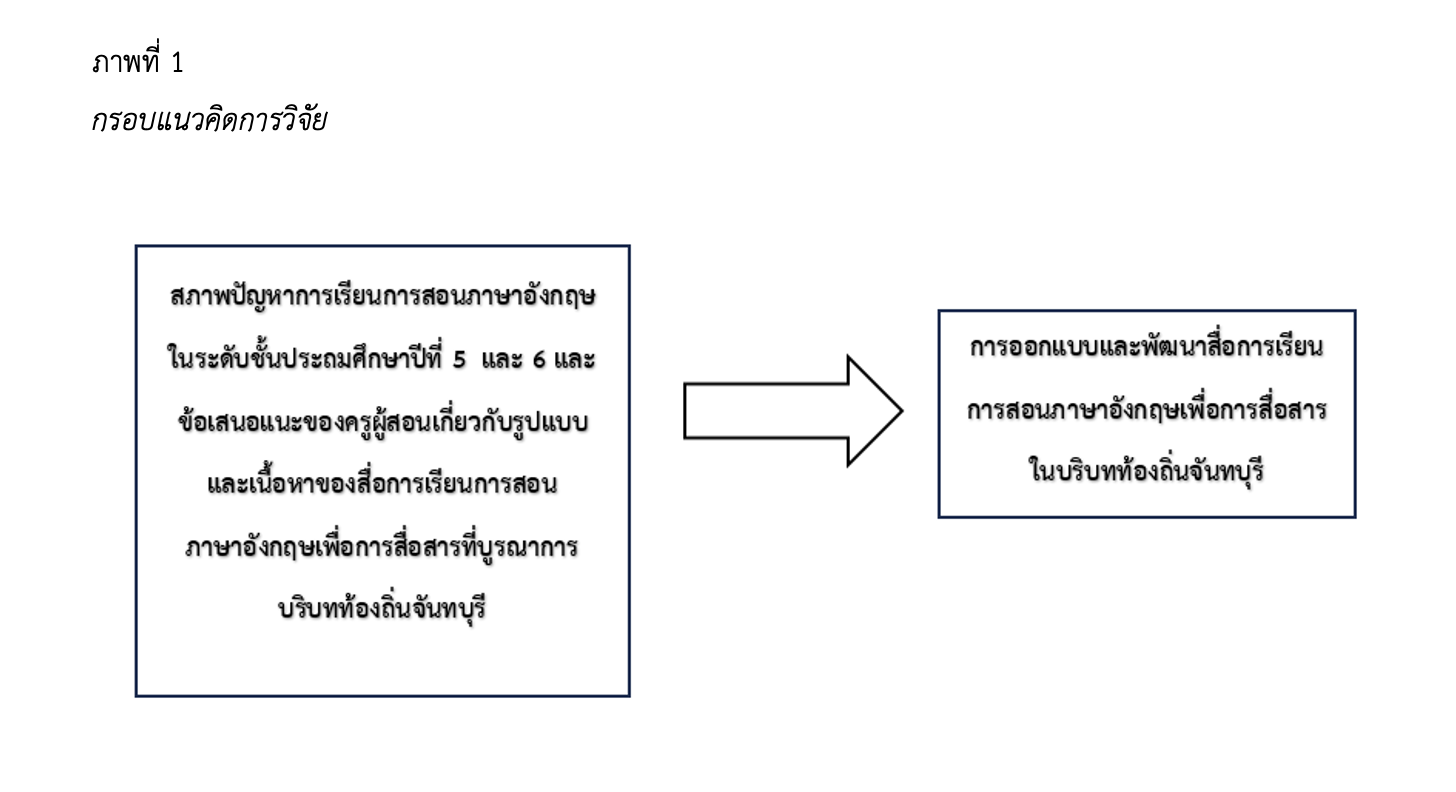
บทนำ: การจัดการเรียนการสอนภาษาอังกฤษส่งผลต่อการเรียนรู้ของผู้เรียน แต่เนื่องจากสื่อการเรียนการสอนภาษาอังกฤษที่มีบริบทท้องถิ่นจันทบุรียังมีจำกัด การวิจัยนี้จึงมีวัตถุประสงค์การศึกษา: เพื่อศึกษาปัญหาการเรียนการสอนภาษาอังกฤษชั้นประถมศึกษาปีที่5และ6โรงเรียนบ้านทุ่งบอนและโรงเรียนวัดทองทั่ว จังหวัดจันทบุรี ออกแบบและพัฒนาสื่อการเรียนการสอนภาษาอังกฤษเพื่อการสื่อสารระดับชั้นประถมศึกษาปีที่5และ6ที่บูรณาการบริบทท้องถิ่นจันทบุรี และศึกษาความพึงพอใจของครูและนักเรียนต่อสื่อการเรียนการสอนในบริบทท้องถิ่นจันทบุรี วิธีการศึกษา: ใช้การวิจัยแบบผสมผสาน โดยการวิจัยเชิงคุณภาพดำเนินการสัมภาษณ์ครูชั้นประถมศึกษาปีที่5และ6 โรงเรียนละ 2 คน ด้วยการเลือกกลุ่มตัวอย่างแบบเฉพาะเจาะจง และใช้แบบสอบถามกึ่งโครงสร้างเพื่อศึกษาปัญหาการเรียนการสอน ออกแบบและพัฒนาสื่อการเรียนการสอน จากนั้นใช้การวิจัยเชิงปริมาณศึกษาความพึงพอใจของครูและนักเรียน โดยเก็บข้อมูลจากครูชั้นประถมศึกษาปีที่5และ6 จำนวน 2 คน และนักเรียน 30 คน วิเคราะห์ข้อมูลด้วยค่าเฉลี่ย ค่าเบี่ยงเบนมาตรฐาน และการทดสอบค่าที (t-test) ผลการวิจัยพบว่า: ปัญหาการเรียนการสอนภาษาอังกฤษในชั้นประถมศึกษาปีที่5และ6 เกิดจากกระแส Soft Power รักษ์ท้องถิ่น แต่มีสื่อการเรียนที่บูรณาการบริบทท้องถิ่น เช่น สถานที่ท่องเที่ยว อาหาร ผลิตภัณฑ์ชื่อดัง และชีวิตชาวสวนผลไม้ไม่เพียงพอ นอกจากนั้นผลการวิจัยยังแสดงคะแนนการเรียนเมื่อใช้สื่อการเรียนการสอนที่ได้รับการออกแบบและพัฒนาคือบทเรียนภาษาอังกฤษเพื่อการสื่อสารในบริบทท้องถิ่นจันทบุรี ดังนี้ คะแนนก่อนเรียนมีคะแนนเฉลี่ยคิดเป็นร้อยละ 76.43 และคะแนนหลังเรียนมีคะแนนเฉลี่ยคิดเป็นร้อยละ 77.43 ดังนั้นบทเรียนภาษาอังกฤษเพื่อการสื่อสารในบริบทท้องถิ่นจันทบุรีมีประสิทธิภาพเท่ากับ 76.43/77.43 และครูมีความพึงพอใจต่อสื่อการเรียนการสอนที่พัฒนาขึ้นในหัวข้อเนื้อหาบริบทจันทบุรีอยู่ในระดับมากที่สุดโดยมีค่าเฉลี่ย 4.63 ด้านนักเรียนมีความพึงพอใจต่อสื่อการเรียนการสอนที่พัฒนาขึ้นในหัวข้อเนื้อหาเข้าใจง่ายไม่ยากจนเกินไปอยู่ในระดับมากที่สุดโดยมีค่าเฉลี่ย 4.90 สรุป: ดังนั้นการมีสื่อการเรียนการสอนบทเรียนภาษาอังกฤษเพื่อการสื่อสารที่มีเนื้อหาท้องถิ่นจันทบุรีซึ่งได้รับการออกแบบและพัฒนามาจากความต้องการของครูผู้สอนโดยตรง ส่งผลให้ครูและนักเรียนพึงพอใจต่อการจัดการเรียนการสอนภาษาอังกฤษ
Downloads
Article Details
เอกสารอ้างอิง
Kottong, K. (2016). The Development of English Reading Exercises based on Asian folktales through the Storyline Method for Prathomsuksa Six Students of Banpao (Samranchaiwittaya) School, Chaiyaphumi Province. Veridian E-Journal, Silpakorn University (Humanities Social Sciences and Arts), 8(2), 2255-2270. https://he02.tci-thaijo.org/index.php/Veridian-E-Journal/article/view/45674/37788
Ministry of Education. (2008). Indicators and Core Learning Materials for Mathematics Learning Materials Group (Issue Revised 2017) according to the Core Curriculum of Basic Education, 2008. Agricultural Cooperative Assembly Printing House of Thailand Limited.
Wongpinit, J., Moonchaisook, V., Pochanakeaw, T., & Sawan, N. (2016). Development of a Supplementary Reading Material by Using Folktales of Khmer Ethnic Groups in Southern Essan: Final research report. Office of the National Science, Research and Innovation Policy Council. https://digital.library.tu.ac.th/tu_dc/frontend/Info/item/dc:58183.
Rajawadee, N. (2021, April 24). Summer Trip to Chanthaburi: Hunting for Chan Gems and
Chatting with Gem Traders of the East. https://readthecloud.co/chan-gems-journey.
Bunjantr, T. (2018). An Analysis of Syntactic Errors in English Writing. Journal of Graduate Studies in Northern Rajabhat Universities, 8(15), 1-16. https://so02.tci-thaijo.org/index.php/JGNRU/article/view/100553/130901.
Kirin, W. (2019). English Local Lessons Development Integrated into Teaching Methodology and Research Courses of English Major Students. Journal of Humanities Naresuan University, 15(1), 13-26. https://so03.tci-thaijo.org/index.php/jhnu/article/view/169107/121678
Rotchu, P. (2020). The Development of English Reading Comprehension Ability Based on Local
Context Reading Materials with Scaffolding Technique of Undergraduate Students.
Journal of MCU Nakhondhat, 7(10), 154-166. http://so03.tci-thaijo.org/index.php/JMND/article/view/247525.
Sutawong, S. (2019). Teaching according to the Thinking School approach (2nd Ed). Nanmeebooks
Thongprasit, S. (2017). Needs in English Reading Skills Practice and the Development of Reading Materials with Southern Contexts. [Master’s thesis, Silpakorn University].https://kb.psu.ac.th/psukb/handle/2016/11654.
EF Thailand Office. (2019, November 25). English Proficiency Index. https://www.ef.co.th/epi
Griffiths, C. (2024). Using Literature to Learn and Teach Language: The L3 Approach. Springer.
McGrath, I. (2018). Teaching Materials and the Roles of EFL/ESL Teachers: Practice and Theory (2nd Ed). Bloomsbury Academic.
Morgana, V. (2023). Task-Based English Language Teaching in the Digital Age (2nd Ed). Bloomsbury Publishing.
Nunan, D. (2016). Teaching English to Speakers of Other Languages: An Introduction (3rd Ed).Cambridge University Press.
Richards, C., & Schmidt R.W. (2014). Language and Communication (2nd Ed). Routledge Press.
Sabatin, I. (2017). The Effect of Cultural Background Knowledge on Learning the English Language. International Journal of Culture and Science, 1(4), 22-32.
Thornbury, S. (2017). About Language: Tasks for Teachers of English (Cambridge Teacher Trainingand Development) (2nd Ed). Cambridge
University Press.
Tomlinson, Carol A. (2021). The Principles and Practices of Learner-Centered Classrooms.
(2nd Ed). ASCD Publications.
