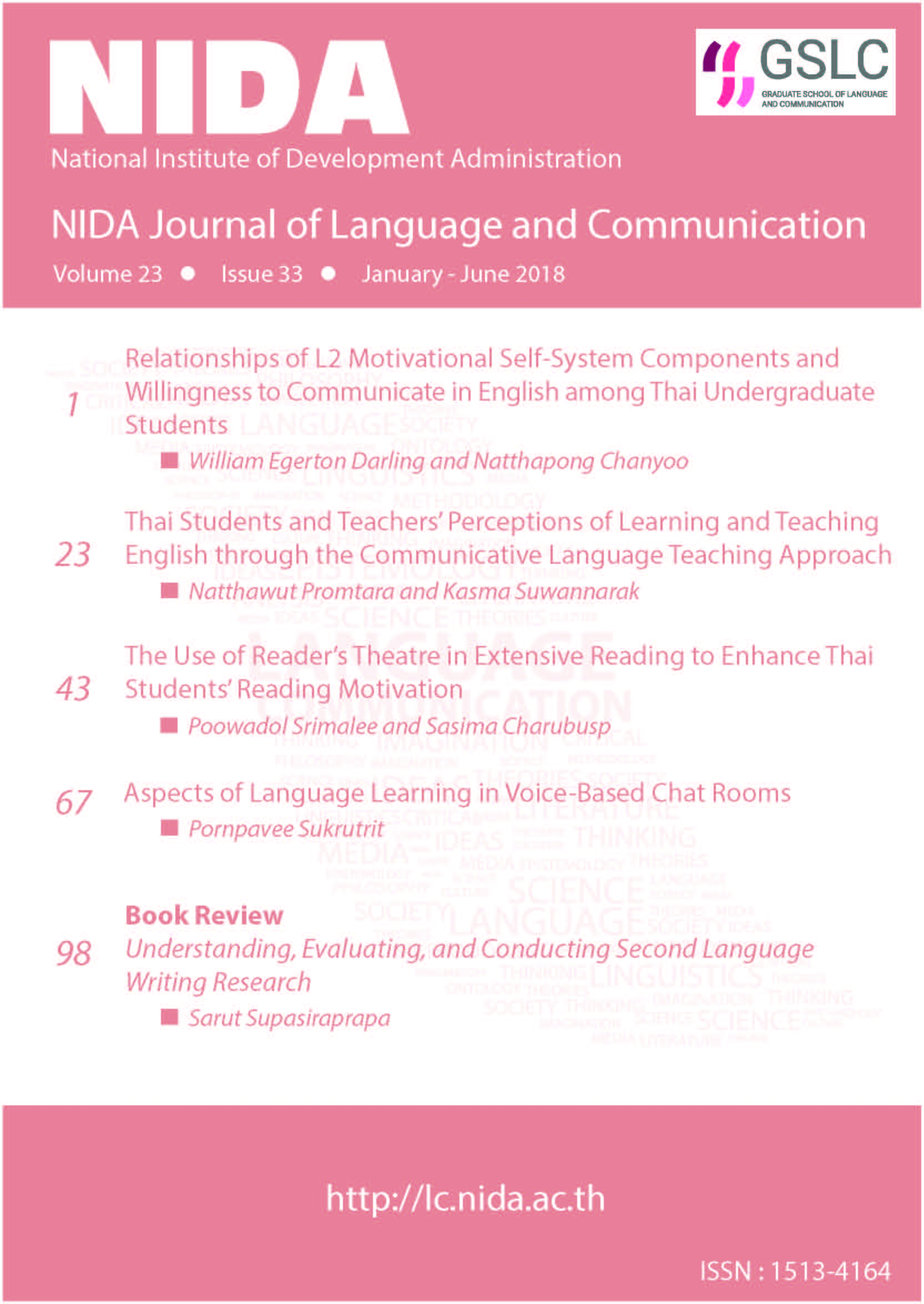
The Use of Reader’s Theatre in Extensive Reading to Enhance Thai Students’ Reading Motivation
Keywords:
extensive reading, reader’s theatre, reading motivation, read aloudAbstract
This study aimed to investigate the effect of using Reader’s Theatre (RT) in Extensive Reading (ER) to enhance reading motivation of Thai students. The participants of this study were 38 first-year students in a six-week intensive English language program from a university in Thailand. The Reader’s Theatre in Extensive Reading (RTER) treatment was conducted as an out-of-class activity for six weeks. In each week, each participant was required to read at least two RT scripts, perform RT as a follow-up activity, record each performance, and submit the video files of the performance to the teacher. RT performance was also conducted as a group in the class once a week. The research instruments were Pre- and Post- reading motivation questionnaires and a semi-structured interview. The results suggest that students report their reading motivation has increased in different aspects including self-efficacy, intrinsic motivation in terms of realizing the importance of reading and an increased interest in reading, and extrinsic motivation in terms of gaining recognition for their reading. From the results, the RT script is suggested as an alternative reading material as it offers several merits including being an achievable goal for students, easily catching students’ attention, giving students a chance to explore more texts, and being compatible with RT. Moreover, performing and recording RT can enhance students’ reading motivation on the aspects of awareness of their own performance and progress as students can observe their strengths and weaknesses each time they perform RT. Thus, using RTER can be an interesting activity that would enhance students’ reading motivation.
Downloads
Published
How to Cite
Issue
Section
License
By submitting a manuscript, the author transfers the copyright for the article to School of Language and Communication, National Institute of Development Administration (NIDA), if and when the manuscript is accepted for publication. Though the journal is an open-access, reproduction of any material published in NIDA Journal of Language and Communication for non-personal and/or commercial purpose requires a written permission from School of Language and Communication, National Institute of Development Administration (NIDA).



