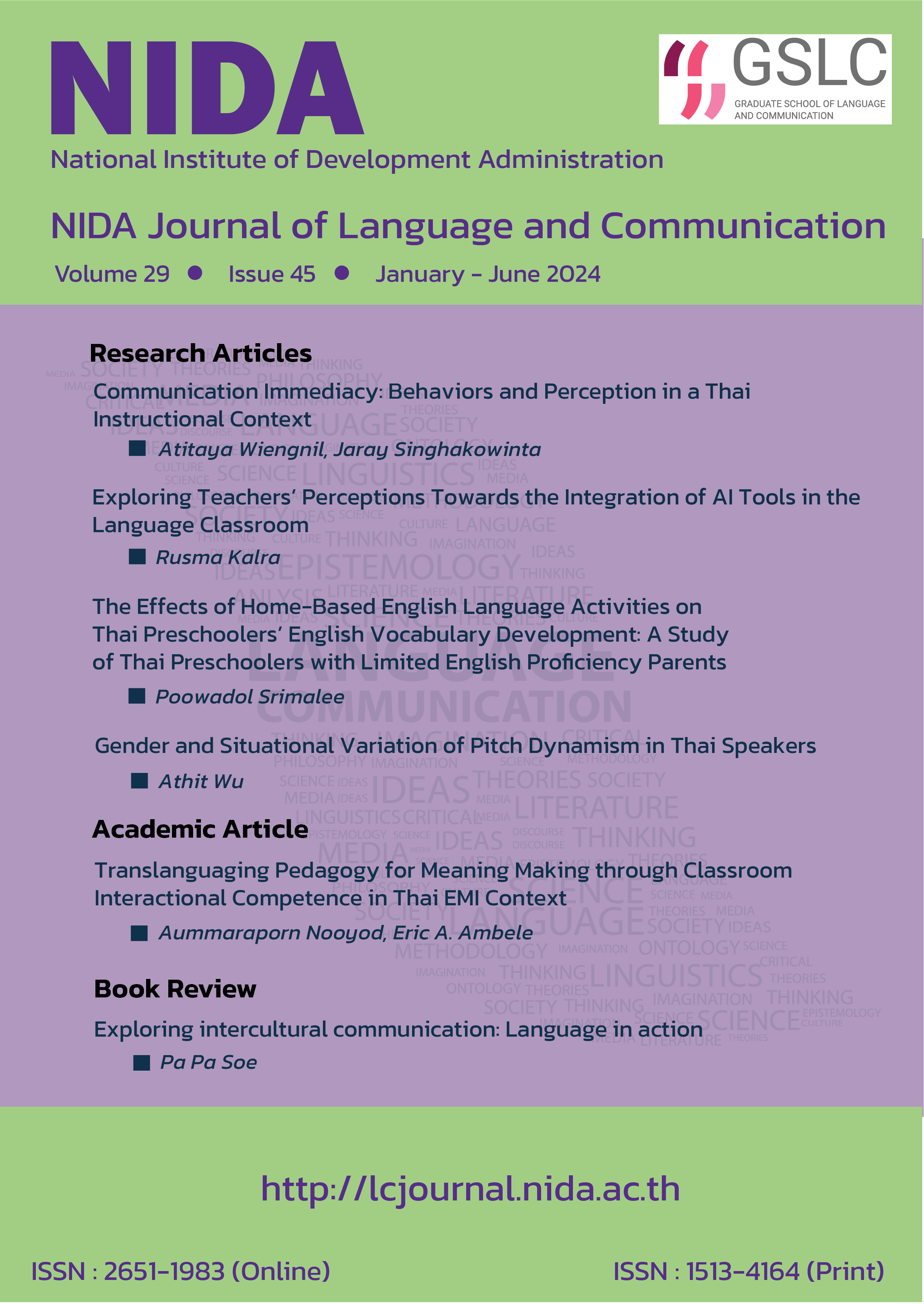
Translanguaging Pedagogy for Meaning Making through Classroom Interactional Competence in Thai EMI Context
Keywords:
Classroom Interactional competence, Meaning Making, Thai EMI context, Translanguaging, Translanguaging PedagogyAbstract
Translanguaging can be conceptualized as a theory of communication and language use, and, involves the fluid use of multiple languages as an integrated system of communication. It is the process where individuals employ their full linguistic and semiotic capabilities to make meaning, considering languages not as fixed codes by themselves, but as fluid codes framed within social practices. Pedagogical translanguaging is a practice that refers to instructional strategies integrating two or more languages in naturally occurring contexts where boundaries between languages are fluid and constantly shifting. It provides spaces to encourage learners’ understanding through discussion activities by using different languages for input and output. This paper explores how translanguaging contribute to knowledge construction of interaction competence within the Thai English Medium Instruction classroom. In particular, the classroom interaction competence builds on ideas related to the centrality of interaction in language learning and focuses on the ways in which teachers’ and learners’ interactional decisions create learning opportunities in the classroom. Employing translanguaging through classroom interactional competence can encourage learners’ deployment of different semiotic resources, especially their free choice and use of languages, in the process of dialogic knowledge construction. The learners can utilize their full linguistic and multimodal repertoires to construct knowledge and facilitate meaning-making processes in the classroom. Therefore, translanguaging can give learners deeper insight into the subject matter discussed and has the potential to promote higher-order thinking and fuller understanding.
References
Ambele, E. A. (2022). Supporting English teaching in Thailand by accepting translanguaging: Views from Thai university teachers. Issues in Educational Research, 32(3), 871-886.
Arthur, J., & Martin, P. (2006). Accomplishing lessons in postcolonial classrooms: Comparative perspectives from Botswana and Brunei Darussalam. Comparative Education, 42(2), 177-202. https://doi.org/10.1080/03050060600628009.
Baker, C. (2011). Foundations of bilingual education and bilingualism. Multilingual matters. Cenoz, J., & Gorter, D. (2017). Minority languages and sustainable translanguaging: Threat or opportunity? Journal of Multilingual and Multicultural development, 38(10), 901-912. https://doi.org/10.1080/01434632.2017.1284855.
Cenoz, J., & Gorter, D. (2021). Pedagogical translanguaging. Cambridge University Press.
Cenoz, J., & Gorter, D. (2022). Pedagogical translanguaging and its application to language classes. RELC Journal, 53(2), 342-354. https://doi.org/10.1177/003368822210827.
Cenoz, J., & Santos, A. (2020). Implementing pedagogical translanguaging in trilingual schools. System, 92, 102273. https://doi.org/10.1016/j.system.2020.102273
Creese, A., & Blackledge, A. (2010). Translanguaging in the bilingual classroom: A pedagogy for learning and teaching? The modern language journal, 94(1), 103- 115. https://doi.org/10.1111/j.1540-4781.2009.00986.x
Curle, S., Yuksel, D., Soruç, A., & Altay, M. (2020). Predictors of English medium instruction academic success: English proficiency versus first language medium. System, 95,102378. https://doi.org/10.1016/j.system.2020.102378
Fang, F., Zhang, L. J., & Sah, P. K. (2022). Translanguaging in language teaching and learning: Current practices and future directions. RELC Journal, 53(2), 305-312. https://doi.org/10.1177/003368822211144.
Galante, A. (2020). Pedagogical translanguaging in a multilingual English program in Canada: Student and teacher perspectives of challenges. System, 92, 102274. https://doi.org/10.1016/j.system.2020.102274
Galloway, N., Kriukow, J., & Numajiri, T. (2017). Internationalisation, higher education and the growing demand for English: An investigation into the English medium of instruction (EMI) movement in China and Japan. The British Council.
García, O. (2009). Bilingual education in the 21st century. Wiley-Blackwell.
García, O., Leiva, C. (2014). Theorizing and Enacting Translanguaging for Social Justice. In: Blackledge, A., Creese, A. (Eds.), Heteroglossia as Practice and Pedagogy. Educational Linguistics (pp.199-216). Springer, Dordrecht.
García, O., & Otheguy, R. (2020). Plurilingualism and translanguaging: Commonalities and divergences. International Journal of Bilingual Education and Bilingualism, 23(1), 17-35. https://doi.org/10.1080/13670050.2019.1598932.
García, O., & Li, W. (2014). Translanguaging: language, bilingualism and education. Basingstoke: Palgrave Macmillan.
Gu, M., Lee, C. & Jin, T. (2022). A translanguaging and trans-semiotizing perspective on subject teachers’ linguistic and pedagogical practices in EMI programme. Applied Linguistics Review, 14 (6), 1589-1615. https://doi.org/10.1515/applirev2022-0036.
Hymes, D. (1972). On communicative competence. In J.B. Pride and J. Holmes (Eds.), Sociolinguistics: Selected Readings (pp. 269-293). Harmondsworth: Penguin.
Infante, P., & Licona, P. R. (2021). Translanguaging as pedagogy: Developing learner scientific discursive practices in a bilingual middle school science classroom. International Journal of Bilingual Education and Bilingualism, 24(7), 913-926. https://doi.org/10.1080/13670050.2018.1526885.
Jakonen, T., Szabó, T. P., Laihonen, P. (2018). Translanguaging as Playful Subversion of a Monolingual Norm in the Classroom. In Mazzaferro, G. (Eds.), Translanguaging as Everyday Practice. (pp.31-48). Cham: Springer. https://doi.org/10.1007/978-3-319-94851-5_3
Jiang, A. L., & Zhang, L. J. (2023). Understanding knowledge construction in a Chinese university EMI classroom: A translanguaging perspective. System, 114, 103024. https://doi.org/10.1016/j.system.2023.103024.
Jiang, L., Zhang, L. J., & May, S. (2019). Implementing English-medium instruction (EMI) in China: Teachers’ practices and perceptions, and students’ learning motivation and needs. International Journal of Bilingual Education and Bilingualism, 22(2), 107-119. https://doi.org/10.1080/13670050.2016.1231166.
Kramsch, C. (1986). From language proficiency to interactional competence. The Modern Language Journal, 70(4), 366-372. https://doi.org/10.2307/326815.
Leonet, O., Cenoz, J., & Gorter, D. (2017). Challenging minority language isolation: Translanguaging in a trilingual school in the Basque Country. Journal of Language, Identity & Education, 16(4), 216-227. https://doi.org/10.1080/15348458.2017.1328281
Lewis, G., Jones, B., & Baker, C. (2012). Translanguaging: origins and development from school to street and beyond. Educational Research and Evaluation, 18(7), 641–654. https://doi.org/10.1080/13803611.2012.718488.
Li, W. (2011). Moment analysis and translanguaging space: Discursive construction of identities by multilingual Chinese youth in Britain. Journal of Pragmatics, 43(5),1222-1235. https://doi.org/10.1016/j.pragma.2010.07.035.
Li, W. (2018). Translanguaging as a practical theory of language. Applied linguistics, 39(1), 9-30. https://doi.org/10.1093/applin/amx039.
Li, W. (2022). Translanguaging as a political stance: Implications for English language education. ELT journal, 76(2), 172-182. https://doi.org/10.1093/elt/ccac001.
Lin, A. M. Y. (2019). Theories of trans/languaging and trans-semiotizing: Implications for content-based education classrooms. International Journal of BilingualEducation and Bilingualism, 22(1), 5-16. https://doi.org/10.1080/13670050.2018.1515175.
Lin, A. M. Y., & He, P. (2017). Translanguaging as dynamic activity flows in CLIL classrooms. Journal of Language, Identity & Education, 16(4), 228-244. https://doi.org/10.1080/15348458.2017.1328283.
Lin, A. M. Y., & Wu, Y. (2015). ‘May I speak Cantonese?’–Co-constructing a scientific proof in an EFL junior secondary science classroom. International Journal of Bilingual Education and Bilingualism, 18(3), 289-305. https://doi.org/10.1080/13670050.2014.988113.
Macaro, E., Curle, S., Pun, J., An, J., & Dearden, J. (2018). A systematic review of English medium instruction in higher education. Language Teaching, 51(1), 36- 76. https://doi.org/10.1017/S0261444817000350.
Ortega, L. (2020). The study of heritage language development from a bilingual and social justice perspective. Language Learning, 70(S1), 15-53. https://doi.org/10.1111/lang.12347.
Otheguy, R., García, O., & Reid, W. (2015). Clarifying translanguaging and deconstructing named languages: A perspective from linguistics. Applied Linguistics Review, 6(3), 281-307. https://doi.org/10.1515/applirev-2015-0014.
Palmer, D. K., Martínez, R. A., Mateus, S. G., & Henderson, K. (2014). Reframing the debate on language separation: Toward a vision for translanguaging pedagogies in the dual language classroom. The Modern Language Journal, 98(3), 757-772. https://doi.org/10.1111/modl.12121.
Parra, M. O. (2023). Negotiating Word Meanings and Identities in a Translanguaging Space. Journal of Language & Literacy Education/Ankara Universitesi SBF Dergisi, 19(1),1-26.
Paulsrud, B., Rosén, J., Straszer, B., & Wedin, Å. (Eds.), (2017). New perspectives on translanguaging and education. Bristol, Blue Ridge Summit: Multilingual Matters. https://doi.org/10.21832/9781783097821.
Pun, J. K., & Tai, K. W. (2021). Doing science through translanguaging: A study of translanguaging practices in secondary English as a medium of instruction science laboratory sessions. International Journal of Science Education, 43(7), 1112-1139. https://doi.org/10.1080/09500693.2021.1902015.
Ra, J.J., Baker, W. (2021). Translanguaging and Language Policy in Thai Higher Education EMI Programs. In: Tsou, W., Baker, W. (Eds.), English-Medium Instruction Translanguaging Practices in Asia (pp.59-77). Springer, Singapore.
Rose, H., Curle, S., Aizawa, I., & Thompson, G. (2020). What drives success in English medium taught courses? The interplay between language proficiency, academicskills, and motivation. Studies in Higher Education, 45(11), 2149- 2161. https://doi.org/10.1080/03075079.2019.1590690.
Tai, K. W. H. (2023). Managing classroom misbehaviours in the Hong Kong English medium instruction secondary classrooms: A translanguaging perspective. System, 113, 102959. https://doi.org/10.1016/j.system.2022.102959.
Tai, K. W. H.,& Dai, D. W. (2023). Observing a teacher’s interactional competence in an ESOL classroom: a translanguaging perspective. Applied Linguistics Review. https://doi.org/10.1515/applirev-2022-0173.
Turnbull, M., Cormier, M., & Bourque, J. (2011). The first language in science class: A quasi experimental study in late French immersion. The Modern Language Journal, 95, 182-198. https://doi.org/10.1111/j.1540-4781.2011.01275.x.
Vygotsky, L. S. (1978). Mind in society: The development of higher psychological processes. Cambridge, MA: Harvard University Press.
Walsh, S. (2006). Investigating classroom discourse. Routledge.
Zhang, L. J., & Zhang, D. (2020). Dialogic discussion as a platform for constructing knowledge: Student-teachers’ interaction patterns and strategies in learning to teach English. Asian-Pacific Journal of Second and Foreign Language Education, 5, 1-24. https://doi.org/10.1186/s40862-020-00101-2.
Zhang, Z. (2017). English-medium instruction policies in China: Internationalisation of higher education. Journal of Multilingual and Multicultural Development, 39(6), 542-555. https://doi.org/10.1080/01434632.2017.1404070.
Downloads
Published
How to Cite
Issue
Section
License

This work is licensed under a Creative Commons Attribution-NonCommercial-NoDerivatives 4.0 International License.
By submitting a manuscript, the author transfers the copyright for the article to School of Language and Communication, National Institute of Development Administration (NIDA), if and when the manuscript is accepted for publication. Though the journal is an open-access, reproduction of any material published in NIDA Journal of Language and Communication for non-personal and/or commercial purpose requires a written permission from School of Language and Communication, National Institute of Development Administration (NIDA).



