
AI Technologies in Optimizing Language Learning: A View of Vocabulary Acquisition
Keywords:
AI technology, language learning, vocabulary acquisition, educational technologyAbstract
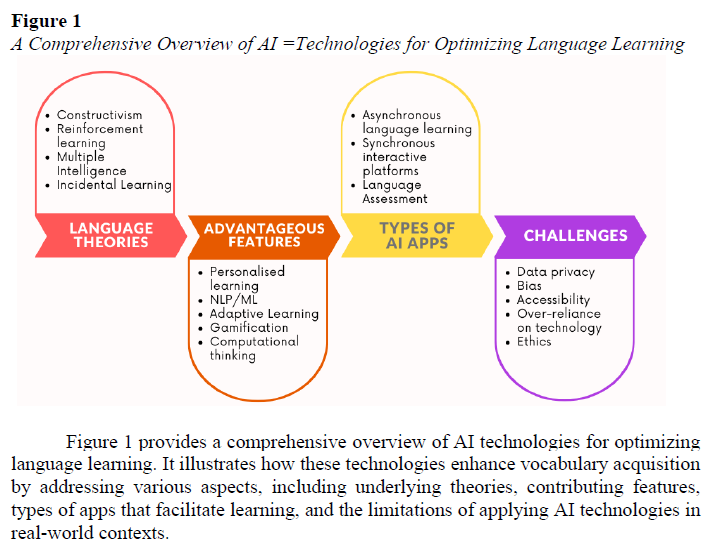
As educational paradigms shift in the digital era, artificial intelligence (AI) technologies have emerged as pivotal tools in language teaching and learning. However, many educators remain unaware of the significance and components of AI technologies in education. This paper provides an overview of AI in optimizing language learning, particularly vocabulary acquisition, through four main aspects. The first aspect covers how AI aligns with theoretical language foundations, especially in constructivism, reinforcement learning, multisensory learning, and incidental learning. Second, it highlights AI features that facilitate language learning, such as personalized language learning, natural language processing, machine learning, adaptive learning, gamification, and computational thinking, with a specific focus on vocabulary acquisition. Third, three types of AI tools are discussed in facilitating vocabulary learning: asynchronous language learning, synchronous interactive platforms, and language assessment. The final aspect addresses the challenges and limitations of AI capabilities, including data privacy, bias, accessibility, over-reliance on technology, and ethical concerns. This paper underscores the potential of AI to transform vocabulary acquisition, enhancing its accessibility and effectiveness for diverse learner populations, while highlighting the need for collaborative efforts among educators, researchers, and technology developers. Ultimately, it contributes to the ongoing discourse on the role of AI in education, providing insights into best practices and future directions for research and implementation in language learning environments.
References
Adeleye, O. O., Eden, C. A., & Adeniyi, I. S. (2024). Innovative teaching methodologies in the era of artificial intelligence: A review of inclusive educational practices. World Journal of Advanced Engineering Technology and Sciences, 11(2), 69-79. https://doi.org/10.30574/wjaets.2024.11.2.0091
Ahmad, S. F., Rahmat, M. K., Mubarik, M. S., Alam, M. M., & Hyder, S. I. (2021). Artificial intelligence and its role in education. Sustainability, 13(22), Article 12902. https://doi.org/10.3390/su132212902
Al-Said, A. B. (2024). Enhancing NLP with quantitative transformations: A vision for the digital language resources industry. Misr University Journal for Humanities, 4(3), 249-268. https://doi.org/10.21608/mjoms.2024.293375.1165
Bahari, N., & Dost Mohammadi, Y. (2023). Multisensory learning and vocabulary retention: An emotioncy-based study with the Stroop task. Journal of Cognition, Emotion & Education, 1(1), 58-76.
Benlaghrissi, H., & Ouahidi, L. M. (2023). The impact of mobile-assisted language learning on developing EFL learners' vocabulary knowledge. International Journal of Interactive Mobile Technologies, 17(22), 38-51. https://doi.org/10.3991/ijim.v17i22.41665
Bergsma, T., van Delden, R., & Theune, M. (2023, September). Vocabulary acquisition in new and learned contexts using immersive virtual reality. In Proceedings of the 17th European Conference on Game-Based Learning: ECGBL 2023 (pp.69-77). Academic Conferences and publishing limited.
Burstein, J., LaFlair, G. T., Kunnan, A. J., & von Davier, A. A. (2022. A theoretical assessment ecosystem for a digital-first assessment-The Duolingo English Test. Duolingo Research Report DRR-22-01.
Caliskan, A. (2023, August). Artificial intelligence, bias, and ethics. In Proceedings of the Thirty-Second International Joint Conference on Artificial Intelligence (IJCAI) (pp. 7007-7013).
Cao, Q. (2024). Design and implementation of English vocabulary orthographical revision application based on Matlab. In Proceedings of the 3rd International Conference on Computing Innovation and Applied Physics (pp.336-345). EWA Publishing. https://doi.org/10.54254/2753-8818/31/20241089
Castelló‐Sirvent, F., Roger-Monzó, V., & Gouveia-Rodrigues, R. (2024). Quo vadis, university? A roadmap for AI and ethics in higher education. The Electronic Journal of e-Learning, 22(6), 34-51. https://doi.org/10.34190/ejel.22.6.3267
Chadha, K. S. (2024, July). Bias and fairness in artificial intelligence: Methods and mitigation strategies. International Journal for Research Publication and Seminar, 15(3), 36-49. https://doi.org/10.36676/jrps.v15.i3.1425
Chandrika, V. P., Verma, R., Charan, N., Ditheswar, S., Hansika, S., & Ishwariya, R. (2024, July). POS tagging using hidden Markov models in natural language processing. In 2024 International Conference on Signal Processing, Computation, Electronics, Power and Telecommunication (IConSCEPT) (pp. 1-6). IEEE. https://doi.org/10.1109/IConSCEPT61884.2024.10627782
Çırtlık, B., & Cosar, S. (2024). Gender bias in AI. Feminist Asylum: A Journal of Critical Interventions, 2, 11-13. https://doi.org/10.5195/faci.2024.124
Dahraj, M. T., Manzoor, H., & Tufail, M. (2020). Use of digital technological tools among undergraduate English language learners in Pakistan. International Journal of English Linguistics, 10(4), 61-74. https://doi.org/10.5539/ijel.v10n4p61
D'Alesio, R., Scalia, M., & Zabel, R. (2007). Improving vocabulary acquisition with multisensory instruction. [Master's thesis, Saint Xavier University]. ERIC. https://eric.ed.gov/?id=ED496974
Daly, N. (2023). A case study exploring the effects of generative AI on incidental language learning. SSRN. https://doi.org/10.2139/ssrn.4615977
Dan, C., Ismail, L., & Razali, A. B. (2024). Effectiveness of using mobile dictionary app to enhance vocabulary knowledge of EFL learners with different level of motivation. International Journal of Academic Research in Business and Social Sciences, 14(7), 202-222. http://dx.doi.org/10.6007/IJARBSS/v14-i7/22022
Drown, L., Giovannone, N., Pisoni, D. B., & Theodore, R. M. (2023). Validation of two measures for assessing English vocabulary knowledge on web-based testing platforms: Brief assessments. Linguistics Vanguard, 9(1), 99-111. https://doi.org/10.1515/lingvan-2022-0116
Dujardin, E., Ecalle, J., Auphan, P., Gomes, C., Cros, L., & Magnan, A. (2021, April). Vocabulary assessment with tablets in grade 1: Examining effects of individual and contextual factors and psychometric qualities. Frontiers in Education, 6, Article 664131. https://doi.org/10.3389/feduc.2021.664131
Elmashhara, M. G., De Cicco, R., Silva, S. C., Hammerschmidt, M., & Silva, M. L. (2024). How gamifying AI shapes customer motivation, engagement, and purchase behavior. Psychology & Marketing, 41(1), 134-150. https://doi.org/10.1002/mar.21912
Fazil, A. W., Hakimi, M., & Shahidzay, A. K. (2024). A comprehensive review of bias in AI algorithms. Nusantara Hasana Journal, 3(8), 1-11. https://doi.org/10.59003/nhj.v3i8.1052
Feng, B., & Ng, L. L. (2024). The spatial influence on vocabulary acquisition in an immersive virtual reality-mediated learning environment. International Journal of Computer-Assisted Language Learning and Teaching (IJCALLT), 14(1), 1-17. https://doi.org/10.4018/IJCALLT.339903
Figueroa, K., & Rivera-Loaiza, C. (2023). Learning systems based on gamification and artificial intelligence. Avances en Interacción Humano-Computadora, 8(1), 17-20. https://doi.org/10.47756/aihc.y8i1.131
Gao, D. K., Haverly, A., Mittal, S., Wu, J., & Chen, J. (2024). AI ethics: A bibliometric analysis, critical issues, and key gaps. International Journal of Business Analytics (IJBAN), 11(1), 1-19. https://doi.org/10.4018/IJBAN.338367
Goldenthal, E., Park, J., Liu, S. X., Mieczkowski, H., & Hancock, J. T. (2021). Not all AI are equal: Exploring the accessibility of AI-mediated communication technology. Computers in Human Behavior, 125, Article 106975. https://doi.org/10.1016/j.chb.2021.106975
Gonzalez-Rodriguez, D., & Hernandez-Carrion, J. R. (2018). Self-organized linguistic systems: From traditional AI to bottom-up generative processes. Futures, 103, 27-34. https://doi.org/10.1016/j.futures.2018.03.003
Grissinger, M. (2019). Understanding human over-reliance on technology. Pharmacy and Therapeutics, 44(6), 320-321, 375.
Ijaiya, H., & Adeniyi, I. A. (2024). AI and personal data privacy in the US: Balancing customer convenience with privacy compliance. ABUAD Law Journal, 12(1), 41-64. https://doi.org/10.53982/alj.2024.1201.03-j
Jia Min, C. (2024). The use of AI and ChatGPT in teaching synonyms to EFL students. Research Studies in English Language Teaching and Learning, 2(4), 187-207. https://doi.org/10.62583/rseltl.v2i4.53
Jumabekovna, E. A. (2024). The role of language learning apps in enhancing vocabulary of B2 level students. International Journal of Pedagogics, 4(1), 91-95. https://doi.org/10.37547/ijp/Volume04Issue01-17
Kayra, Z. (2024). Enhancing English vocabulary learning through mobile apps: A new paradigm in educational technology. Research Studies in English Language Teaching and Learning, 2(2), 87-95. https://doi.org/10.62583/rseltl.v2i2.41
Kazu, İ. Y., & Kuvvetli, M. (2023a). A triangulation method on the effectiveness of digital game-based language learning for vocabulary acquisition. Education and Information Technologies, 28, 13541-13567. https://doi.org/10.1007/s10639-023-11756-y
Kazu, I. Y., & Kuvvetli, M. (2023b). The influence of pronunciation education via artificial intelligence technology on vocabulary acquisition in learning English. International Journal of Psychology and Educational Studies, 10(2), 480-493. https://doi.org/10.52380/ijpes.2023.10.2.1044
Khan, M. Y., & Ayaz, A. (2023). Lexicographical landscape: An investigation into digital tools, preferences, challenges and usage patterns among Pakistani graduate ESL learners. Annals of Social Sciences and Perspective, 4(2), 541-553. https://doi.org/10.52700/assap.v4i2.341
Kishore, H. S., Raj, D. S. P., & Senthilkumar, K. R. (2024). AI for accessibility: A case study of enhancing library services for users with disabilities. In Improving Library Systems with AI: Applications, Approaches, and Bibliometric Insights (pp. 214-225). IGI Global. https://doi.org/10.4018/979-8-3693-5593-0.ch015
Klašnja-Milićević, A., Marošan, Z., Ivanović, M., Savić, N., & Vesin, B. (2018). The future of learning multisensory experiences: Visual, audio, smell and taste senses. In Methodologies and Intelligent Systems for Technology Enhanced Learning, 8th International Conference (pp. 213-221). Springer International Publishing.
Kovalenko, I., & Baranivska, N. (2024). Integrating artificial intelligence in English language teaching: Exploring the potential and challenges of AI tools in enhancing language learning outcomes and personalized education. European Socio-Legal & Humanitarian Studies, 1, 86-95. https://doi.org/10.61345/2734-8873.2024.1.9
Latham, A., & Goltz, S. (2019). A survey of the general public’s views on the ethics of using AI in education. In S. Isotani, E. Millán, A. Ogan, P. Hastings, B. McLaren, & R. Luckin (Eds.), Artificial Intelligence in Education: 20th International Conference, AIED 2019, Chicago, IL, USA, June 25-29, 2019, Proceedings, Part I (pp. 194-206). Springer International Publishing. https://doi.org/10.1007/978-3-030-23204-7_17
Leone, V., & Di Caro, L. (2020). The role of vocabulary mediation to discover and represent relevant information in privacy policies. In G. Sileno, J. Spanakis, & G. van Dijck (Eds.) Legal Knowledge and Information Systems: JURIX 2023: The Thirty-sixth Annual Conference, Maastricht, the Netherlands, 18-20 December 2023 (pp. 73-82). IOS Press. https://doi.org/10.3233/FAIA200851
Leschanowsky, A., Rech, S., Popp, B., & Bäckström, T. (2024). Evaluating privacy, security, and trust perceptions in conversational AI: A systematic review. Computers in Human Behavior, 159, Article 108344. https://doi.org/10.1016/j.chb.2024.108344
Li, X. (2023, November). Unveiling the benefits, limitations, and mitigation of bias in artificial intelligence within organizational contexts-A systematic review. In H. Kassim, N. Malik, P. Rajagopal, & M. K. M. Singh (Eds.), Proceedings of the 2023 8th International Conference on Modern Management and Education Technology (MMET 2023) (pp. 55-65). Atlantis Press. https://doi.org/10.2991/978-2-38476-146-3_9
Lindner, A., & Romeike, R. (2019). Teachers’ perspectives on artificial intelligence. In E. Jasutė & S. Pozdniakov (Eds), ISSEP 2019 12th International conference on informatics in schools, “Situation, evaluation and perspectives” (pp. 22-29), ISSEP.
Memarian, B., & Doleck, T. (2024). A scoping review of reinforcement learning in education. Computers and Education Open, 6, Article 100175. https://doi.org/10.1016/j.caeo.2024.100175
Mete, F., Alibaşiç, B., & Köksal, B. (2023). Impact of vocabulary teaching approach in Turkish curriculum on Turkish textbooks and use of technology in vocabulary teaching. Journal of Learning and Teaching in Digital Age, 8(1), 124-135. https://doi.org/10.53850/joltida.1179069
Nallam, M., Murala, R., Maganti, S. S. V. P., Chinni, B., Vutukuru M. M., &, Subramanyam, D. M. (2024) AI Privacy Policies and Security. African Journal of Biological Sciences, 6(Si4), 908-918. https://doi.org/10.48047/afjbs.6.si4.2024.908-918
Narayanan, K. S., & Kumaravel, A. (2024). Hybrid gamification and AI tutoring framework using machine learning and adaptive neuro-fuzzy inference system. Journal of Advanced Research in Applied Sciences and Engineering Technology, 42(2), 221-233. https://doi.org/10.37934/araset.42.2.221233
Nemorin, S. (2024). Towards decolonising the ethics of AI in education. Globalisation, Societies and Education, Advance online publication. https://doi.org/10.1080/14767724.2024.2333821
Novikov, P., & Kiseleva, A. (2024). Over-reliance on technology in foreign language learning: Case study of LLB undergraduates. In INTED2024 Proceedings (pp. 2962-2966). IATED. https://doi.org/10.21125/inted.2024.0803
Osorio, C., Fuster, N., Chen, W., Men, Y., & Juan, A. A. (2024). Enhancing accessibility to analytics courses in higher education through AI, simulation, and e-collaborative tools. Information, 15(8), Article 430. https://doi.org/10.3390/info15080430
Pandit, H. J., Esteves, B., Krog, G. P., Ryan, P., Golpayegani, D., & Flake, J. (2024). Data privacy vocabulary (DPV)--version 2.0 In G. Demartini, K. Hose, M. Acosta, M. Palmonari, G. Cheng, H. Skaf-Molli, N. Ferranti, D. Hernández, & A. Hogan (Eds), The Semantic Web – ISWC 2024 23rd International Semantic Web Conference, Baltimore, MD, USA, November 11–15, 2024, Proceedings, Part III (pp. 171-193). https://doi.org/10.48550/arXiv.2404.13426
Perkins, M. (2023). Academic integrity considerations of AI large language models in the post-pandemic era: ChatGPT and beyond. Journal of University Teaching and Learning Practice, 20(2), Article 7. https://doi.org/10.53761/1.20.02.07
Phakiti, A., & Paltridge, B. (2015). Approaches and methods in applied linguistics research. In B. Paltridge & A. Phakiti (Eds.), Research Methods in Applied Linguistics: A Practical Resource (pp. 5-25). Bloomsbury Publishing.
Poláková, P., & Klímová, B. (2020). Assessment of vocabulary knowledge through a mobile application. Procedia Computer Science, 176, 1523-1530. https://doi.org/10.1016/j.procs.2020.09.163
Polyzi, P., & Moussiades, L. (2023). An artificial vocabulary learning assistant. Education and Information Technologies, 28(12), 16431-16455. https://doi.org/10.1007/s10639-023-11810-9
Prandi, C., Valva, A., Salomoni, P., Roccetti, M., & Mirri, S. (2023). Incidental language and culture learning through mobile technologies: A multi-case study. Multimedia Tools and Applications, 82, 46039-46063. https://doi.org/10.1007/s11042-023-16095-1
Qin, L., & Zhong, W. (2024). Adaptive system of English-speaking learning based on artificial intelligence. Journal of Electrical Systems, 20(6s), 267-275. https://doi.org/10.52783/jes.2637
Roopaei, M., & Roopaei, R. (2024, May). Gamifying AI education for young minds: The TransAI adventure in learning. In 2024 IEEE World AI IoT Congress (AIIoT) (pp. 129-134). IEEE. https://doi.org/10.1109/AIIoT61789.2024.10578991
Saxena, R., & Carnewale, K. (2023). Exploring the synergy of synchronous and asynchronous learning approaches in medical education. IJRDO-Journal of Educational Research, 9(8), 6-11. https://doi.org/10.53555/er.v9i8.5869
Schulz, K., Beyer, A., Dreyer, M., & Kipf, S. (2020). A data-driven platform for creating educational content in language learning. In Proceedings of the Conference on Digital Curation Technologies (QURATOR 2020). http://ceurws. org/Vol-2535/paper_9.pdf
Shih, Y. C. (2023). Vocabulary acquisition from a virtual street-view context. In Research Anthology on Virtual Environments and Building the Metaverse (pp. 259-279). IGI Global. https://doi.org/10.4018/978-1-6684-7597-3.ch013
Shrivastav, H., & Hiltz, S. R. (2013). Information overload in technology-based education: A meta-analysis. In Proceedings of the Nineteenth Americas Conference on Information Systems (AMCIS2013) (pp. 1994-2003).
Siau, K., & Wang, W. (2020). Artificial intelligence (AI) ethics: Ethics of AI and ethical AI. Journal of Database Management (JDM), 31(2), 74-87.
Silitonga, L. M., Wiyaka, W., & Prastikawati, E. F. (2024). Boosting students’ ESP vocabulary by utilizing AI chatbot. ETERNAL: English Teaching Journal, 15(2), 275-283. https://doi.org/10.26877/eternal.v15i2.605
Tang, Y., & Ma, X. (2023, August). Enhancing EFL vocabulary acquisition through computational thinking. In F. Zhao, & D. Miao (Eds.), AI-generated Content: First International Conference, AIGC 2023, Shanghai, China, August 25–26, 2023, Revised Selected Papers (pp. 70-82). Springer. https://doi.org/10.1007/978-981-99-7587-7_6
Wang, L. (2019). Research on intelligent learning APP in junior English vocabulary teaching. Theory and Practice in Language Studies, 9(12), 1573-1577. http://dx.doi.org/10.17507/tpls.0912.14
Wang, X., Huang, R. “Tammy”, Sommer, M., Pei, B., Shidfar, P., Rehman, M. S., Ritzhaupt, A. D., & Martin, F. (2024). The efficacy of artificial intelligenceenabled adaptive learning systems from 2010 to 2022 on learner outcomes: A meta-analysis. Journal of Educational Computing Research, 62(6), 1568-1603. https://doi.org/10.1177/07356331241240459
Watkins, K. E., & Marsick, V. J. (1992). Towards a theory of informal and incidental learning in organizations∗. International Journal of Lifelong Education, 11(4), 287-300. https://doi.org/10.1080/0260137920110403
Wei-Xun, L., & Jia-Ying, Z. (2024). Impact of AI-driven language learning apps on vocabulary acquisition among English learners. Research Studies in English Language Teaching and Learning, 2(1), 1-11. https://doi.org/10.62583/rseltl.v2i1.32
Wilschut, T., Sense, F., & van Rijn, H. (2024). Speaking to remember: Model-based adaptive vocabulary learning using automatic speech recognition. Computer Speech & Language, 84, Article 101578. https://doi.org/10.1016/j.csl.2023.101578
Yao, Z. M., & Lee, K. C. (2023). The application of multiple intelligence theory to English vocabulary teaching for vocational college students in China . International Journal of Social Science and Business Management, 1(2), 44- 53. https://doi.org/10.59021/ijssbm.v1i02.44
Yildiz, M. (2023). Exploring the potential of chatbots and ChatGPT in enhancing vocabulary knowledge. In G. Kartal (Ed.), Transforming the Language Teaching Experience in the Age of AI (pp. 160-188). IGI Global. https://doi.org/10.4018/978-1-6684-9893-4.ch010
Young, S. R., Dworak, E. M., Kaat, A. J., Adam, H., Novack, M. A., Slotkin, J., Stoeger, J., Nowinski, C. J., Hosseinian, Z., Amagai, S., Pila, S., Diaz, M. V., Correa, A. A., Alperin, K., Omberg, L., Kellen, M., Camacho, M. R., Landavazo, B., Nosheny, R. L., Weiner, M. W., & Gershon, R. M. (2024). Development and validation of a vocabulary measure in the mobile toolbox. Archives of Clinical Neuropsychology, 39(6), 714-723. https://doi.org/10.1093/arclin/acae010
Zhang, Z. (2023). Promoting L2 vocabulary learning through an artificial intelligent chatbot. SSRN. https://doi.org/10.2139/ssrn.4592068
Zhang, Z., & Huang, X. (2024). The impact of chatbots based on large language models on second language vocabulary acquisition. Heliyon, 10(3), Article e25370. https://doi.org/10.1016/j.heliyon.2024.e25370
Downloads
Published
How to Cite
Issue
Section
License

This work is licensed under a Creative Commons Attribution-NonCommercial-NoDerivatives 4.0 International License.
By submitting a manuscript, the author transfers the copyright for the article to School of Language and Communication, National Institute of Development Administration (NIDA), if and when the manuscript is accepted for publication. Though the journal is an open-access, reproduction of any material published in NIDA Journal of Language and Communication for non-personal and/or commercial purpose requires a written permission from School of Language and Communication, National Institute of Development Administration (NIDA).



