Enhancing Learning Outcomes and Students’ Satisfaction Through Flipped Classroom and STAD Integration in Thai EFL Students’ Syntax Learning
Keywords:
Flipped Classroom, STAD, Student Achievement and Satisfaction, Collaborative Learning, Peer Learning StrategiesAbstract
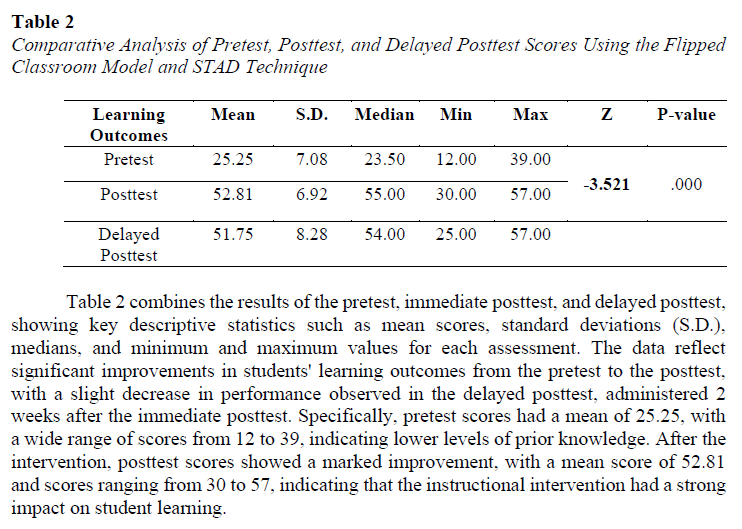
This study explores the impact of integrating the Flipped Classroom model with the Student Teams-Achievement Divisions (STAD) technique on Thai EFL students’ syntax learning, focusing on learning outcomes and student satisfaction. The quasi-experimental study was conducted with 16 first-year Thai Bachelor of Education students in English. The study involved administering pre-immediate posttests and delayed posttests each consisting of 60 items. The tests assessed students’ knowledge and application of English grammar, focusing on the types and functions of words. The results of the comparative analysis show significant improvements in student achievement. Pretest scores (M = 25.25, SD = 7.08) increased substantially in the posttest (M = 52.81, SD = 6.92), with a statistically significant difference (Z = -3.521, p = .000). Retention was supported by the delayed posttest scores (M = 51.75, SD = 8.28), which remained high but slightly lower than the immediate posttest. Students expressed high satisfaction with the integrated approach, highlighting enhanced engagement, active participation, and personalized learning. The flipped classroom promoted self-directed learning by encouraging students to prepare before class, while the STAD technique facilitated peer collaboration, fostering teamwork and communication skills. The combined approach also developed higher-order thinking and a growth mindset, as students engaged in analytical and practical tasks. Despite these strengths, some students found pre-class preparation tasks less engaging, indicating a need for improved task design. Overall, this integration significantly enhances academic performance and satisfaction.
References
Abeysekera, L., & Dawson, P. (2015). Motivation and cognitive load in the flipped classroom: Definition, rationale, and a call for research. Higher Education Research & Development, 34(1), 1-14. https://doi.org/10.1080/07294360.2014.934336
Afrilyasanti, R., Cahyono, B. Y., & Astuti, U. P. (2017). Indonesian EFL students’ perceptions on the implementation of flipped classroom model. Journal of Language Teaching and Research, 8(3), 476-484. https://doi.org/10.17507/jltr.0803.05
Anwar, I., & Rosa, R. (2020). The role of morphological awareness and explicit morphological instructions in ELT. Language Literacy: Journal of Linguistics Literature and Language Teaching, 4(1), 28-37. https://doi.org/10.30743/ll.v4i1.1825
Asaad, H. Q. M., Hasan, M. K., Alidoust, N., Shabdin, A. A., Ounissi, A., & Hossain, M. D. (2022). The impact of morphological awareness intervention in enhancing L2 postgraduate students’ productive vocabulary breadth. Education Research International, 2022, Article ID 5930822. https://doi.org/10.1155/2022/5930822
Baker, J. W. (2000). The classroom flip: Using web course management tools to become the guide by the side. In Proceedings of the 11th International Conference on College Teaching and Learning (pp. 9–17). Florida Community College at Jacksonville.
Bergmann, J., & Sams, A. (2012). Flip your classroom: Reach every student in every class every day. International Society for Technology in Education.
Bishop, J., & Verleger, M. A. (2013, June), The Flipped Classroom: A Survey of the Research Paper presented at 2013 ASEE Annual Conference & Exposition, Atlanta, Georgia. 10.18260/1-2--22585.
Daulay, S. H., Dalimunte, M., & Ningrum, D. W. (2021). The importance of linguistics for teachers in English language teaching. English Franca: Academic Journal of English Language and Education, 5(2), 339-348. https://doi.org/10.29240/ef.v5i2.2721
Day, L. (2018). A gross anatomy flipped classroom effects performance, retention, and higher‐level thinking in lower performing students. Anatomical Sciences Education, 11(6), 565-574. https://doi.org/10.1002/ase.1772
Felder, R. M., & Brent, R. (2009). Active Learning: An Introduction. ASQ Higher Education Brief, 2(4), 1-5.
Ghasemi, B., & Vaez-Dalili, M. (2019). Effect of three methods of morphological awareness on Iranian intermediate EFL learners’ reading comprehension. International Journal of Instruction, 12(2), 623-638. https://doi.org/10.29333/iji.2019.12239a
Goodwin, A. P., Lipsky, M., & Ahn, S. (2012). Word detectives: using units of meaning to support literacy. The Reading Teacher, 65(7), 461-470. https://doi.org/10.1002/trtr.01069Hew, K. F. and Lo, C. K. (2018). Flipped classroom improves student learning in health professions education: a metaanalysis. BMC Medical Education, 18(1). https://doi.org/10.1186/s12909-018- 1144-z
Jang, H. Y. and Kim, H. J. (2020). A meta-analysis of the cognitive, affective, and interpersonal outcomes of flipped classrooms in higher education. Education Sciences, 10(4), 115. https://doi.org/10.3390/educsci10040115
Jdaitawi, M. (2019). The effect of flipped classroom strategy on students' learning outcomes. International Journal of Instruction, 12(3), 665-680. https://doi.org/10.29333/iji.2019.12340a
Jensen, J. L., Kummer, T. A., & Godoy, P. D. d. M. (2015). Improvements from a flipped classroom may simply be the fruits of active learning. CBE—Life Sciences Education, 14(1), ar5. https://doi.org/10.1187/cbe.14-08-0129
Johnson, D. W., Johnson, R. T., & Smith, K. A. (2014). Cooperative learning: Improving university instruction by basing practice on validated theory. Journal on Excellence in College Teaching, 25(3&4), 85-118.
Kagan, S. (2021). The structural approach and Kagan structures. In N. Davidson (Ed.) Pioneering perspectives in cooperative learning (pp. 78-127). Routledge.
Karyadi, P. A., Paristiowati, M., & Afrizal. (2020). Analysis the 21st century skills of students in chemical equilibrium learning with flipped classroom-collaborative problem solving model. JTK (Jurnal Tadris Kimiya), 5(1), 48-60. https://doi.org/10.15575/jtk.v5i1.7971
Khanova, J., Roth, M. T., Rodgers, J. E., & McLaughlin, J. E. (2015). Student experiences across multiple flipped courses in a single curriculum. Medical Education, 49(10), 1038-1048. https://doi.org/10.1111/medu.12807
Lage, M. J., Platt, G. J., & Treglia, M. (2000). Inverting the classroom: A gateway to creating an inclusive learning environment. The Journal of Economic Education, 31(1), 30-43.
Le, Q. T. (2023). Teaching and learning morphology in the English language curriculum: An exploration into belief and reality in Vietnam. International Journal of TESOL & Education, 3(2), 43-59. https://doi.org/10.54855/ijte.23324
Leary, M., Tylka, A., Corsi, V., & Bryner, R. (2021). The effect of first-year seminar classroom design on social integration and retention of stem first-time, full-time college freshmen. Education Research International, 2021, Article ID 4262905. https://doi.org/10.1155/2021/4262905
Lin, Y., Zhu, Y., Chen, C., Wang, W., Chen, T., Li, T., Li, Y., Liu, B., Lian, Y., Lu, L., Zou, Y., & Liu, Y. (2017). Facing the challenges in ophthalmology clerkship teaching: Is flipped classroom the answer? Plos One, 4(12), Article ID e0174829. https://doi.org/10.1371/journal.pone.0174829
Mayasari, A. D., Budiyanto, M., & Purnomo, A. R. (2022). The implementation of the flipped classroom-STAD model to improve student learning outcomes. Pensa: eJurnal Pendidikan Sains, 10(2), 240-245.
Morgan, H., McLean, K., Chapman, C., Fitzgerald, J., Yousuf, A., & Hammoud, M. (2015). The flipped classroom for medical students. The Clinical Teacher, 12(3), 155-160. https://doi.org/10.1111/tct.12328
Nanor, E., Mahama, A., & Hanson, R. (2024). Effect of stad model of cooperative learning on students’ learning outcome on nomenclature of hydrocarbon. International Journal of Scientific Research and Management (IJSRM), 12(03), 3264-3274. https://doi.org/10.18535/ijsrm/v12i03.el03
Noroozi, A., Rezvani, E., & Ameri-Golestan, A. (2020). The effect of flipped classrooms on L2 learners’ development and retention of grammatical knowledge. Turkish Online Journal of Distance Education, 21(4), 14-30. https://doi.org/10.17718/tojde.803344
Putri, R. R., Khairil, K., & Safrida, S. (2022). The application of the flipped classroom model integrated with Google Classroom to the student’s learning motivation. Jurnal Penelitian Pendidikan IPA, 8(1), 263-268. https://doi.org/10.29303/jppipa.v8i1.1157
Rohyami, Y., & Huda, T. (2020). The effect of flipped classroom cooperative learning on learning outcomes in the analytical chemistry course. In I. Fatimah, Muhaimin, & M. Musawwa (Eds.), 3rd International Seminar on Chemical Education: Trends, Applications, Changes in Chemical Education for the 4.0 Industrial Revolution, AIP Conference Prodeedings Vol.2229, Article ID 020008. AIP Publishing.
Shafiee Rad, H., Namaziandost, E., & Razmi, M. H. (2022). Integrating STAD and flipped learning in expository writing skills: Impacts on students’ achievement and perceptions. Journal of Research on Technology in Education, 55(4), 710-726. https://doi.org/10.1080/15391523.2022.2030265
Slavin, R. E. (2014). Cooperative learning in elementary schools. Education 3-13, 43(1), 5–14. https://doi.org/10.1080/03004279.2015.963370.
Sulistyawati, E. E., Nugroho, A. A., & Bram, B. (2021). Morphological teaching strategies to enhance students’ vocabulary knowledge and reading comprehension. JET (Journal of English Teaching), 7(2), 179-190. https://doi.org/10.33541/jet.v7i2.2472
Tucker, C. R. (2012). Blended learning in grades 4–12: Leveraging the power of technology to create student-centered classrooms. Corwin.
Washburn, E., & Mulcahy, C. (2018). Morphology matters, but what do teacher candidates know about it? Teacher Education and Special Education: The Journal of the Teacher Education Division of the Council for Exceptional Children, 42(3), 246-262. https://doi.org/10.1177/0888406418806649
Downloads
Published
How to Cite
Issue
Section
License

This work is licensed under a Creative Commons Attribution-NonCommercial-NoDerivatives 4.0 International License.
By submitting a manuscript, the author transfers the copyright for the article to School of Language and Communication, National Institute of Development Administration (NIDA), if and when the manuscript is accepted for publication. Though the journal is an open-access, reproduction of any material published in NIDA Journal of Language and Communication for non-personal and/or commercial purpose requires a written permission from School of Language and Communication, National Institute of Development Administration (NIDA).



