
Academic Writing Anxiety and Coping Strategies of EFL Postgraduate Students at a Thai University
Keywords:
writing anxiety, academic writing, EFL learners, postgraduate students, Thai universityAbstract
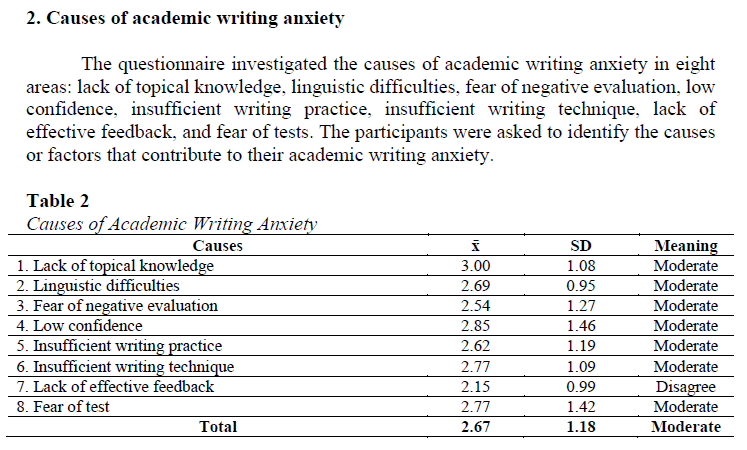
This study aimed to investigate symptoms and causes of academic writing anxiety among Thai postgraduate students of English as a foreign language, as well as the strategies that students use to cope with academic writing anxiety. The participants were 30 postgraduate students majoring in English in a Master of Arts (MA) program at a Thai university. The primary research instruments used in this study were the Academic Writing Anxiety Inventory (AWAI) and semi-structured interviews. The quantitative results revealed that cognitive anxiety emerged as the highest category. Additionally, the data indicated that a lack of topical knowledge was the most significant source of academic writing anxiety among the participants. The qualitative results demonstrated the participants' perceptions of academic writing and their strategies to cope with anxiety during the academic writing process. These strategies can be categorized into four main groups: seeking support from others, taking breaks or pausing during the writing process, adopting a positive mindset, and employing cognitive strategies such as effective time management. These insights contribute to a deeper understanding of the challenges associated with writing anxiety in a graduate context.
References
Aripin, N., & Rahmat, N. H. (2021). Writing Anxiety and its Signs: A Qualitative Study of a Female ESL Writer. International Journal of Academic Research in Business and Social Sciences, 11(1), 334-345. http://doi.org/10.6007/IJARBSS/v11-i1/8399
Ariyanti, A. (2017). Foreign language anxiety in academic writing. Dinamika Ilmu, 17(1), 143-152. https://doi.org/10.21093/di.v17i1.815
Bailey, S. (2014). Academic writing: A handbook for international students (4th ed.). Routledge. https://doi.org/10.4324/9781315768960
Barrot, J. S., & Agdeppa, J. Y. (2021). Complexity, accuracy, and fluency as indices of college-level L2 writers’ proficiency. Assessing Writing, 47, Article 100510. https://doi.org/10.1016/j.asw.2020.100510
Cahyono, B. Y., Astuti, U. P., & Suryati, N. (2023, May). Writing anxiety among Indonesian EFL university students. In U. Widiati, M. Hidayati, N. Suryati, Suharyadi, A. N. Wulyani, I. L. Damayanti, N. A. Drajati, S. Karmina, E. L. Zen, L. Hakim, & Prihantoro (Eds.), Proceedings of the 20th AsiaTEFL-68th TEFLIN-5th iNELTAL Conference (ASIATEFL 2022) (pp. 112-125). Atlantis Press. https://doi.org/ 10.2991/978-2-38476-054-1_28
Chatdecha, C., & Liangpanit, C. (2023). Thai graduate students’ opinions on anxiety in writing academic papers. The Journal of Sirindhornparithat, 24(1), 539-555.
Cheng, Y. S. (2002). Factors associated with foreign language writing anxiety. Foreign Language Annals, 35(5), 647-656. https://doi.org/10.1111/j.1944-9720.2002.tb01903.x
Cheng, Y. S. (2004a). A measure of second language writing anxiety: Scale development and preliminary validation. Journal of Second Language Writing, 13(4), 313-335. https://doi.org/10.1016/j.jslw.2004.07.001
Cheng, Y. S. (2004b). EFL students’ writing anxiety: Sources and implications. English Teaching & Learning, 29(2), 41-62.
Daly, J. A., & Miller, M. D. (1975). The empirical development of an instrument to measure writing apprehension. Research in the Teaching of English, 9(3), 242-249. https://doi.org/10.58680/rte197520067
Leki, I. (Ed.). (2001). Academic writing programs. Teachers of English to Speakers of Other Languages (TESOL).
Hassan, B. A. (2001). The relationship of writing apprehension and self-esteem to the writing quality and quantity of EFL university students (ED459671). ERIC. https://eric.ed.gov/?id=ED459671
Horwitz, E. (2001). Language anxiety and achievement. Annual Review of Applied Linguistics, 21, 112-126. https://doi.org/10.1017/S0267190501000071
Horwitz, E. K., Horwitz, M. B., & Cope, J. (1986). Foreign language classroom anxiety. The Modern Language Journal, 70(2), 125-132. https://doi.org/10.1111/j.1540-4781.1986.tb05256.x
Huwari, I., & Al-Shboul, Y. (2015). The effects of writing apprehension among Jordanian PhD students' perspectives. Journal of Global Research in Education and Social Science, 3(1), 22-32.
Hyland, K. (2009). Academic discourse: English in a global context. Continuum.
Jawas, U. (2019). Writing anxiety among Indonesian EFL students: Factors and strategies. International Journal of Instruction, 12(4), 733-746. https://doi.org/10.29333/iji.2019.12447a
Kara, S. (2013). Writing anxiety: A case study on students’ reasons for anxiety in writing classes. Anadolu Journal of Educational Sciences International, 3(1), 103-111.
Kirmizi, Ö., & Kirmizi, G. D. (2015). An investigation of L2 learners' writing self-efficacy, writing anxiety and its causes at higher education in Turkey. International Journal of Higher Education, 4(2), 57-66. https://doi.org/10.5430/ijhe.v4n2p57
Kondo, D. S., & Ying-Ling, Y. (2004). Strategies for coping with language anxiety: The case of students of English in Japan. ELT Journal, 58(3), 258-265. https://doi.org/10.1093/elt/58.3.258
Kurniawati, A., & Atmojo, A. E. P. (2022). EFL thesis writing anxiety: Causes, effects, and coping strategies. EnJourMe (English Journal of Merdeka): Culture, Language, and Teaching of English, 7(2), 137-151. https://doi.org/10.26905/enjourme.v7i2.8004
MacIntyre, P. D., & Gardner, R. C. (1991). Language anxiety: Its relationship to other anxieties and to processing in native and second languages. Language Learning, 41(4), 513-534. https://doi.org/10.1111/j.1467-1770.1991.tb00691.x
Matsuda, P. K. (2015). Identity in written discourse. Annual Review of Applied Linguistics, 35, 140-159. https://doi.org/10.1017/S0267190514000178
Oi, Y. S. (2023). Writing anxiety among Japanese first-year university students. Journal of Pan-Pacific Association of Applied Linguistics, 27(1), 61-83.
Pimsarn, P. (2013). EFL students' writing apprehension. International Journal of Arts & Sciences, 6(4), 99-109.
Prasetyaningrum, A., Nazri, A., & Asrobi, M. (2021). A study of learners’ writing anxiety in EFL context. Jo-ELT (Journal of English Language Teaching) Fakultas Pendidikan Bahasa & Seni Prodi Pendidikan Bahasa Inggris IKIP, 8(1), 19-31. https://doi.org/10.33394/jo-elt.v8i1.3707
Qadir, S. M., Bostanci, H. B., & Kurt, M. (2021). Writing apprehension among English as a foreign language postgraduate students. SAGE Open, 11(2), 21582440211007121. https://doi.org/10.1177/21582440211007121
Rasuan, Z. B., & Wati, L. (2021). Students’ writing anxiety and its correlation with their writing performance. EEdJ: English Education Journal, 1(1), 20-29.https://doi.org/10.32923/eedj.v1i1.1773
Rezaei, M., & Jafari, M. (2014). Investigating the levels, types, and causes of writing anxiety among Iranian EFL students: A mixed-method design. Procedia - Social and Behavioral Sciences, 98, 1545-1554. https://doi.org/10.1016/j.sbspro.2014.03.577
Rohmah, N., & Muslim, A. B. (2021, April). Writing anxiety in academic writing practice. In Y. Wirza, I. L. Damayanti, W. Gunawan, E. D. A. Imperiani, A. A. Danuwijaya, & L. Hakim (Eds.), Proceedings of the Thirteenth Conference on Applied Linguistics (CONAPLIN 2020) (pp. 45-56). Atlantis Press. https://doi.org/10.2991/assehr.k.210427.053
Rudiyanto, M. (2017). English writing anxiety toward Indonesian EFL learners: A descriptive study. INTERAKSI: Jurnal Kependidikan, 12(2), 98-111.
Rungruangthum, M. (2011). Writing anxiety: EFL postgraduate students writing research papers in English. Journal of Studies in the English Language, 6, 185-198.
Sa'adah, N., & Ali, F. (2022). Writing anxiety in English academic writing: A case study of EFL students’ perspectives. ETERNAL (English, Teaching, Learning, and Research Journal), 8(1), 18-33. https://doi.org/10.24252/Eternal.V81.2022.A2
Shang, H. F. (2013). Factors associated with English as a foreign language university students writing anxiety. International Journal of English Language Teaching, 1(1), 1-12.
Sun, J., Motevalli, S., & Chan, N. N. (2024). Exploring writing anxiety during writing process: An analysis of perceptions in Chinese English as a foreign language (EFL) learners. Qualitative Research in Education, 13(2), 149-164. https://doi.org/10.17583/qre.12938
Swales, J. M., & Feak, C. B. (2004). Academic writing for graduate students: Essential tasks and skills (Vol. 1). University of Michigan Press.
Syarifudin, S. (2020). Survey on EFL students’ writing anxiety: Level, types, and causes. Eralingua: Jurnal Pendidikan Bahasa Asing dan Sastra, 4(2), 122-132. https://doi.org/10.26858/eralingua.v4i2.13925
Tahira, M., & Haider, G. (2019). The role of critical thinking in academic writing: An investigation of EFL students’ perceptions and writing experiences. IOJPE: International Online Journal of Primary Education, 8(1), 1-30.
Talasee, K., & Poopatwiboon, S. (2023). Second language writing anxiety of Thai EFL undergraduate students: Dominant causes, levels and coping strategies.Journal of Education and Learning, 14(1), 235-248. https://doi.org/10.5539/jel.v14n1p235
Wahyuni, D., Oktavia, W., & Marlina, L. (2019). Writing anxiety among Indonesian EFL college students: Levels, causes, and coping strategies. Lingua Cultura, 13(1), 67-74. https://doi.org/10.21512/lc.v13i1.5239
Weigle, S. C. (2002). Assessing writing. Cambridge University Press. https://doi.org/10.1017/CBO9780511732997
Wern, T. C., & Rahmat, N. H. (2021). An investigative study on the types and causes of ESL writing anxiety: A case study of learners from a Chinese independent middle school. European Journal of English Language Teaching, 6(3). http://doi.org/10.46827/ejel.v6i3.3553
Zabihi, R., Mousavi, S. H., & Salehian, A. (2020). The differential role of domain-specific anxiety in learners’ narrative and argumentative L2 written task performances. Current Psychology, 39, 1438-1444. https://doi.org/10.1007/s12144-018-9850-6
Zhang, H. (2011). A study on ESL writing anxiety among Chinese English majors: Causes, effects, and coping strategies for ESL writing anxiety [Unpublished master’s thesis]. Kristianstad University.
Downloads
Published
How to Cite
Issue
Section
License

This work is licensed under a Creative Commons Attribution-NonCommercial-NoDerivatives 4.0 International License.
By submitting a manuscript, the author transfers the copyright for the article to School of Language and Communication, National Institute of Development Administration (NIDA), if and when the manuscript is accepted for publication. Though the journal is an open-access, reproduction of any material published in NIDA Journal of Language and Communication for non-personal and/or commercial purpose requires a written permission from School of Language and Communication, National Institute of Development Administration (NIDA).



