
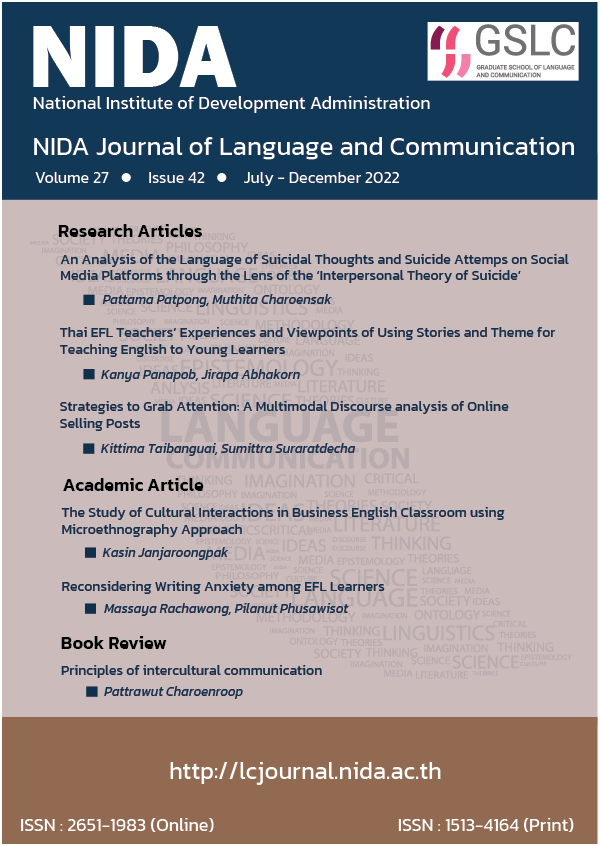
An Analysis of the Language of Suicidal Thoughts and Attempts on Social Media Platforms through the Lens of the ‘Interpersonal Theory of Suicide’
Keywords:
depression, major depressive disorder, suicidal behaviors, Interpersonal Theory of Suicide, social mediaAbstract
Language is an essential means to communicate and express how people think or feel. This study aimed to investigate if suicide-related behaviors can be evidenced by linguistic signs in posts on social media platforms. A total of 490 posts from 17 bloggers who had depressive episodes were analyzed. The analysis was based on Systemic Functional Linguistics (Halliday & Matthiessen, 2004) and the Interpersonal Theory of Suicide (Joiner, 2005) frameworks. According to the results, the presence of language related to perceived burdensomeness, thwarted belongingness, and acquired capability was found. Feelings of hopelessness, worthlessness, and emptiness were also reported in the data. These aspects were stated by bloggers in both explicit and implicit ways and could be identified using some linguistic indicators at word level, group level, and clause level. Three patterns of social media posts were revealed: stressed posting, triggering posting, and problem posting. Increased understanding of the language of suicidal thoughts and suicide attempts is helpful for family and friends as well as medical practitioners in detecting or in dealing with suicidal thoughts and/or behaviors, and in averting the occurrence and/or recurrence of suicide attempts.
References
American Psychological Association. (2021). Suicide. Retrieved 12 December 2021, from https://www.apa.org/topics/suicide
Angkapanichkit, J., Rochanahastin, A., & Intasian, S. (2019). Language, communication, and depression: An cxploration of Communicative practices about depression for sustainable quality of life of Thai adolescents [in Thai]. Thammasat University, Thailand.
Aydin, S., Kocak, O., Shaw, T. A., Buber, B., Akpinar, E. Z., & Younis, M. (2021). Investigation of the effect of social media addition on adults with depression. Healthcare, 9, 1-14.
Barak, A., & Dolev-Cohen, M. (2006). Does activity level in online support groups for distressed adolescents determine emotional relief. Counselling and Psychotherapy Research, 6, 186-190.
Barry, C. T., Sidoti, C. L., Briggs, S. M., Reiter, S. R., & Lindsey, R. A. (2017). Adolescent social media use and mental health from adolescent and parent perspectives. Journal of Adolescence, 61, 1-11.
Bohn, K. (2021). How social media is changing the way people get to know one another. Retrieved 4 November 2021, from https://www.psu.edu/news/research/story/how-social-media-changing-way-people-get-know-one-another/
Brunborg, G. S., & Andreas, J. B. (2019). Increase in time spent on social media is associated with modest increase in depression, conduct problems, and episodic heavy drinking. Journal of Adolescence, 74, 201-209.
Carruthers, H. R., Morris, J., Tarrier, N., & Whorwell, P. J. (2010). The Manchester Color Wheel: Development of a noval way of identifying color choice and its validation in healthy, anxious and depressed individuals. BMC Medical Research Methodology, 10(12), 1-13.
Castle, K., & Kriepe, R. (2007). Suicidal behavior. In C. G. Garfunkel, J. M. Kaczorowski., & C. Christy (Eds.). Pediatric clinical advisor (2nd ed.), (pp. 544-545). https://doi.org/10.1016/B978-032303506-4.10315-3.
Centers for Disease Control and Prevention. (2021). Risk and protective factors. Retrieved 12 December 2021, from https://www.cdc.gov/suicide/factors/index.html
Cero, I., & Sifers, S. (2013). Moderating factors in the path from physical abuse to attempted suicide in adolescents: application of the interpersonal-psychological theory of suicide. Suicide and Life-Threatening Behavior, 43(3), 296-304.
Christensen, H., Batterham, P. J., Soubelet, A., & Mackinnon, A. J. (2013). A test of the Interpersonal Theory of Suicide in a large community-based cohort. Journal of Affective Disorders, 144(3), 225-234.
Daine, K., Hawton, K., Singaravelu, V., Stewart, A., Simkin, S., & Montgomery, P. (2013). The power of the web: A systematic review of studies of the influence of the internet of self-harm and suicide in young people. PLOS ONE, 8(10), 1-6.
Dhir, A., Yossatorn, Y., Kaur, P., & Chen, S. (2018). Online social media fatigue and psychological wellbeing: A study of compulsive use, fear of missing out, fatigue, anxiety and depression. International Journal of Information Management, 40, 141-152.
Edwards, T., &Holtzman, N. S. (2017). A meta-analysis of correlations between depression and first person singular pronoun use. Journal of Research in Personality, 68, 63-68.
Foye, U., Chakkalackal, L., Breedvelt, J., & Elliott, I. (2019). The truth about self-harm for young people and their friends and families. Mental Health Foundation, UK. Retrieved 12 December 2021, from https://www.mentalhealth.org.uk/sites/default/files/Truth%20about%20self%20harm%20WEB%20FINAL.pdf
Frison, E., & Eggermont, S. (2016). Exploring the relationships between different types of Facebook use, perceived online social support, and adolescents’ depressed mood. Social Science Computer Review, 34(2), 153-171.
Halliday, M. A. K., & Matthiessen, C. M. I. M. (2004). An Introduction to Functional Grammar (3rd ed.). Edward Arnold. Hanprathet, N., Manwong, M., Khumsri, J., Yingyeun, R., & Phanasathit, M. (2015). Facebook addiction and its relationship with mental health among Thai high school students. Journal of the Medical Association of Thailand, 98, S81-S90.
Hay, C., & Meldrum, R. (2010). Bullying victimization and adolescent self-harm: Testing hypotheses from general strain theory. Journal of Youth Adolescence, 39, 446-459. Hinduja, S., & Patchin, J. W. (2010). Bullying, cyberbullying, and suicide. Archives of Suicide Research, 14, 206-221.
Hunt, M. G., Marx, R., Lipson, C., & Young, J. (2018). No more FOMO: Limiting social media decreases loneliness and depression. Journal of Social and Clinical Psychology, 37(10), 751-768.
Jarrold, W., Javitz, H. S., Krasnow, R., Peintner, B., Yeh, E., Swan, G. E., & Mehl, M. (2011). Depression and self-focused language in structured interviews with older men. Psychological Reports, 109, 686-700.
Joiner Jr, T. E., Van Orden, K. A., Witte, K. T., Selby, E. A., Ribeiro, J. D., Lewis, R., & Rudd, M. D. (2009). Main predictions of the interpersonal-psychological theory of suicidal behavior: Empirical tests in two samples of young adults. Journal of Abnormal Psychology, 118(3), 634-646.
Joiner, T. (2005). Why do people die by suicide? Harvard University Press. Jones, R., Sharkey, S., Ford, T., Emmens, T., Hewis E., Smithson, J., Sheaves, B., & Owens, C. (2011). Online discussion forums for young people who self-harm: User views. Psychiatrist, 35(10), 364-368.
Kakkar, G. (2020). What are the different types of social media? Engaging Ideas Pvt. Ltd. Retrieved 4 November 2021, from https://www.digitalvidya.com/blog/types-of-social-media/
Karthick, S., & Barwa, S. (2017). A review on theoretical models of suicide. International Journal of Advances in Scientific Research, 3(9), 101-109.
Katsumata, Y., Matsumoto, T., Kitani, M., & Takeshima, T. (2008). Electronic media use and suicidal ideation in Japanese adolescents. Psychiatry and Clinical Neurosciences, 62(6), 744-746.
Kim, K., Ryu, E., Chon, M-Y., Yeun, E-J., Choi, S-Y., Seo, J-S., & Nam, B-W. (2006). Internet addiction in Korean adolescents and its relation to depression and suicidal ideation: A questionnaire survey. International Journal of Nursing Studies, 43(2), 185-192.
King, A. (2018). There were warning signs before Chester Bennington’s suicide, the Linkin Park singer’s widow says. CNN, USA. Retrieved 4 November 2021, from https://edition.cnn.com/2018/06/23/us/talinda-bennington-suicide-town-hall-cnntv/index.html
Koreaboo. (2017). Fans realize Jonghyun had the symbol of depression tattooed on his body. Koreaboo, Korea. Retrieved 4 November 2021, from https://www.koreaboo.com/news/fans-realize-jonghyun-had-the-symbol-of-depression-tattooed-on-his-body/
Lam, L.T., Peng, Z., Mai, J., & Jing, J. (2009). The association between internet addiction and self-injurious behaviour among adolescents. Injury Prevention, 15(6), 403-408.
Lin, I-H., Ko, C-H., Chang, Y-P., Liu, T-L., Wang, P-W., Lin, H-C., Huang, M-F., Yeh, Y-C., Chou, W-J., & Yen, C-F. (2014).The association between suicidality and Internet addiction and activities in Taiwanese adolescents. Comprehensive Psychiatry, 55, 504-510.
Nock, M. K., Hwang, I., Sampson, N., Kessler, R. C., Angermeyer, M., & Beautrais, A. (2009). Cross-national analysis of the associations among mental disorders and suicidal behavior: Findings from the WHO World Mental Health Surveys. PLOS Medicine, 6(8):e1000123, Retrieved 4 December 2021, from https://www.ncbi.nlm.nih.gov/pmc/articles/PMC2717212/
O’ Connor, R., &Nock, M. K. (2014). The psychology of suicidal behavior. Lancet Psychiatry, 1(1). 73-85.
Park, S., Hong, K. E. M., Park, E. J., Ha, K. S., & Yoo, H. J. (2013). The association between problematic internet use and depression, suicidal ideation and bipolar disorder symptoms in Korean adolescents. Australian and New Zealand Journal of Psychiatry, 47(2), 153-159.
Pompili, M., Belvederi Murri, M., Patti, S., Innamorati, M., Lester, D., Girardi, P., & Amore, M. (2016). The communication of suicidal intentions: A meta-analysis. Psychological Medicine, 46(2), 2239-2253.
Radovic, A., Gmelin, T., Stein, B. D., & Miller, E. (2017). Depressed adolescents’ positive and negative use of social media. Journal of Adolescence, 55, 5-15.
Ribeiro, J. D., & Joiner, T. E. (2009). The interpersonal-psychological theory of suicidal behavior: Current status and future directions. Journal of Clinical Psychology, 65(12), 1291-1299.
Rude, S., Gortner, E., & Pennebaker, J. (2004). Language use of depressed and depression-vulnerable college students. Cognition and Emotion, 18, 1121-1133.
Sampasa-Kanyinga, H., & Lewis, R. F. (2015). Frequent use of social networking sites is associated with poor psychological functioning among children and adolescents. Cyberpsychology, Behavior, and Social Networking, 18(7), 380-385.
Selby, E. A., Anestis, M. D., Bender, W. T., Ribeiro, D. J., Nock, M. K., Rudd, M. D., Bryan, C. J., Lim, I. C., Baker, M. T., Gutierrez, P. M., & Joiner Jr., T. E. (2010). Overcoming the fear of lethal injury: Evaluating suicidal behavior in the military through the lens of the interpersonal-psychological theory of suicide. Clinical Psychology Review, 30(3), 298-307.
Sloan, D. M. (2005). It’s all about me: Self-focused attention and depressed mood. Cognitive Therapy and Research, 29, 279-288.
Smith, P. N., & Cukrowicz, K. C. (2010). Capable of suicide: A functional model of the acquired capability component of the interpersonal-psychological theory of suicide. Suicide and Life-Threatening Behavior, 40(3), 266-275.
Smithson, J., Sharkey, S., Hewis, E., Jones, R., Emmens, T., Ford, T., & Owens, C. (2011). Problem presentation and responses on an online forum for young people who self-harm. Discourse Studies, 13(4), 487-501.
Stellrecht, N. E., Gordon, K. H., Van Orden, K., Witte, T. K., Wingate, L. R., Cukrowicz, K. C., Butler, M., Schmidt, N. B., Fitzpatrick, K. K., & Joiner Jr. T. E. (2006). Clinical applications of the interpersonal-psychological theory of attempted and completed suicide. Journal of Clinical Psychology, 62(2), 211-222.
Thompson, G. (2004). Introducing Functional Grammar (2nd ed.). Routledge. University of South Florida. (2021). Introduction to social media. Retrieved 4 November 2021, from https://www.usf.edu/ucm/marketing/intro-social-media.aspx
U.S. Department of Health and Human Services. (2022). Does depression increase the risk for suicide? HHS Headquarters. Retrieved 20 January 2022, from https://www.hhs.gov/answers/mental-health-and-substance-abuse/does-depression-increase-risk-of-suicide/index.html
Van Orden, K. A., & Conwell, Y. (2011). Suicides in late life. Current Psychiatry Reports, 13(3), 234-241.
Van Orden, K. A., Witte, K. T., Cukrowicz, K. C., Braithwaite, S., Selby, E. A., & Joiner Jr, T. E. (2011). The interpersonal theory of suicide. Psychology Review, 117(2), 575-600.
Wang, A. B. (2017). K-pop star’s suicide note reveals pressures of fame, depression that ‘consumed’ him. Washington Post, USA. Retrieved 4 November 2021, from https://www.washingtonpost.com/news/worldviews/wp/2017/ 12/19/k-pop-stars-suicide-note-reveals-depression-that-consumed-him-pressures-of-fame/
Wang, P., Wang, X., Wu, Y., Xie, X., Wang, X., Zhao, F, Ouyang, M., & Lei, L. (2018). Social networking sites addiction and adolescent depression: A moderated mediation model of rumination and self-esteem. Personality and Individual Differences, 127, 162-167.
Wasserman, D., Thanh, H. T. T., Minh, D. P. T., Goldstein, M., Nordenskiöld, A., & Wasserman, C. (2008). Suicidal process, suicidal communication and psychosocial situation of young suicide attempters in a rural Vietnamese community. World Psychiatry, 7(1), 47-53.
Woods, H. C., & Scott, H. (2016). # Sleepyteens: Social media use in adolescence is associated with poor sleep quality, anxiety, depression and low self-esteem. Journal of Adolescence, 51, 41-49.
World Health Organization. (2021). Suicide worldwide in 2019: Global health estimates. World Health Organization: Retrieved 12 December 2021, from https://www.who.int/publications/i/item/9789240026643
Yan, H., Zhang, R., Oniffrey, T. M., Chen, G., Wang, Y., Wu, Y., Zhang, X., Wang, Q., Ma, L., Li, R., & Moore, J. B. (2017). Associations among screen time and unhealthy behaviors, academic performance, and well-being in Chinese adolescents. International Journal of Environmental Research and Public Health, 14, 1-15.
Zimmermann, J., Wolf, M., Bock, A., Peham, D., & Benecke, C. (2013). The way we refer to ourselves reflects how we relate to others: Associations between first-person pronoun use and interpersonal problems. Journal of Research in Personality, 47, 218-225.
Zimmermann, J., Brockmeyer, T., Hunn, M., Schauenburg, H., & Wolf, M. (2017). First-person pronoun use in spoken language as a predicator of future depressive symptoms: Preliminary evidence from a clinical sample of depressed patients. Clinical Psychology and Psychotherapy, 24, 384-391.
Downloads
Published
How to Cite
Issue
Section
License

This work is licensed under a Creative Commons Attribution-NonCommercial-NoDerivatives 4.0 International License.
By submitting a manuscript, the author transfers the copyright for the article to School of Language and Communication, National Institute of Development Administration (NIDA), if and when the manuscript is accepted for publication. Though the journal is an open-access, reproduction of any material published in NIDA Journal of Language and Communication for non-personal and/or commercial purpose requires a written permission from School of Language and Communication, National Institute of Development Administration (NIDA).



