
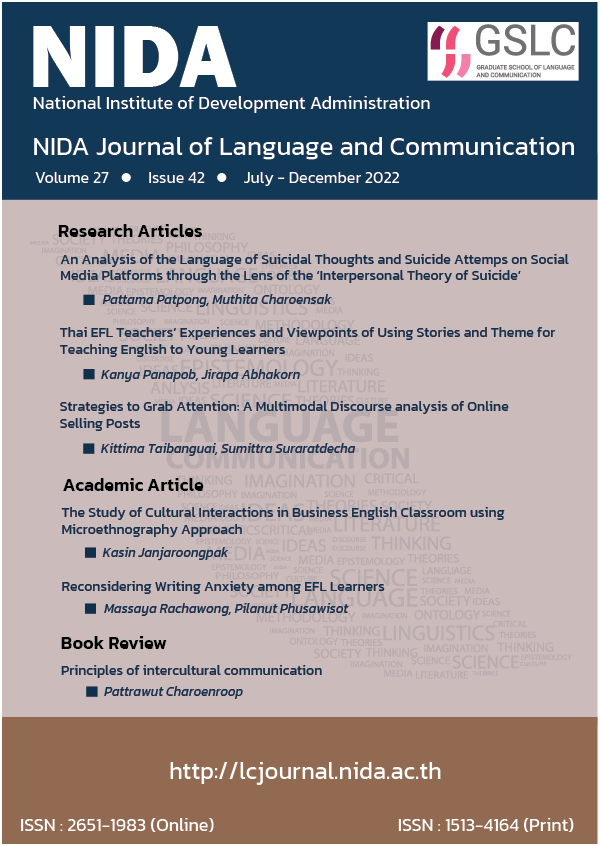
Reconsidering Writing Anxiety among EFL Learners
Keywords:
Writing Anxiety, Writing Performance, EFL LearnersAbstract
Having a level of writing anxiety is normal and often a sign that writers are concerned about writing well. If this type of anxiety motivates the writers to devote thought and effort to their writing, their mindset can have a certain positive value. However, in excessive quantities, writing anxiety can be a hindrance. In the EFL context, being a good writer depends on many factors, including learners’ psychological factors. Writing anxiety is one of the most affective factors which is claimed to affect the learners’ motivation and attitudes towards writing. Many studies have shown that when EFL learners have high levels of writing anxiety, the writing process becomes more complicated. This can lead to a negative effect on their writing performance. Therefore, this article provides an overview of the writing anxiety among EFL learners in terms of its aspects, factors, and effects based on literature and previous studies. There are three main types of writing anxiety: Somatic Anxiety, Cognitive Anxiety, and Avoidance Behavior. Writing Anxiety can be caused from lacking self-confidence, fear of negative evaluation, having a low level of English proficiency, teachers’ giving feedback, and peers’ criticisms. When writing, the learners with a high level of the anxiety perform more poorly than those with a lower level.
References
Abbas, S. H. (2016). Writing apprehension and performance of Iraqi EFL students according to their academic locus of control orientation. International Journal of English Language Teaching, 4(7), 34-48.
Aida, Y. (1994). Examination of Horwitz, Horwitz, and Cope’s construct of foreign language anxiety: The case of students of Japanese. The Modern Language Journal, 78(2), 155-168.
Al Asmari, A. (2013). Investigation of writing strategies, writing apprehension, and writing achievement among Saudi EFL-major students. International Education Studies, 6(11), 130-143.
Al-Sawalha, A. M. S., & Chow, T. V. V. (2012). The effects of writing apprehension in English on the writing process of Jordanian EFL students at Yarmouk University. International Interdisciplinary Journal of Education, 1(1), 6-14.
Aragão, R. (2011). Beliefs and emotions in foreign language learning. System, 39(3), 302-313.
Arindra, M. Y., & Ardi, P. (2020). The correlation between students’ writing anxiety and the use of writing assessment rubrics. LEARN Journal, 13(1), 76-93.
Aripin, N., & Rahmat, N. H. (2021). Writing anxiety and its signs: A qualitative study of a female ESL writer. International Journal of Academic Research in Business and Social Sciences, 11(1), 334-345.
Cheng, Y. S., Horwitz, E. K., & Schallert, D. (1 9 9 9 ) . Language anxiety: Differentiating writing and speaking components. Language Learning, 49(3), 417-446.
Cheng, Y. S. (2004). A measure of second language writing anxiety: Scale development and preliminary validation. Journal of Second Language Writing, 13, 313-335.
Daly, J. A. (1978). Writing apprehension and writing competency. The Journal of Educational Research, 72(1), 10-14.
Daly, J. A., & Miller, M. D. (1975). The empirical development of an instrument to measure writing apprehension. Research in the Teaching of English, 9(3), 242-249.
Daly, J. A., & Wilson, D. A. (1983). Writing apprehension, self-esteem, and personality. Research in the Teaching of English, 17(4), 327-341.
Dörnyei, Z. (2005). The psychology of the language Learner: Individual differences in second language acquisition. Lawrence Erlbaum Associates Publishers.
Erkan, Y. D., & Saban, A. I. (2011). Writing performance relative to writing apprehension, self-efficacy in writing, and attitudes towards writing: A correlational study in Turkish tertiary-level EFL. The Asian EFL Journal Quarterly, 13(1), 163-191.
Fukai, M. (2000). Foreign language anxiety and perspectives of college students of Japanese in the United States: An exploratory study. Japanese Language Education around the Globe, 10, 21-41.
Gardner, R. C., & MacIntyre, P. D. (1993). On the measurement of affective variables in second language learning. Language Learning, 43(2), 157-194.
Golda, T. L. (2015). Exploring reasons for writing anxiety: A survey. The Journal for English Language and Literary Studies, 5(2), 40-44.
Hadaway, N. L. (1 9 8 7 ) . Writing apprehension among second language learners [Unpublished doctoral dissertation]. Texas A & M University, College Station.
Hassan, B. (2001). The relationship of writing apprehension and self-esteem to the writing quality and quantity of EFL university students. Mansoura Faculty of Education Journal, 39, 1-36.
Hassania, S., & Azizah R. (2012). General communication anxiety among EFL students: A case of Iranian students of intensive English programs. Procedia - Social and Behavioral Sciences, 66, 410-418.
Horwitz, E. K., Horwitz, M. B., & Cope, J. (1986). Foreign language classroom anxiety. The Modern Language Journal, 70(2), 125-132.
Hyland, K. (2003). Second language writing. Cambridge University Press.
Jebreil, N., Azizifar, A., Gowhary, H., & Jamalinesari, A. (2015) . A study on writing anxiety among Iranian EFL students. International Journal of Applied Linguistics & English Literature, 4(2), 68-72.
Kabigting, R. P., Gumangan, A. S., Vital, D. P., Villanueva, E. S. V., Mosuela, E. S., Muldong, F. B., & Sagum, M. G. L. (2020). Anxiety and writing ability of Filipino ESL learners. International Journal of Linguistics, Literature and Translation, 3(7), 126-132.
Kara, S. (2013). Writing anxiety: A case study on students’ reasons for anxiety in writing classes. Anadolu Journal of Educational Sciences International, 3(1), 103-111.
Kassim, N. L. A., Daud, N. M., & Daud, N. S. M. (2013). Interaction between writing apprehension, motivation, attitude and writing performance: A structural equation modeling approach. World Applied Sciences Journal, 21, 102-108.
Krashen, S. (1985). The input hypothesis: Issues and implications. Longman.
Kurt, G., & Atay, D. (2007). The effects of peer feedback on the writing anxiety of prospective Turkish teachers of EFL. Journal of Theory and Practice in Education, 3(1), 12-23.
Liu, M., & Ni, H. (2015). Chinese university EFL learners' foreign language writing anxiety: Pattern, effect and causes. English Language Teaching, 8(3), 46-58.
Masriani, E., Mukhaiyar, M., & Wahyuni, D. (2018). Writing anxiety and writing strategies used by English department students of universitas Negeri Padang. Lingua Didaktika: Jurnal Bahasa dan Pembelajaran Bahasa, 12(1), 76-85.
Miri, M. A., & Joia, J. (2018). Writing anxiety in an Afghan EFL setting: Voices from five Afghan students. Journal of Foreign Language Teaching & Learning, 3(1), 14-29.
Parichut, W. (2014). English language writing anxiety among grade 11 Thai students. OJED, 9(1), 657-671.
Rezaei, M., & Jafari, S. M. (2014). Investigating the levels, types and causes of writing anxiety among Iranian EFL students: A mixed method design. Procedia Social and Behavioral Sciences, 98, 1545-1554.
Sabti, A. A., Md Rashid, S., Nimehchisalem, V., & Darmi, R. (2019). The impact of writing anxiety, writing achievement motivation, and writing self-efficacy on writing performance: A correlational study of Iraqi tertiary EFL Learners. SAGE Open, 1-13.
Solangi, A. A., Memon, S., & Lohar, S. A. (2021). Figuring out the levels, types, and sources of writing anxiety among undergrad ESL students in Pakistan. International Journal of Linguistics, Literature and Translation, 4(10), 73-78.
Wahyuni, S., & Khotibul Umam, M. (2017). An analysis on writing anxiety of Indonesian EFL college learners. JEELS, 4(1), 105-128.
Young, D. J. (1991). Creating a low-anxiety classroom environment: What does language anxiety research suggest?. Modern Language Journal, 75(4), 426-437.
Downloads
Published
How to Cite
Issue
Section
License

This work is licensed under a Creative Commons Attribution-NonCommercial-NoDerivatives 4.0 International License.
By submitting a manuscript, the author transfers the copyright for the article to School of Language and Communication, National Institute of Development Administration (NIDA), if and when the manuscript is accepted for publication. Though the journal is an open-access, reproduction of any material published in NIDA Journal of Language and Communication for non-personal and/or commercial purpose requires a written permission from School of Language and Communication, National Institute of Development Administration (NIDA).



