Assessing Contextual Vocabulary Gaps Among Non-English Majors Across Daily, Social, and Professional Domains
Keywords:
contextual vocabulary, EFL learners, vocabulary gaps, non-English majors, formative assessment, domain-specific instructionAbstract
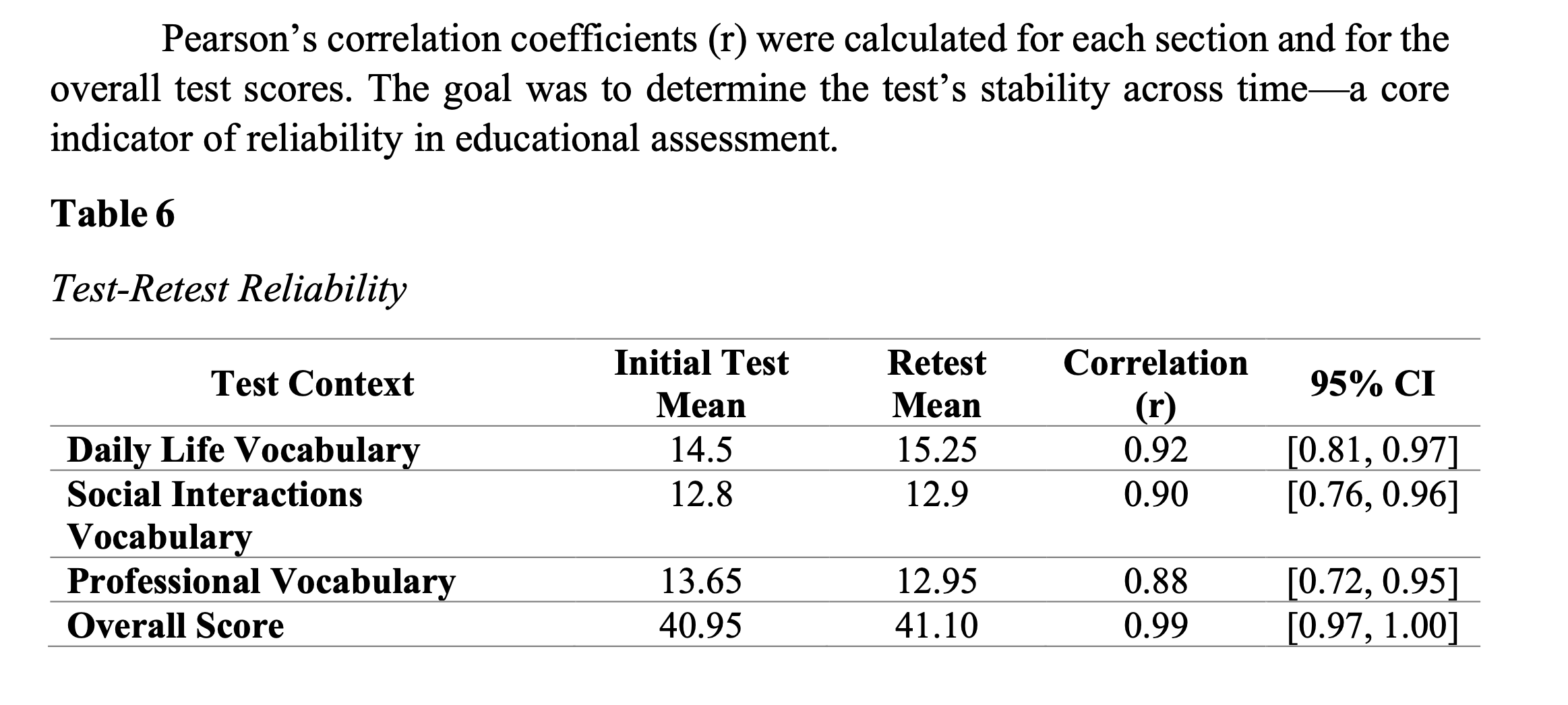
This study investigates the vocabulary proficiency of non-English major university students in an EFL context across three communicative domains: daily life, social interactions, and professional environments. These domains were selected based on their practical relevance to learners’ real-world communication needs. A 90-item multiple-choice test was developed with reference to existing vocabulary frameworks, reviewed by experts, and piloted with 20 students to ensure validity and reliability. The finalized test was administered to 200 students who self-identified their English proficiency levels as basic, intermediate, or advanced. Results indicated that students demonstrated the highest proficiency in daily life vocabulary, followed by professional vocabulary, with the lowest performance in social interactions. Surprisingly, students at the basic proficiency level outperformed their intermediate and advanced counterparts. This unexpected outcome may be attributed to overestimation bias in self-assessment or to task familiarity that favored basic-level learners. Item analysis revealed significant challenges with abstract and pragmatic vocabulary, particularly in social and professional domains. The test showed strong internal consistency (Cronbach’s alpha >.80) and high construct validity through strong correlations with the Vocabulary Levels Test. These findings highlight the need for differentiated vocabulary instruction that reflects learners’ communicative needs, context-sensitive assessment practices, and targeted pedagogical support to address vocabulary development gaps in EFL learners.
References
Bachman, L. F., & Palmer, A. S. (1996). Language testing in practice: Designing and developing useful language tests. Oxford University Press.
Chen, J. C. (2016). EFL learners’ strategy use during task-based interaction in second life. Australasian Journal of Educational Technology, 32(3). https://doi.org/10.14742/ajet.2306
Coxhead, A. (2000). A new academic word list. TESOL Quarterly, 34(2), 213–238. https://doi.org/10.2307/3587951
Coxhead, A. (2013). Vocabulary and ESP. In B. Paltridge & S. Starfield (Eds.), The handbook of English for specific purposes (pp. 115–132). Wiley-Blackwell. https://doi.org/10.1002/9781118339855.ch6
Ebel, R. L., & Frisbie, D. A. (1991). Essentials of educational measurement (5th ed.). Prentice Hall.
Hastini, H., Mertosono, S. R., Wahyudin, W., Eisenring, M. A. A., & Sadilia, S. (2025). Targeted learning with speaking worksheets: Advancing professional communication skills in EFL higher education. Utamax: Journal of Ultimate Research and Trends in Education, 7(1), 12–29.
Kim, H. (2023). Perceptions of L1 and L2 speakers on task difficulty of pragmatic tasks. English Teaching, 78(1), 31–53. https://doi.org/10.15858/engtea.78.1.202303.25
Laufer, B. (2005). Focus on form in second language vocabulary learning. EUROSLA Yearbook, 5, 223–250. https://doi.org/10.1075/eurosla.5.11lau
Laufer, B., & Hulstijn, J. H. (2001). Incidental vocabulary acquisition in a second language: The construct of task-induced involvement. Applied Linguistics, 22(1), 1–26. https://doi.org/10.1093/applin/22.1.1
Li, M., & Wang, T. (2025). Identifying optimal learning strategies: Application of the asymptotic retention rate model in college students’ vocabulary learning. The Asia-Pacific Education Researcher. Advance online publication. https://doi.org/10.1007/s40299-025-00976-0
Meara, P. (2005). Designing vocabulary tests for English, Spanish, and other languages. Language Learning Journal, 31, 23–29. https://doi.org/10.1075/pbns.140.19mea
Milton, J. (2009). Measuring second language vocabulary acquisition (Vol. 45). Multilingual Matters.
Nation, I. S. P. (2001). Learning vocabulary in another language. Cambridge University Press. https://doi.org/10.1017/9781009093873
Nation, I. S. P. (2006). How large a vocabulary is needed for reading and listening? The Canadian Modern Language Review, 63(1), 59–82. https://doi.org/10.3138/cmlr.63.1.59
Oscarson, A. D. (2009). Self-assessment of writing in learning English as a foreign language: A study at the upper secondary school level (Göteborg Studies in Educational Sciences No. 277). University of Gothenburg.
Read, J. (2000). Assessing vocabulary. Cambridge University Press.
Ross, S. (1998). Self-assessment in second language testing: A meta-analysis and analysis of experiential factors. Language Testing, 15(1), 1–20. https://doi.org/10.1177/026553229801500101
Schmitt, N. (2010). Researching vocabulary: A vocabulary research manual. Palgrave Macmillan. https://doi.org/10.1057/9780230293977
Webb, S. (2005). Receptive and productive vocabulary learning: The effects of reading and writing on word knowledge. Studies in Second Language Acquisition, 27(1), 33–52. https://doi.org/10.1017/S0272263105050023
Webb, S., & Nation, I. S. P. (2017). How vocabulary is learned. Oxford University Press.
Young, A., & Son, J. B. (2023). Synchronous computer-mediated communication and task-based learning in the EFL classroom. Language Teaching Research. Advance online publication. https://doi.org/10.1177/13621688231191309
Downloads
Published
How to Cite
Issue
Section
License

This work is licensed under a Creative Commons Attribution-NonCommercial-NoDerivatives 4.0 International License.
By submitting a manuscript, the author transfers the copyright for the article to School of Language and Communication, National Institute of Development Administration (NIDA), if and when the manuscript is accepted for publication. Though the journal is an open-access, reproduction of any material published in NIDA Journal of Language and Communication for non-personal and/or commercial purpose requires a written permission from School of Language and Communication, National Institute of Development Administration (NIDA).



