The Communication Theory of Identity: Investigating Sources, Communication Strategies, and Outcomes of Identity Gaps Management during College Internships
Keywords:
communication theory of identity, identity gaps, communication strategies, communication satisfaction, internshipAbstract
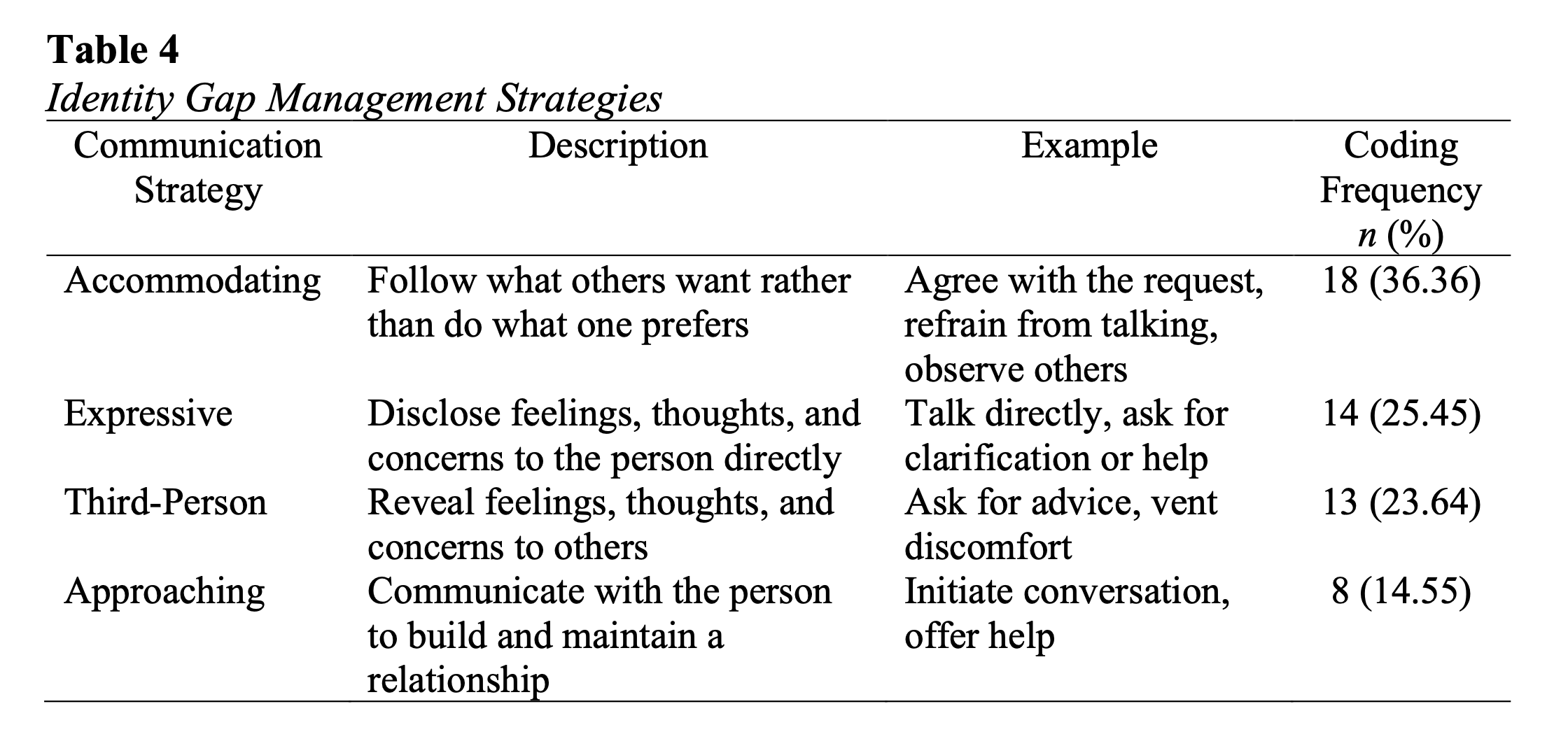
The communication theory of identity (CTI) posits that identity is inseparable from communication and outlines four interrelated identity frames that are influenced through communication: personal, enacted, relational, and communal. When these identity frames contradict one another, identity gaps occur. Although identity gaps appear in various contexts, the literature provides limited insight into how people manage them. College internships represent a setting in which students may experience identity gaps during the transition from university to workplace. This study aims to further explain (1) the sources of identity gaps, (2) how interns respond to these identity gaps, and (3) whether such responses result in positive outcomes. Participants (N = 20) were undergraduates majoring in language and visual arts who completed a 1–3-month internship during their junior or senior year. They were recruited through snowball sampling and participated in 30- to 60-minute interviews. The findings revealed seven sources of identity gaps and four communication strategies to cope with them, leading to both positive and negative outcomes, including communication satisfaction, career interest, and self-exploration. Theoretical and practical implications are suggested for future research.
References
Abrams, J., O’Connor, J., & Giles, H. (2003). Identity and intergroup communication. In W. B. Gudykunst (Ed.), Cross-cultural and intercultural communication (pp. 209–224). Sage Publications.
Amado, S., Snyder, H. R., & Gutchess, A. (2020). Mind the gap: The relation between identity gaps and depression symptoms in cultural adaptation. Frontiers in Psychology, 11, https://doi.org/10.3389/fpsyg.2020.01156
Bergquist, G., Soliz, J., Everhart, K., Braithwaite, D. O., & Kreimer, L. (2019). Investigating layers of identity and identity gaps in refugee resettlement experiences in the midwestern United States. Western Journal of Communication, 83(3), 383–402. https://doi.org/10.1080/10570314.2018.1552009
Chin, D., Phillips, Y., Woo, M. T., Clemans, A., & Yeong, P. K. (2020). Key components that contribute to professional identity development in internships for Singapore’s tertiary institutions: A systematic review. Asian Journal of the Scholarship of Teaching and Learning, 10(1), 89–113. https://ejournals.lib.hkbu.edu.hk/index.php/AJSoTL/article/view/3129/2515)
Collier, M. J. (2005). Theorizing cultural identifications: Critical updates and continuing evolution. In W. B. Gudykunst (Ed.), Theorizing about intercultural communication (pp. 235–256). Sage Publications.
Craig, R. T. (1981). Generalization of Scott's index of intercoder agreement. The Public Opinion Quarterly, 45(2), 260–264. https://doi.org/10.1086/268657
Dailey, S. L., Pierce, C. S., Bailey, D. E., Leonardi, P. M., & Nardi, B. (2023). Being creative within (or outside) the box: Bridging occupational identity gaps. Management Communication Quarterly, 38(1), 86–116. https://doi.org/10.1177/08933189231167385
Dempsey, S., Healy, M., & Linehan, C. (2023). Placement experiences as identity work: Crafting fit with professional possibilities. Studies in Higher Education, 49(8), 1346–1359. https://doi.org/10.1080/03075079.2023.2265404
Downs, C., Mughal, F., Shah, U., & Ryder, M. (2024). Are undergraduate internships worth the effort? Time to reconceptualize work-based learning for building protean meta-competencies. Studies in Higher Education, 49(1), 84–97. https://doi.org/10.1080/03075079.2023.2222147
Frey, L., Botan, C. H., & Kreps, G. L. (2000). Investigating communication: An introduction to research methods (2nd ed.). Allyn & Bacon.
Hecht, M. L., Andersen, P. A., & Ribeau, S. A. (1989). The cultural dimensions of nonverbal communication. In M. K. Asante, & W. B. Gudykunst (Eds.), Handbook of international and intercultural communication (pp. 163–185). Sage Publications.
Hecht, M. L., & Lu, Y. (2014). Communication Theory of Identity. In T. L. Thompson (Ed.), Encyclopedia of health communication (pp. 225–227). Sage Publications. https://doi.org/10.4135/9781483346427.n85
Hecht, M. L., Warren, J. R., Jung, E., & Krieger, J. L. (2005). A communication theory of identity: Development, theoretical perspective, and future directions. In W. B. Gudykunst (Ed.), Theorizing about intercultural communication (pp. 257–278). Sage Publications.
Hou, Y. (2018). Avoiding the gap of college students’ internship expectations and perceptions: A case study in Taiwan. Open Journal of Nursing, 8, 531–551. https://doi.org/10.4236/ojn.2018.88040
Jackson, D., & Bridgstock, R. (2021). What actually works to enhance graduate employability? The relative value of curricular, co-curricular, and extra-curricular learning and paid work. Higher Education, 81, 723–739. https://doi.org/10.1007/s10734-020-00570-x
Jung, E. (2013). Delineation of a threefold relationship among communication input variables, identity gaps, and depressive symptoms. The Southern Communication Journal, 78(2), 163–184. https://doi.org/10.1080/1041794X.2012.741652
Jung, E., & Hecht, M. L. (2004). Elaborating the communication theory of identity: Identity gaps and communication outcomes. Communication Quarterly, 52(3), 265–283. https://doi.org/10.1080/01463370409370197
Jung, E., & Hecht, M. L. (2008). Identity gaps and level of depression among Korean immigrants. Health Communication, 23(4), 313–325. https://doi.org/10.1080/10410230802229688
Kam, J. A., & Hecht, M. L. (2009). Investigating the role of identity gaps among communicative and relational outcomes within the grandparent–grandchild relationship: The young-adult grandchildren’s perspective. Western Journal of Communication, 73(4), 456–480. https://doi.org/10.1080/10570310903279067
Kennedy-Lightsey, C. D., Martin, M. M., LaBelle, S., & Weber, K. (2015). Attachment, identity gaps, and communication and relational outcomes in marital couples’ public performances. Journal of Family Communication, 15(3), 232–248. https://doi.org/10.1080/15267431.2015.1043430
Kuiper, K. (2021). Communication theory of identity: A fifth frame. Annals of the International Communication Association, 45(3), 175–187. https://doi.org/10.1080/23808985.2021.1976069
Kuiper, K. (2023). Bridging the gaps: Advancing the communication theory of identity. Communication Studies, 74(4), 302–321. https://doi.org/10.1080/10510974.2023.2201463
Miscenko, D., & Day, D. V. (2015). Identity and identification at work. Organizational Psychology Review, 6(3), 215–247. https://doi.org/10.1177/2041386615584009
Putnam, L. L., Fairhurst, G. T., & Banghart, S. G. (2016). Contradictions, dialectics, and paradoxes in organizations: A constitutive approach. Academy of Management Annals, 10(1), 65–171. https://doi.org/10.1080/19416520.2016.1162421
Ramsey, M. C., Knight, R. A., & Knight, M. L. (2019). Student identification and communication instruction: An examination of identity gaps as predictors of communication satisfaction and teacher apprehension. Communication Studies, 70(5), 620–632. https://doi.org/10.1080/10510974.2019.1650087
Stewart, C. O., Campbell, J. T., Chase, T., Darbeheshti, M., Goodman, K., Hashemikamangar, S., Cummings, M. H., Ivey, S. S., Russomanno, D. J., & Simon, G. E. (2023). Communicating identity in the urban STEM collaboratory: Toward a communication theory of STEM identities. International Journal of Science Education, Part B, 13(4), 345–361. https://doi.org/10.1080/21548455.2023.2179380
Ting-Toomey, S. (2005). Identity negotiation theory: Crossing cultural boundaries. In W. B. Gudykunst (Ed.), Theorizing about intercultural communication (pp. 211–233). Sage Publications.
Warren, J. R., & Sukumar, A. (2013). Identity-congruent communication in user interface design: The case of medically underserved smokers. Howard Journal of Communications, 24(4), 348–369. https://doi.org/10.1080/10646175.2013.835590
Woo, D. (“DJ”), Putnam, L. L., & Riforgiate, S. E. (2017). Identity work and tensions in organizational internships: A comparative analysis. Western Journal of Communication, 81(5), 560–581. https://doi.org/10.1080/10570314.2017.1312510
Downloads
Published
How to Cite
Issue
Section
License

This work is licensed under a Creative Commons Attribution-NonCommercial-NoDerivatives 4.0 International License.
By submitting a manuscript, the author transfers the copyright for the article to School of Language and Communication, National Institute of Development Administration (NIDA), if and when the manuscript is accepted for publication. Though the journal is an open-access, reproduction of any material published in NIDA Journal of Language and Communication for non-personal and/or commercial purpose requires a written permission from School of Language and Communication, National Institute of Development Administration (NIDA).



