The Effect of The Relationship Between Social Responsibility and Confidence on Corporate Reputation
Keywords:
corporate reputation, social responsibility, confidenceAbstract
In terms of gaining a competetive advantage in a globalized economy, reputation is currently considered to be increasingly significant. Corporate reputation consists of a number of factors including people’s general views, experiences and perceptions and it takes corporations a considerable length of time to build a good reputation, however, a reputation can also be damaged or even destroyed in a very short time. Corporations which are aware of this fact undertake corporate communications practices and develop strategies that create and maintain mutual understanding among shareholders to protect and provide sustainability. The most important strategic asset increasing the success of corporate reputation is foundations. In today’s competitive environment in which corporate communication is planned very carefully, a corporation’s reputation being built upon trust is of vital importance. In the process of building corporate reputation in which different components have different roles, social responsibility has a vital function. Thanks to the social service projects, corporations send the message that their main aim is not to earn money but to share what they gain with their target group and to pay attention to the needs of its target group. In this study, the relationship between social responsibility and confidence will be analysed and, from the aspect of corporate reputation, the relationship of social responsibility and confidence will be emphasized in terms of their contribution to corporate reputation.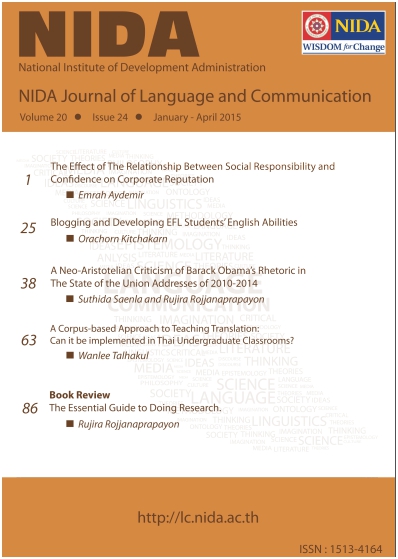
Downloads
How to Cite
Aydemir, E. (2016). The Effect of The Relationship Between Social Responsibility and Confidence on Corporate Reputation. NIDA Journal of Language and Communication, 20(24), 1–24. retrieved from https://so04.tci-thaijo.org/index.php/NJLC/article/view/46970
Issue
Section
Research Article
License
By submitting a manuscript, the author transfers the copyright for the article to School of Language and Communication, National Institute of Development Administration (NIDA), if and when the manuscript is accepted for publication. Though the journal is an open-access, reproduction of any material published in NIDA Journal of Language and Communication for non-personal and/or commercial purpose requires a written permission from School of Language and Communication, National Institute of Development Administration (NIDA).



