
Phraya Kraek’s Bathing And Dressing Dance: The Text And Choreography In The Early Period Of Lakhon Pantang
Article Sidebar
Main Article Content
Abstract
Background and objective (s): The story of Phraya Kraek is a legend in the Thai Northern Chronicles. Telling stories from the Ayutthaya period, Phra Wichian Pricha (Noi) compiled stories from the Thai Northern Chronicles and HRH Prince Narathip Praphanphong wrote them into plays for Thai dance. In the play Phraya Kraek, there are the Phraya Kraek bathing and dressing dances, which shows a set of important Thai dance steps that are not widely seen. The research for this article studied the text and choreography for Phraya Kraek's bathing and dressing dances and the writings of HRH Prince Narathip Praphanphong.
Methodology: The methodology used was a study of the text for Phraya Kraek's bathing and dressing dance from the writings of HRH Prince Narathip Praphanphong including history from textbooks, documents and related research material. Also, a broadcast of the Phraya Kraek bathing and dressing dances received from Associate Professor Dr. Supachai Chansuwan, a national artist, was reviewed as well as interviews with literary experts, Thai dance experts and Thai music experts. The research tools were interviews, with data collected from textbooks, documents and related research materials and interviews with experts. These sources were analyzed to display the nature of the text and choreography of Lakhon Panthang of HRH Prince Narathip Praphanphong in the first period of production of his work.
Main result: Phraya Kraek's bathing and dressing dances are an episode in the drama "Phraya Kraek" of HRH Prince Narathip Praphanphong, who took stories from the Thai Northern Chronicles and wrote them into plays for Thai dance in 1909. The playwright's initial dramas were categorized as "Lakhon Phongsawadan" due to their storylines drawn from Thai chronicles. However, as the plays incorporated chronicles from other groups of people, such as Chinese and Mon, the designation shifted to "Lakhon Panthang". In this play, there are the Phraya Kraek bathing and dressing dances. The bathing and dressing dance sequences comprise distinct elements: bathing, applying perfume and dressing. The choreography comprises a main, extension, conjunction and the additional dance steps.
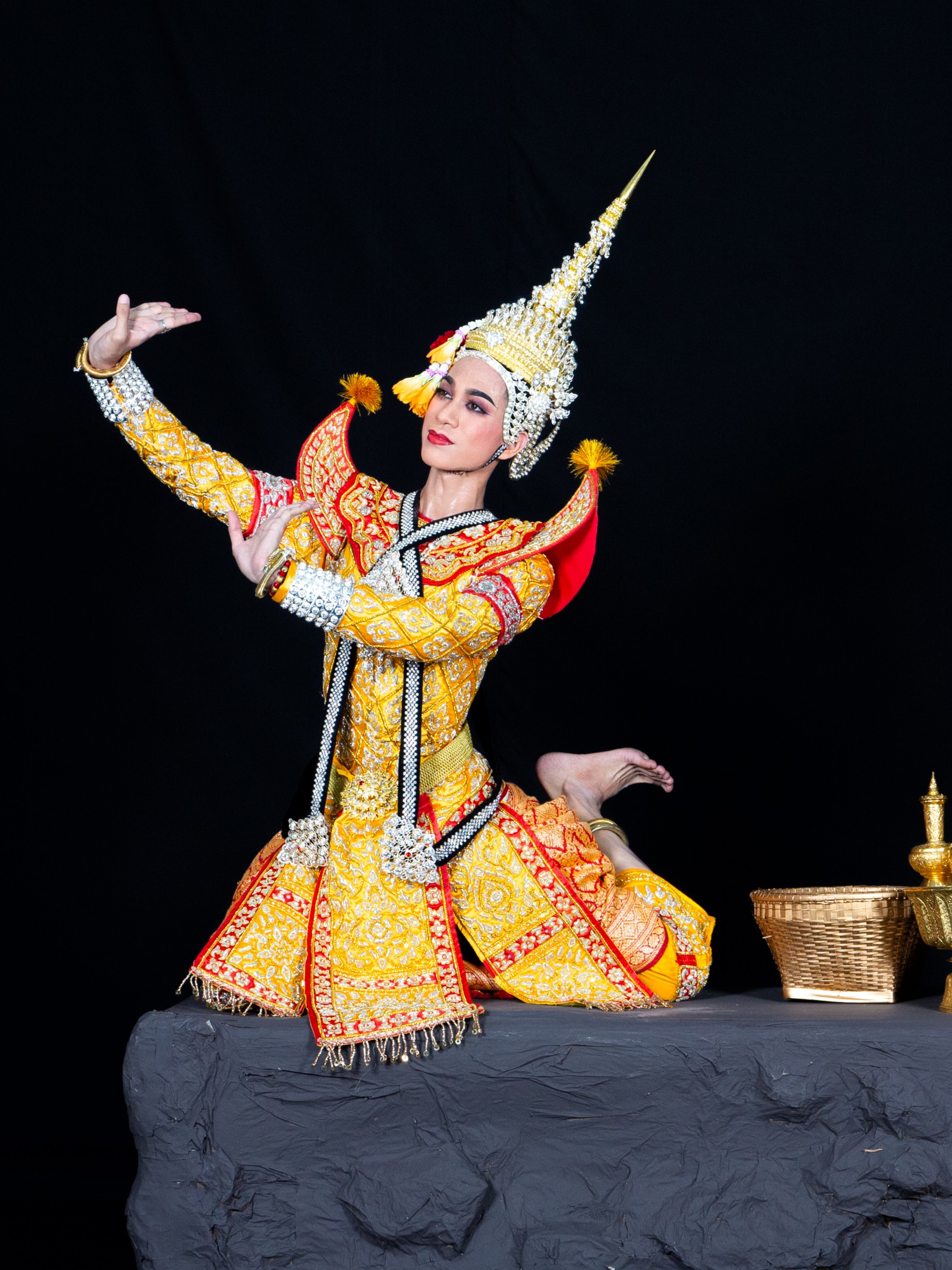
Performers wear traditional attire known as "Yuen Khrueang."
Relevance to Thai Studies: This research studied the text and choreography for Phraya Kraek's bathing and dressing dance, a story taken from the Thai Northern Chronicles and transformed into the text of a Thai dance drama. The text shows the essential characteristics of the legend in its performance form. Dance drama is a traditional Thai performance art. Both text and choreography is a literary and dramatic art that has continued in the Thai way until the present.
Conclusion: The choreography for Phraya Kraek's bathing and dressing dances align seamlessly with the text and reflects the nature of "Lakhon Phongsawadan," the initial phase of "Lakhon Panthang," while seamlessly blending elements from various drama styles. However, the emphasis remains on preserving the exquisite characteristics inherent to Thai royal drama.
Downloads
Article Details

This work is licensed under a Creative Commons Attribution-NonCommercial-NoDerivatives 4.0 International License.
Journal of Thai studies is licensed under a Creative Commons Attribution-Noncommercial-NoDerivatives4.0 Intenational (CC BY-NC-ND 4.0) licence, unless otherwise stated. Plese read our Policies page for more information on Open Access, copyright and permissions.
References
Bidyalongkon, HRH Prince. (1931). Samnao Phraratchahatthalekha Phrabatsomdet Phra Chunlachomklao Chaoyuhua Thi mi Phraratchathan Krom Phra Narathippraphanphong [Writings from King Rama IV to HRH Prince Narathippraphanphong]. Bangkok: Sophon phiphat thanakon Publishing.
Boonyachai, P. (2000). Lakhon Wang Suan Kulab [The Dance Drama of Suan Kulab Palace]. Bangkok: The Department of Fine Arts.
Damrong Rachanuphab, HRH Prince. (1963). Tamnan Rueang I nao. [History of Inao]. Bangkok: Phrachan Publishing.
Duangklaithin, S. (2007). Performance and Singing Methods for Laong Saong. [Master’s Thesis, Chulalongkorn University]. https://cuir.car.chula.ac.th/handle/123456789/13100
Editorial team of Art and Culture Magazine. (2023, August 25). Nong Sano chut phop sang thaksinawat phuenthi samkhan yuk kamnoet Krung Sri Ayutthaya. [Nong Sano Where the Auspicious Conch Was Founded, The Important Beginning Area of Ayuthaya]. Art and Culture Magazine. https://www.silpa-mag.com/history/article_115781.
Fine Arts Department. (1958). Phraratphongsawadan Nuea [Thai Northern Chronicles]. N.P.: n.p..
Fine Arts Department. (2018). Rueang Krungkao. [Story of the old city]. Bangkok: Rueankaeo printing.
Khongthawon, K. (2015). Choreography Long song thon Suranagong: Royal Conservative dance Traditions. Research and Development Journal Suan Sunandha Rajabhat University, 7(3), 32 – 42. https://so05.tci-thaijo.org/index.php/irdssru/article/view/214433
Narathippraphanpong – Worawan Foundation. (1979). Phra Prawat Lae Phonngan Khong Phrachao Borom Wong Thoe Krom Phra Narathippraphanphong [Biography and Work of Prince Narathippraphanphong]. Bangkok: Saha Pracha Phanit Publishing.
Prasert Aksorn. (1909). Bot Lakhon Phongsawadan Nuea Rueang Phraya Kraek [Drama Text of Thai Northern Chronicles: Phraya Kraek]. Bangkok: Sapphakit Publishing.
Royal Institute. (2013). Photchananukrom Chabap Ratchabandittayasathan BE 2556 [Dictionary of the Royal Institute, 2013 Edition]. Bangkok: Royal Institute.
Rueangsin, C. (2002). Prawattisat Thai Samai Phoso 2352 – 2453: Dan Sangkhom. [History of Thailand from 1809 to 1950 : A Social Perspective. Bangkok: Sinlapabannakhan.
Saisunee, K. (2020). The Dance technique and choreography for the bathing and dressing dances of the male protagonists in the story of the drama Ngo pa. [Master’s Thesis, Bunditpatanasilapa Institute of Fine Arts]. https://apcbpi.com/km_detail.php?id=3760
Sooksom, V. (2002). Long Song Tone: Dance Patterns in Lakhon nai - Inao. [Master’s Thesis, Chulalongkorn University]. https://cuir.car.chula.ac.th/handle/123456789/5138
Thummapussana, R. (2001). A Study of Bot Lahorn Ram by Prince Narathippraphanphong as Performing Literature. [Master’s Thesis, Chulalongkorn University]. https://cuir.car.chula.ac.th/handle/123456789/65942
Vingvorn, S. (2012). Wannakhadi Kan Sadaeng [Literature of Performing Art]. Bangkok: Sakdi Sopha printing.
Virunrak, S. (2010). Nattayasin Ratchakan Thi 5 [Thai Classical Dance in the Reign of King Rama V]. Bangkok: Otep. Publishing Lat Phrao.
Wongthet, S. (2017, February 27). “Phraya Kraek” sanyalak phut-Therawat khatyaeng Phram lae Mahayan. [“Phraya Kraek” a symbol of Theravada Buddhism, conflicts with Brahmanism and Mahayana.]. matichonweekly. https://www.matichonweekly.com/culture/article_26245
