
The role of Dhammaduta Bhikkhus in the interaction with Thai cultural diplomacy toward India
Article Sidebar
Main Article Content
Abstract
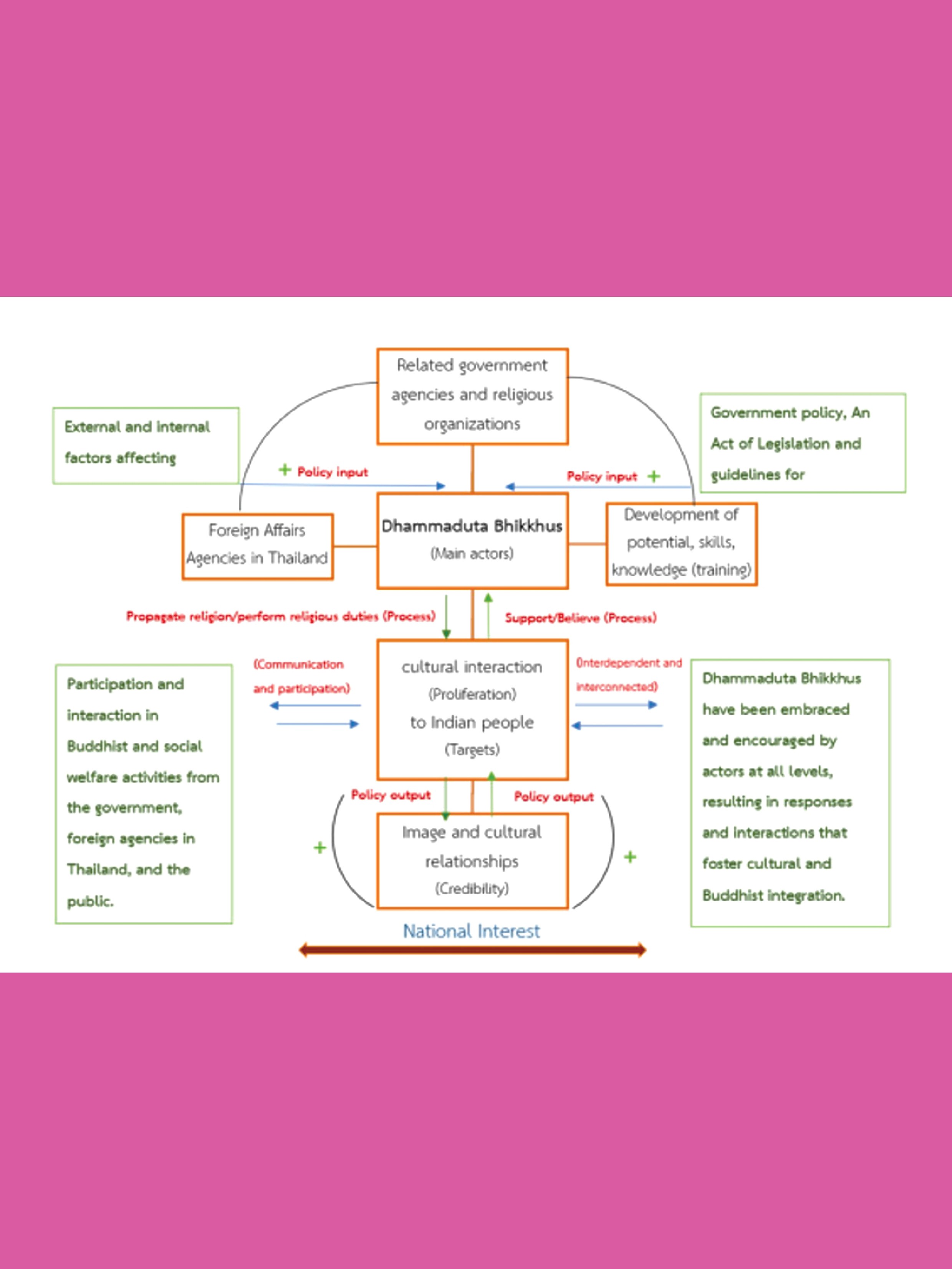
Background and objective (s): Thai cultural diplomacy is a key aspect in creating ties that allow social actors at all levels to interact, as well as a tool for developing friendly contacts so that the public can creatively engage with Thai culture. Thai Dhammaduta Bhikkhus in India have played a significant role in promoting cultural diplomacy by utilizing Buddhism as an opportunity to make religious advocacy and social services more accessible to the Indian people. Although Thailand and India have different cultural backgrounds and languages, Dhammaduta Bhikkhus have expanded collaboration between Thailand and India to the extent that the local Indian population understands the Thai Dhammaduta Bhikkhus' purpose to promote Buddhism, while also increasing the quality of life. Furthermore, India is a significant case study for Dhammaduta Bhikkhus' religious activities, which have tangible benefits and are always evolving to better serve Buddhists and the Indian people. The purpose of this study was to explore the function of Dhammaduta Bhikkhus and their interactions in cultural diplomacy, utilizing the cultural diplomacy framework, as well as describe the function of missionaries in spreading Buddhism and fulfilling religious responsibilities overseas, which might lead to engagement with Indians.
Methodology: The me thodology used was document -ba sed research on Thai Dhammaduta Bhikkhus' roles in India. This included gathering data from in-depth interviews on Buddhism and the role of Thai monk missionaries. All information was evaluated within the framework of cultural diplomacy to understand Thai cultural diplomatic relations with India, in which Dhammaduta Bhikkhus play a significant role.
Main result: Dhammaduta Bhikkhus, together with other actors in Buddhist and social welfare activities, play an important role in developing interaction with Indian people. This facilitates cultural diplomacy, can help to improve social interactions and has increased Thai Dhammaduta Bhikkhus' awareness and faith, allowing them to play an essential role in spreading culture and Buddhism in India. Through such cultural diplomatic interaction, the Indian people are cognizant of and have access to Thai culture, which results in collaboration and the advancement of Buddhist and cultural missions between Thailand and India.
Relevance to Thai Studies: This study identified cultural diplomacy and analyzed the role of Dhammaduta Bhikkhus in driving Thai Theravada Buddhism, as well as the history of driving Buddhism abroad and the dissemination of Thai culture, which serve as an illustration of creative interaction with India. Cultural diplomacy is thus a key approach to enhancing images and mutual understanding to foster cordial interactions, as well as serving as a framework for future research into Thai cultural diplomacy in the context of Buddhism, which may be merged with Thailand's international relations and foreign affairs.
Conclusion: Dhammaduta Bhikkhus play a role in India not only to enhance religious activities and Buddhism, but their role is also important to foster culture sustainably through social interaction by engaging in Buddhist and social service endeavors that are acceptable to Buddhists, the government and the Indian people. As a result, Dhammaduta Bhikkhus have emerged as important actors in cultural diplomacy, capable of fostering creative and amicable relationships, as well as creating a positive image of Thai culture in India.
Downloads
Article Details

This work is licensed under a Creative Commons Attribution-NonCommercial-NoDerivatives 4.0 International License.
Journal of Thai studies is licensed under a Creative Commons Attribution-Noncommercial-NoDerivatives4.0 Intenational (CC BY-NC-ND 4.0) licence, unless otherwise stated. Plese read our Policies page for more information on Open Access, copyright and permissions.
References
Happiness Explorer. (2017, 26 August). Dhammayatra: Walking with Dhamma. https://www.happinessisthailand.com/2017/08/26/dhammayatra/
Jamnil, S. (2013). Development of a Model of and Strategies for Propagating Buddhism of Buddhist Universities in Thailand. [Doctoral dissertation, Chulalongkorn University]. https://cuir.car.chula.ac.th/handle/123456789/43620
Mahaveeriyo, P. (2005). A study of the propagation of Buddhism by Phra Rajarattana Rangsi (Weerayut Wirayuttho) as a regular Thai missionary ambassador in India. [Master’s thesis, Mahachulalongkornrajavidyalaya University]. https://e-thesis.mcu.ac.th/thesis/2669
Nanadhiro, S. (2018). Proactive propagation model of Buddhism by Dhammaduta monks, India-Nepal line according to the principles of Buddhist psychology [Doctoral dissertation, Mahachulalongkornrajavidyalaya University] https://e-thesis.mcu.ac.th/thesis/571
New service division all India radio. (2023). Thailand Buddhist monk's 32-day ‘Dhamma Padh Yatra’ culminates in Ladakh. https://newsonair.gov.in/News?title=Thailand-Buddhistmonk%26%2339%3Bs-32-day-%E2%80%98Dhamma-PadhYatra%E2%80%99=culminatesin-Ladakh&id=464400
Pandit, S. and Basu, R. (2012). Cultural Diplomacy in South-East-Asia: India’s Look East Policy": Buddhism as an Instrument of Foreign Policy. LAP LAMBERT Academic Publishing.
Pannavajiro, S., Ariyavamso,C. and Piyasilo,S. (2021). The role and duties of missionary monks from the past to the present. Saengkhomkham Bundit Journal, 6(1). 116-131. https://so02.tci-thaijo.org/index.php/jsbs/article/view/243907
Phra Rahu Foundation. (2018). Group ordination project following the footsteps of the Lord Buddha to the land of Buddha. Pilgrimage to 4 places of worship, 4 sub-districts, 2nd generation, at Wat Thai Bodh Gaya. India!. https://rahufoundation2006.readyplanet.site/17505990/25611008%E0%
B8%AD%E0%B8%B8%E0%B8%9B%E0%B8%AA%E0%B8%1%E0%B8%9
A%E0%B8%97%E0%B8%AB%E0%B8%A1%E0%B8%B9%E0%B9%88
Post Today. (2017, 29 January). Wat Thai Bodh Gaya, opening of the International Vipassana Hall. https://www.posttoday.com/lifestyle/478241
Pothisook, B. Jaisit, S. Wasanchai, S. Wichai. (2018). Management of monastic affairs of Thai temples in India. Ganesha Journal, 13(2). 113-129. https://so01.tci-thaijo.org/index.php/pikanasan/article/view/107584
Sumeto, B. (2009). Study and analysis of the main strategies for propagating Buddhism of Thai missionaries in India. (Research report). Faculty of Buddhism Mahachulalongkorn rajavidyalaya, Phra Nakhon Si Ayutthaya, Thailand.
Thairath Online. (2020, 3 October). Help 32 Thai temples in India fight COVID-19. Maha Kuson offering robes to Buddhist priests at the monastery “Suvarnabhumi to Buddhabhumi.” https://www.thairath.co.th/news/foreign/1943591
Thairath Online. (2021, 19 September). The abbot of Thai Bodh Gaya Temple, India, distributes rice to Indian workers. https://www.thairath.co.th/news/foreign/2196640
Thairath Online. (2024, 21 January). The Buddhist monks at Thai temples in India organized Children's Day, giving away toys, many children paid attention. https://www.thairath.co.th/news/foreign/2756769
The Buddha. (2023). The most magnificent opening ceremony!! 18th International Recitation of the Tripitaka. https://thebuddh.com/?p=75785
The Sangha Supreme Council of Thailand. (2002). Resolution of Maha Sangha Samakhom No. 33/2002, Resolution No. 546/2002, Topic: report on religious practices of Thai Bodhgaya Temple, India. https://www.mahathera.org/index.php?url=mati&id=528
The Sangha Supreme Council of Thailand. (2012). Resolution of Maha Sangha Samakhom No. 22/2012, Resolution No. 520/2012, Topic: report on religious practices of Wat Thai Nalanda, India, 2012. https://www.mahathera.org/index.php?url=matireport&id=85
The Royal Thai Monastery Kushinara. (2023). Royal Kathin Ceremony Thai Kusinara Chalermrat Temple Republic of India. https://www.watthaikusinara.org/17362794/%E0%B8%9B%E0%B8%A3%E0%B8%B0%E0%B8%
A1%E0%B8%A7%E0%B8%A5%E0%B8%A0%E0%B8%B2%E0%B8%9E%E0%B8%81%E0%
B8%B4%E0%B8%88%E0%B8%81%E0%B8%A3%E0B8%A3%E0%B8%A1
The Wire. (2023, 24 April). At Global Buddhist Summit, Modi Under Spotlight. https://thewire.in/government/at-global-buddhist-summit-modi-under-spotlight
Yanothaikhajit, T. (2023). Cross-cultural learning model of Thai-Indian Buddhist organization. MCU Journal of Social Development, 8(2). 171-189. https://so06.tci-thaijo.org/index.php/JMSD/article/view/266759
