
Khmer Pad Baky Metre and Its Modification from Thai Klon Metre
Article Sidebar
Main Article Content
Abstract
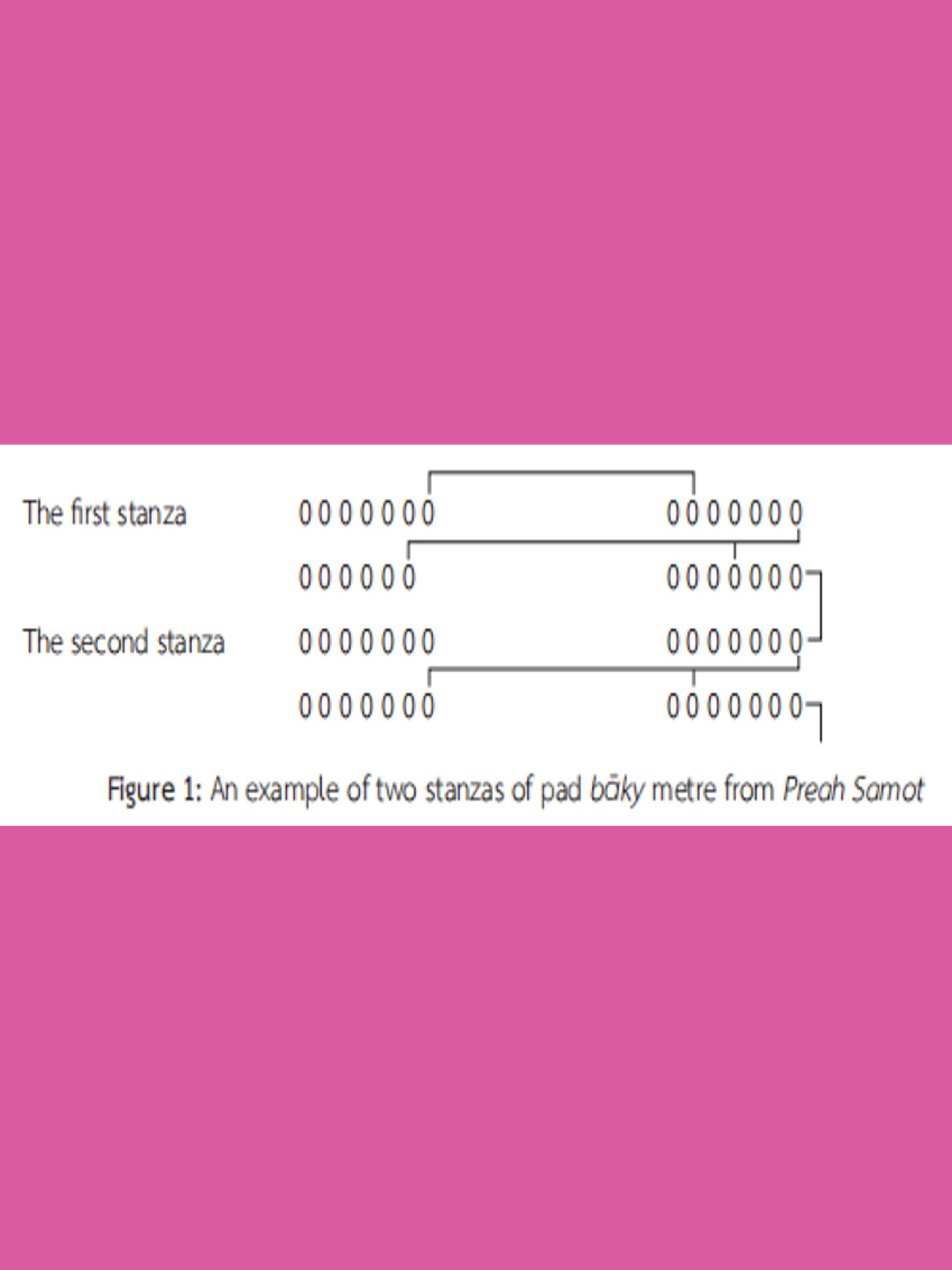
Background and objective (s): Khmer pad bāky metre shares some similarities in terms of versification with Thai klon metre, which has made some scholars propose that pad bāky metre had its origin from Thai klon metre. Nevertheless, the versification of pad bāky metre displays many different aspects from those of Thai klon metre, which indicates that pad bāky metre underwent its own modifications. The research for this article, therefore, aimed to study the modifications in Khmer pad bāky versification from Thai klon metre and to analyze the factors responsible for these modifications.
Methodology: Using Göran Hermerén’s concept on the influence in art and literature as the framework, this study employed comparative study methodology in order to point out the similarities and differences between the versifications of pad bāky metre and Thai klon metre.
Main result: The modifications of pad bāky versification occur in three aspects: the rhyme, the creation of melodious sound and the rhythm. These three aspects of modification result from two main factors: Khmer literary conventions and the different nature of the Khmer language from the Thai language.
Relevance to Thai Studies: This study demonstrates the influence of Thai literature on the literature of neighboring countries.
Conclusion: A study of the modifications of pad bāky metre indicates that pad bāky metre has been modified according to Khmer literary convention and the nature of the Khmer language. The relationship between Thai klon metre and pad bāky metre was, therefore, an influence following Hermerén’s concept, Thai poets and literary works being the donor and Khmer poets and literary works being the recipient. The result of the study additionally show that the recipient of influence has played an important role in the “choosing-modifying” process instead of just as a “receiver.”
Downloads
Article Details

This work is licensed under a Creative Commons Attribution-NonCommercial-NoDerivatives 4.0 International License.
Journal of Thai studies is licensed under a Creative Commons Attribution-Noncommercial-NoDerivatives4.0 Intenational (CC BY-NC-ND 4.0) licence, unless otherwise stated. Plese read our Policies page for more information on Open Access, copyright and permissions.
References
Boonyarith, O. (2019). Rabop siang lae waiyakon phasa thai lae phasa khamen [Sound System and Grammar of Thai and Khmer Languages]. Bangkok: Department of Oriental Languages, Faculty of Archeology, Silpakorn University.
Bunkhloi, S. (2015). Wannakam khamen [Khmer Literary Works]. Bangkok: The Fine Arts Department.
Chea, K. (2003). Kamrong kamnap amata [A Compilation of Timeless Poems]. N.P.: n.p.
Chitchamnong, D. (1991). The literary values and characteristics of early Ratanakosin literature. [Doctoral dissertation, Chulalongkorn University]. https://cuir.car.chula.ac.th/handle/123456789/31939
Chumnum Tamra Klon Chabap Ho Phra Samut Wachirayan [A Compilation of Versification Technical Books Vajirayan Edition]. (1976). Phra Nakorn: Khurusapha Business Organization.
Damrong Rajanubhab, H.R.H. Prince. (2018). Chiwit lae ngan khong sunthon phu [Life and Works of Sunthon Phu]. Bangkok: Thaiqualitybooks.
Dhanachai, K. (2004). Prosody in modern Thai poetry: continuity, creation, and relation to literary aesthetics. [Master thesis, Chulalongkorn University]. https://cuir.car.chula.ac.th/handle/123456789/2704
Heng, Y. (1946). Kampul Sneha [The Best of Love]. Kambujasuriya, 18(7), p.337-349.
Hermerén, G. (1975). Influence in Art and Literature. Princeton and London: Princeton University Press.
Huffman, F. E. (1977). Cambodian Literary Reader and Glossary. London, England: Yale University Press.
J. M. (1993). Some features of Khmer versification. In Cambodian Linguistics, Literature and History: Collected Articles. London: School of Oriental and African Studies.
Jacob, J. M. (1996). The Traditional Literature of Cambodia: A Preliminary Guide. London, England: Oxford University Press.
Jenner, P. N. (1976). The Relative Dating of Some Khmer CP Ā’PA*. Oceanic Linguistics Special Publications, 13, 693–710.
Jenner, P.N. (2011). A Dictionary of Middle Khmer. Canberra, Australia: The Australian National University.
Khing, H. D. (2003). Mealibat aksarsel Khmer satavoat ti 19 [Khmer Literature of the 19th Century]. Phnom Penh: Angkor.
Khing, H. D. (2003). Tidthpheap tutov ney aksarsastr Khmer [A Survey of Khmer Literature]. Phnom Penh: Angkor.
Khing, H. D. (2007). Aksarsel Khmer satavoat ti 20 kavinipoan ning kamrong atthabat [Khmer Literature of the 19th Century: Poets and Texts]. Phnom Penh: Angkor.
Kuy, S. (2019). Thvay bangkum preah haeuy khnhom rean taeng kamnap [Pay Homage to the Buddha and then learn to compose poetry]. Phnom Penh: Mao Phon Printing House.
Leang, H. A. (1967). Seksa bravott aksarsastr Khmer samey Nokor Phnom dal samey Oudong (satavot ti 1 dal 1859) [A Study of Khmer Literature from the Nokor Phnom Period to the Oudong Period (1st Century to 1859)]. Phnom Penh: Bannakear Kim-Eng.
Ly, S. (2009). Kamnap Khmer [Khmer Poetry]. Phnom Penh: Ministry of Education, Youth and Sport.
Ly, T. T. (1960). Aksorsah Khmer [Khmer Literature]. Phnom Penh: n.p.
Nacaskul, K. (1973). Elaborated Forms in Thai and Khmer Languages. In Krong phasa lae wannakam: Prachum botkhwam choeng wichakan [Thai language and Literaty Works Academic Articles]. Bangkok: Arts Academic Club of Chulalongkorn University.
Nacaskul, K. (2021). An phasa khamen [Reading Khmer]. (3rd ed.). Bangkok: Faculty of Arts, Chulalongkorn University.
Pakdeekham, S. (2000). Kawi si kamphut thet: khwamriang waduai prawat kawi khamen [Poets of Cambodia: A Prose on Khmer poets’ biography]. Pathumthani: Thammasat Printing House.
Pakdeekham, S. (2007). Khwamsamphan wannakhadi thai – khamen [A Relation of Thai and Khmer Literature]. Bangkok: Association Committee of Thai–Cambodian Culture, Department of Information, Ministry of Foreign Affairs.
Pakdeekham, S. (2014). Sunthon Phu in Khmer Literature. In Sunthon Phu: alak nakleng tham phlengyao [Sunthon Phu: A Poet Who Loves Composing Klon Plengyao] (p.199-223).Raksamani, K. (Ed.). Bangkok: Satapornbooks.
Pakdeekham, S. (2018). Phlengyao konlabot lae konla-akson watphrachetuphon thima khong konlabot kamphucha [Klon Konlabot Metres of Phrachetuphon Temple: The Origin of Khmer Konlabots]. Bangkok: Sahathammik.
Pech, T. (1998). Selpa taeng kamnap [The Art of Composing poem]. N.P.
Phrakhlang (Hon), Chaophraya. (n.d.). Wannakhadi chaophraya phrakhlang (hon) [Chaophraya Prakhlang (Hon)’s Literary Works]. Phra Nakorn: Khlangwitthaya.
Royal Institute. (2013). Photchananukrom chabap ratchabandittayasathan BE 2554 [Dictionary of the Royal Institute, 2011 Edition]. Bangkok: Royal Institute.
Ruengruglikit, C. (2002). Chiwaprawat lae phonngan khong sunthon phu [Sunthon Phu’s Biography and Works]. (2nd ed.). Bangkok: Academic works dissemination project, Faculty of Arts, Chulalongkorn University.
Saengthaksin, Y. (2007). Thai Literature of the Thonburi Period to the Rattanakosin Period within 2394 B.E.. In Ekkasan kan son chut wicha phatthanakan wannakhadi thai [A Teaching Document in the Evolution of Thai Literature] (p.207-3 27). Nonthaburi: Sukhothai Thammathirat Open University.
Sajjaphan, R. (2004). Sat lae sin haeng wannakhadi [Principles and Art of Literature]. Bangkok: Praphansarn.
Sikkhakosol, T. (1983). A Comparative Analysis of Thai Poetry “Klon” and Chinese Poetry “Shih”. [Master thesis, Srinakharinwirot University].
Som, P. (2018). Tum Teav [The Story of Tum and Teav]. Phnom Penh: Bannakear K.B.C.
Sou, K. (2020). Tuek Khmov Lving [Bitter Ink]. Phnom Penh: Khmer Books Edition.
Suttantaprija Ind, Oknha. (1959). Supheasit Cba Srey [A Code of Conduct for Women]. Phnom Penh: Buddhist Institute.
Suttantaprija Ind, Oknha. (1997). Nireah Nokor Vot [A Journey to Angkor]. Phnom Penh: Buddhist Institute.
Thammaphimon, Luang. (2019). Prachum lamnam [A Compilation of Versification]. Nonthaburi: Sripanya.
Thei, C Kimhak. (1928). Kosach [Laziness] In Kambujasuriya (p.750-758). Phnom Penh: Buddhist Institute.
Thoun, H. (2004). Kamrong Kamnap Boran [A Compilation of Old Poems]. N.P.: n.p.
Upakitsilapasan, Phraya. (1998). Lak phasa thai [Fundamentals of Thai Language]. Bangkok: Thai Watana Panich Press.
Vatiktinakorn, P. (2004). Wannakam sunthon phu [Sunthon Phu’s Works]. Bangkok: Ramkamhaeng University.
Vespada, D. (2000). Thai Texts on Poetics: Concept and Relation to Thai Literary Convention. [Doctoral dissertation, Chulalongkorn University]. https://cuir.car.chula.ac.th/handle/123456789/9335
Yim, G. (1982). Yuveavey Meayea [Youth’s Illusion]. Berlin, Germany: N.P.: n.p.
Yuden, W. (1989). Kansueksa rueang klon [A Study of the Klon Metre]. Bangkok: Akson Charoen Tat.
Yung, S. (1969). Reatrei Chaktomukh [Chatumuk at Night] In Kambujasuriya (p.710-715). Phnom Penh: Buddhist Institute.
