
Knowledge Crystallization in Nithan Borankhadi
Article Sidebar
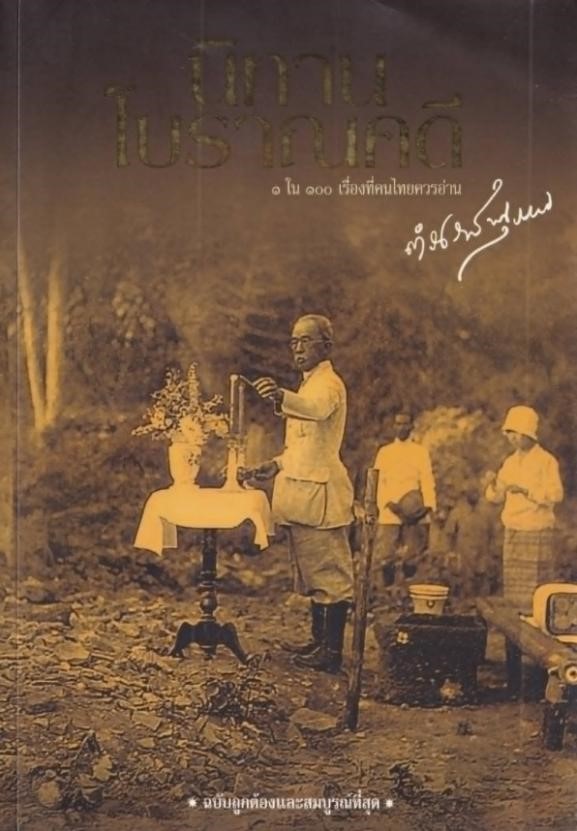
Main Article Content
Abstract
Background and objective (s): This study was inspired by the content of Nithan Borankhadi that was composed by H.R.H. Prince Damrong Rajanubhab, who told many stories by adding knowledge to the topics of history, archaeology and the culture of Thailand. The significance of this work is that it was the author's last work. To further an understanding, the synthesized and collected his own earlier works, refining, expanding and polishing the texts to guarantee accuracy and comprehensiveness. It has been demonstrated that the writings reflected the author's knowledge and crystallization of ideas, which inspired the researcher to examine the essence and knowledge crystallization.
Methodology: A textual analysis procedure was applied using the concept of studying the essence of the content from the text and comparing the content with other texts of the author using the concept of intertextuality in order to present the crystallization of knowledge reflected through the royal writings.
Main result: This study showed that Nithan Borankhadi was made up of facts and narratives. The main contents include Thai history, archaeology, culture and society, which were taken from the original works and improved until they crystallized into knowledge.Furthermore, Nithan Borankhadi was not considered fiction, according to the definition of a “tale”, but is a name given to the storytelling method because it provided insight into Thai studies. The author's expertise was crystallized through Nithan Borankhadi in the following techniques: 1) data analysis and narrative correction; 2) causal significance explanation; 3) data addition, clarity and elaboration; and 4) new storytelling.
Relevance to Thai Studies: Nithan Borankhadi is related to Thai history, archaeology, culture and society. Moreover, the author provided a logical interpretation in addition to the facts. As a result, there is a wealth of information for Thai studies, including Thai history, archaeology, culture and society.
Conclusion: Nithan Borankhadi was the author's final composition prior to his passing. This significant piece of writing encapsulated the author's expertise, which was gathered from a variety of stories for this book. As a result, the study revealed the text’s essential features, significance nature of the Nithan Borankhadi as evidence that Thai studies can be referenced and searched.
Downloads
Article Details

This work is licensed under a Creative Commons Attribution-NonCommercial-NoDerivatives 4.0 International License.
Journal of Thai studies is licensed under a Creative Commons Attribution-Noncommercial-NoDerivatives4.0 Intenational (CC BY-NC-ND 4.0) licence, unless otherwise stated. Plese read our Policies page for more information on Open Access, copyright and permissions.
References
Anambutr, T. (1982). phraniphon banthoengkhadi khong somdet phrachaoborommawongthoe kromphraya damrong ra chanu phap [The Fiction of Prince Damrong Rajanibhab]. The Department of Thai and Oriental Languages, The Faculty of Humanities, Ramkhamhaeng University.
Chulachomklao Royal Military Academy. (2022). khumue kan son oprom wicha prawattisat chatthai [Teaching Manual for Thai National History]. (2nd ed.). Nonthaburi: Wacharin P.P Printing.
Damrong Rajanubhab, H.R.H. Prince. (1920). rueang thiao thi tang tang phak thi 4 thiao monthon udon lae monthon isan [A Variety of Travel Section 4: A Story of Monton Udon and Monton Isan]. Bangkok: Sophonpipatthanakorn Press.
Damrong Rajanubhab, H.R.H. Prince. (1930). pathakatha rueang sa-nguan khong boran [Lecture on Preserving Ancient Things]. Bangkok: Royal Society.
Damrong Rajanubhab, H.R.H. Prince. (1974). khwam song cham [Memoirs]. Bangkok: Khangvittaya.
Damrong Rajanubhab, H.R.H. Prince. (2011). kan sadet truat ratchakan huamueang khong somdet phrachaoborommawongthoe kromphraya damrong ra chanu phap [The Inspection of Civil Servants of Prince Damrong Rajanubhab]. Bangkok: Ministry of Interior.
Damrong Rajanubhab, H.R.H. Prince. (2017). nithan borankhadi [Archaeology tales]. (6th ed.). Bangkok: Ton-or.
Damrong Rajanubhab, H.R.H. Prince. (2021). ekkasan sadet truat ratchakan senabodi krasuang mahatthai phoso 2443-2455 [The Inspection of Ministry of Interior in the Prince Damrong Rajanubhab era during 2443-2445 BE]. Bangkok: The Fine Art Department.
Eamanondh, J. (2011). Intertextuality: A New Perspective on Analytical Language and Discourse. Journal of Language and Linguistics, 29(2), 1-26.
Na Nakorn, C. (2022, August,12). Historiography In the history of Nithi. Way Magazine https://waymagazine.org/ประวัติศาสตร์นิพนธ์ในป-2/.
Phakdeephasook, S. (2010). wathakam nai nittayasan sukkhaphap lae khwam ngam phasa thai [Discourse of femininity in health and beauty magazines in Thai]. Bangkok: Faculty of Arts, Chulalongkorn University.
Phungpracha, E. (2012). “The story of traveling in Phetchabun Province”: Ethnographic description in the writings of His Royal Highness Prince Damrong Rajanubhab. Damrong Journal, 11(Special edition), 129-151.
Sinlarat, P. (2012). lak lae theknik kan son radap udomsueksa [Teaching Principles and techniques for higher education level]. (3rd ed.). Bangkok: Chulalongkorn University Press.
Sritangsuk, P. (2023). naresuan niphon: kanmueang anusawari lae prawattisat rueang taeng [Naresuan-nipon: Politics Monument and the Fictional History]. Bangkok: Matichon.
Tangpongthiti, W. (2001). The travelogues of Prince Damrong Rajanubhab. [Master’s thesis, Chulalongkorn University]. http://cuir.car.chula.ac.th/handle/123456789/2657.
