
Nora Drama Masks: The Integration of Thai Art and Culture from Ramakien
Article Sidebar
Main Article Content
Abstract
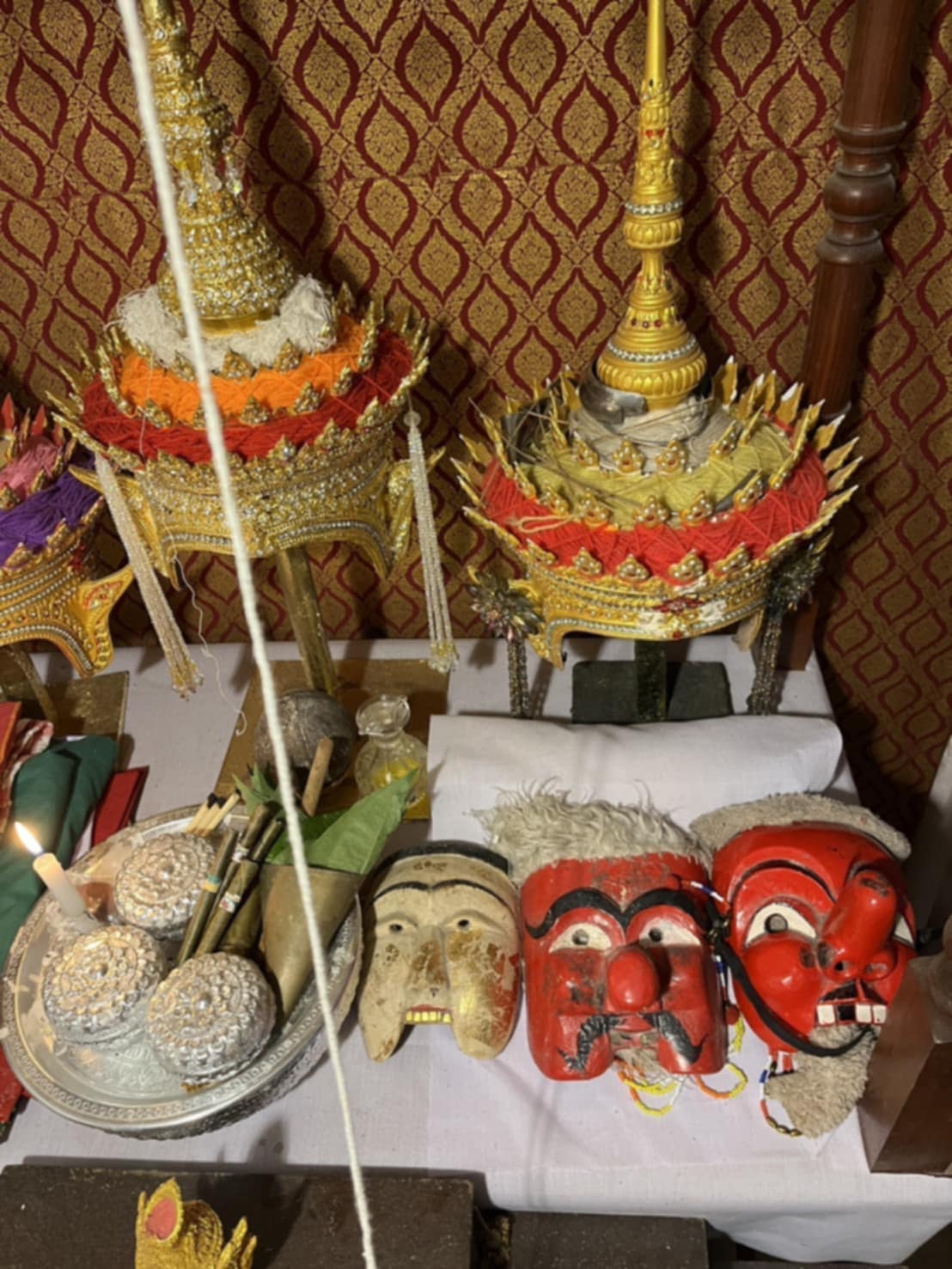
Background and objective (s): Masks have always been associated with Thai culture, as evidenced by their use in traditions and performances throughout all regions of Thailand. For example, the Lanna mask dance in the north, the Khon dance in the central region, the Phi Ta Khon in the northeast, and the Nora dance in the south. Masks in each region differ according to the social context and their uses. Therefore, the researcher has taken the concept of wearing masks in theatrical performances as the main idea, blending the unique characteristics of the Nora performance and elements of the Khon performance, such as the colour coding of characters in Ramakien and the wearing of the Khon headgear. The research for this article aimed to create masks by integrating the unique characteristics of the Khon headgear in the Khon performance and the phran mask in the Nora performance for the Nora play of Ramakien.
Methodology: The researcher employed a creative research methodology by studying various information sources and in-depth interviews with three experts on the performance of Nora. The collected data was then analyzed and synthesized, leading to the creation of masks for Nora’s theatrical performances of Ramakien.
Main result: The study found that masks in Thai art and culture all have established traditions and prohibitions as patterns. For example, the headpieces used in Khon performances have specific characteristics and colours determined by the character's traits. In the Nora performance tradition, human or divine characters wear a headdress, while animal characters do not. This is because Nora artists consider the headdress to be sacred. Additionally, Nora masks for both male and female clowns are worn during the performance, which is something Nora artists hold in high esteem. These masks are shaped like human faces, but have an opening around the mouth to allow the performers to sing and speak. In the past, various forms of Nora masks were used, such as giant and ghost masks for Nora performances that told stories. Therefore, the newly created Nora masks have unique features, including designing the masks to clearly convey the characteristics of the characters in the Ramakien epic following the example of Khon performances, such as Phra Ram, Phra Lak, Thotsakan, and Hanuman. The masks will have an opening around the mouth to allow the performers to sing and speak on their own, similar to the hunter's mask. For royal characters, such as Phra Ram, Phra Lak, and Thotsakan, there will be a headdress on top of the mask with specific patterns, such as the "crown of ordination" or a three-layered giant mask similar to Thotsakan’s headpiece in Ramakien. Animal characters, such as Hanuman and Sukhrip, will have fur attached to the top of their masks and Nora bead decorations at the bottom. This Nora mask is, therefore, a development and extension, while preserving the traditions and uniqueness of Nora and Khon performances.
Relevance to Thai Studies: The Nora masks blend the unique characteristics of Khon and Nora performances, which are valuable and unique Thai art forms. Designing masks that correspond to the characters in Ramakien, a significant Thai literary work, demonstrates the inheritance of traditional wisdom and its adaptation to the flexible performance style of Nora. The creation of these masks promotes learning about Thai art, literature, and cultural traditions. The Nora masks also serve as a medium for preserving and disseminating Thai performing arts in a contemporary context, both in education and in extending knowledge to the international level.
Conclusion: The new "Nora masks" represent a blend of Thai cultural arts from two significant disciplines: Khon and Nora performances. The masks incorporate the unique characteristics of characters from Ramakien and the characteristics of masks of Nora, and transform them into masks for the performance of Nora. These masks reflect a unique beauty and identity. This creation not only helps preserve Thai cultural heritage but also demonstrates the ability to adapt traditional arts and culture to performances in new contexts. This work serves as a significant example of inheriting, creating, and developing Thai cultural arts to ensure their contemporary relevance and sustainable continuation into the future.
Downloads
Article Details

This work is licensed under a Creative Commons Attribution-NonCommercial-NoDerivatives 4.0 International License.
Journal of Thai studies is licensed under a Creative Commons Attribution-Noncommercial-NoDerivatives4.0 Intenational (CC BY-NC-ND 4.0) licence, unless otherwise stated. Plese read our Policies page for more information on Open Access, copyright and permissions.
References
Institute for the Research and Promotion Arts & Culture. (2022, March 11). Ngan pan huakhon hua lakhon [Mask and character head sculpting]. Institute for the Research and Promotion Arts & Culture. https://research.pbru.ac.th/news/156/.
Khongkun, D. (n.d.). Sinlapa sue phasom (mixed media) khue arai? [What is mixed media art?]. Artroom by KruPOR. https://sites.google.com/view/artroomkrupor/หนาแรก/หกตลก/ประตมากรรมสอผสม.
Komarakul Na Nakhon, T. (2020, August 13) Huakhon sinlapa chan sung haeng usakhane [Masks: High Art of Southeast Asia]. culture.go.th. http://article.culture.go.th/index. php/layouts-modules-positions/3-column-layout-3/219-2020-08-13-02-08-13.
Limrattanapan, J. (2020). Nakak: watthu thang watthanatham tua on lae rok rabat [Masks: Cultural Objects, Mules, and Epidemics]. Princess Maha Chakri Sirindhorn Anthropology Centre (Public Organisation). https://www.sac.or.th/portal/th/article/detail/110.
Nagapradipa. (2008). Somya Phi Than Ramakien [Glossary of Names in Ramakien]. (3rd ed.). Bangkok: Siam Publishing.
Noosawas, J. (2019). Masks, Symbols of Ramakien (Super Value Edition). Office of Academic Resources and Information Technology Bansomdejchaopraya Rajabhat University, 18(1), 131-135.
Office of the National Culture Commission. (1980). Khanop niyom nai kan sadaeng nora nai adit [Popular costumes in Nora performances in the past]. Bangkok: Siam Printing.
Sukonthachat, P. (1968). narai sip pang lae phong nai rueang rammakian [The Ten Incarnations of Vishnu and the Lineage in Ramakien]. Bangkok: Prachan Printing House.
The Fine Arts Department. (2004). Sinlapa tham khao sam roi yot [Cave art at Khao Sam Roi Yot]. Bangkok: Samaphan Press Co., LTD.
The Royal Institute of Thailand. (2013). Dictionary of the Royal Institute Edition, 2011, in honor of His Majesty the King. His Majesty the King on the occasion of the auspicious occasion of His Majesty the King's 7th Cycle Birthday Anniversary, 5 December 2011. Bangkok: The Royal Institute of Thailand.
The Sustainable Arts and Crafts Institute of Thailand (Public Organization). (n.d.). huakhon thot kan si khiao [Green Thotsakan mask]. SACIT. https://archive.sacit.or.th handicraft/2289.
