
Local Wisdom in the Suburban World:Reframing Cultural Heritage through Knowledge-Power Relations and the Community Learning Process in Plai Bang, Thailand
Article Sidebar
Main Article Content
Abstract
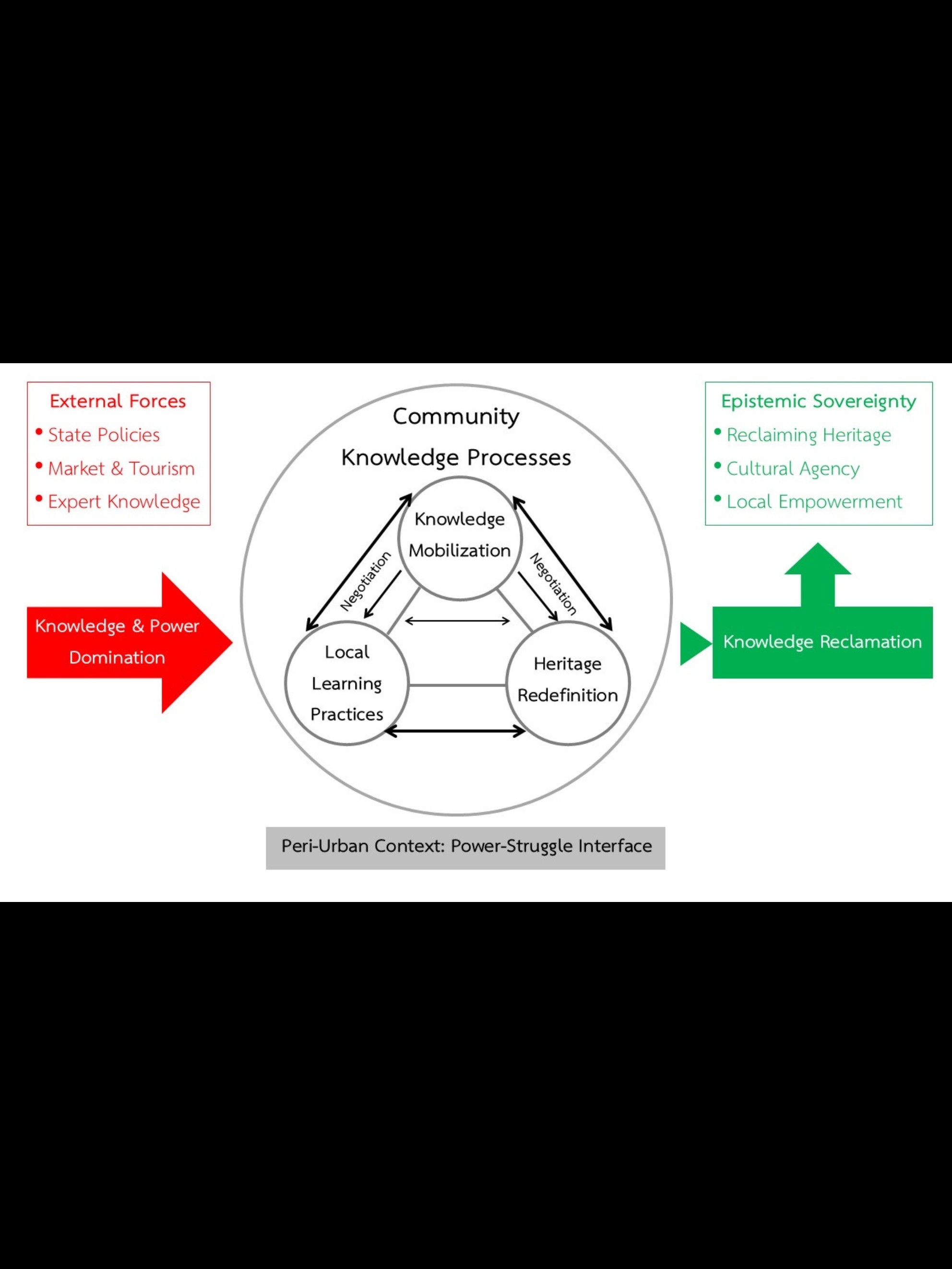
Background and objective (s): Studies of cultural heritage and local wisdom in Thailand have largely conceptualized heritage as a static object defined through state-led development frameworks and expert-driven knowledge systems. Such approaches prioritize external standards of value, while positioning local communities as passive recipients of interpretation. Under rapid urban expansion, peri-urban areas have become critical interface zones where competing knowledge regimes and power relations intersect. Existing studies have paid limited attention to the epistemological processes through which communities actively negotiate, legitimize and reclaim authority over cultural meanings. Addressing this gap, this present study aimed to 1) analyze the dynamics of knowledge-power relations in defining cultural heritage in a peri-urban context; 2) examine the Community Learning Process (CLP) as an epistemological mechanism mediating these relations; and 3) assess the CLP’s theoretical contribution to epistemological sovereignty in contemporary Thai society.
Methodology: This qualitative study adopted a non-participatory action research framework combined with an in-depth case study approach. Fieldwork was conducted in Plai Bang Subdistrict, Nonthaburi Province, a peri-urban agricultural community undergoing intensive urban transition driven by infrastructural development, land-use change and metropolitan expansion. The site was selected for its analytical value as a space where state, market, expert and community-based knowledge regimes intersect. Data was collected through semi-structured interviews with seven key informants involved in community learning and cultural practices, non-participant observation of everyday cultural activities, and document analysis of local records, development plans and community-produced materials. Data analysis employed thematic analysis and critical interpretation informed by perspectives on knowledge-power relations and practice-based knowledge, enabling an examination of how knowledge is produced, authorized and mobilized within everyday practices.
Main result: The findings demonstrate that the definition of cultural heritage in Plai Bang is not merely an outcome of urban development or policy in tervention, but an ongoing pistemological process shaped by unequal knowledge-power relations. Dominant external frameworks associated with state agencies, expert authority and tourism-oriented development tend to marginalize practice-based local knowledge by prioritizing standardized criteria of value. Local wisdom is thus often rendered invisible or reduced to raw material for external interpretation. However, this study reveals that the CLP functions as a critical epistemological space through which community members collectively organize, legitimize and mobilize practice-based knowledge. Through participatory learning and everyday cultural activities, the CLP enables community members to challenge hierarchical knowledge structures and renegotiate cultural meanings. Rather than rejecting external knowledge outright, local actors selectively edit and recontextualize such knowledge in accordance with locally defined values. As a result, community members shift from objects of heritage definition to active agents capable of meaningfully defining their cultural heritage, reflecting the emergence of epistemological sovereignty at the level of practice.
Relevance to Thai Studies: This study contributes to Thai Studies by reframing cultural heritage from a static resource or developmental outcome to a dynamic pistemological process embedded in power relations, learning practices and everyday life, and contemporary forms of community-based cultural knowledge negotiation. By foregrounding communitybased knowledge production and authorization, the findings extend debates that have largely emphasized structural domination or policy outcomes and highlight peri-urban spaces as critical analytical sites for nderstanding contemporary struggles over knowledge and cultural meaning in Thai society.
Conclusion: The article argues that the CLP should be understood as an epistemological intervention enabling communities to attain epistemological sovereignty in defining their cultural heritage. Rather than idealizing community knowledge, this perspective emphasizes the negotiated nature of epistemological authority under conditions of urban transition. By focusing on knowledge production and power negotiation, rather than fixed cultural representations, the study advances theoretical debates in Thai Studies and offers an analytical framework applicable to other peri-urban contexts in Thailand.
Downloads
Article Details

This work is licensed under a Creative Commons Attribution-NonCommercial-NoDerivatives 4.0 International License.
Journal of Thai studies is licensed under a Creative Commons Attribution-Noncommercial-NoDerivatives4.0 Intenational (CC BY-NC-ND 4.0) licence, unless otherwise stated. Plese read our Policies page for more information on Open Access, copyright and permissions.
References
Brenner, N., & Schmid, C. (2015). Towards a new epistemology of the urban? City, 19(2–3), 151–182. https://doi.org/10.1080/13604813.2015.1014712
Cooke, B., & Kothari, U. (2001). Participation: The new tyranny? Zed Books.
Crotty, M. (1998). The foundations of social research: Meaning and perspective in the research process. SAGE.
Douglas, I. (2006). Peri-urban ecosystems and societies: Transitional zones and contrasting values. In D. McGregor, D. Simon, & D. Thompson (Eds.), The peri-urban interface: Approaches to sustainable natural and human resource use (pp. 18–29). Earthscan.
Giampiccoli, A., & Kalis, J. H. (2012). Tourism, food, and culture: Community-based tourism, local food, and community development in Mpondoland. Culture, Agriculture, Food and Environment, 34(2), 101–123. https://doi.org/10.1111/j.2153-9561.2012.01071.x
Harrison, R. (2012). Heritage: Critical approaches. Routledge.
Lave, J. & Wenger, E. (1991). Situated learning: Legitimate peripheral participation. Cambridge University Press.
MacCannell, D. (1999). The tourist: A new theory of the leisure class. University of California Press.
Nonaka, I. & Takeuchi, H. (1995). The knowledge-creating company: How Japanese companies create the dynamics of innovation. Oxford University Press.
Ristiawan, R. & Tiberghien, G. (2021). A critical assessment of community-based tourism practices in Nglanggeran ecotourism village, Indonesia. Journal of Indonesian Tourism and Development Studies, 9(1), 26–37. https://doi.org/10.21776/ub.jitode.2021.009.01.04
Schianetz, K. Kavanagh, L. & Lockington, D. (2007). The learning tourism destination: The potential of a learning organisation approach for improving the sustainability of tourism destinations. Tourism Management, 28(6), 1485–1496. https://doi.org/10.1016/j.tourman.2007.01.012
Simon, D. (2008). Urban environments: Issues on the peri-urban fringe. Annual Review of Environment and Resources, 33(1), 167–185. https://doi.org/10.1146/annurev.energy.33.021407.093240
Smith, L. (2006). Uses of heritage. Routledge.
Urry, J. (2002). The tourist gaze (2nd ed.). SAGE.
Watson, V. (2009). Seeing from the South: Refocusing urban planning on the globe’s central urban issues. Urban Studies, 46(11), 2259–2275. https://doi.org/10.1177/0042098009342598
Walter, P. (2009). Local knowledge and adult learning in environmental adult education: Community-based ecotourism in southern Thailand. International Journal of Lifelong Education, 28(4), 513–532. https://doi.org/10.1080/02601370903031363
Winter, T. (2013). Clarifying the critical in critical heritage studies. International Journal of Heritage Studies, 19(6), 532–545. https://doi.org/10.1080/13527258.2012.720997
Yau, Y. (2013). Willingness to participate in collective action: The case of multi-owned housing management. Journal of Urban Affairs, 35(2), 153–171. https://doi.org/10.1111/j.1467-9906.2012.00621.x
