
Tension and Passion: Political Statements through Buddhist Iconography in the Art of Pratuang Emjaroen and Thawan Duchanee in the Cold War Era
Article Sidebar
Main Article Content
Abstract
Background and objective (s): Buddhism is one of the fundamental aspects of Thai identity, and Buddhist iconography is often discussed within religious contexts. By momentarily stepping away from their role as sacred objects, the study for this paper sheds light on the underexplored socio-political perspective of Buddhist iconography in Thai art with respect to Cold War Thailand – the period that was packed with political tensions and social movements – focusing on Pratuang Emjaroen and Thawan Duchanee, whose art practices intersected with student movements and calls for freedom of speech. This study demonstrates how Buddhist iconography became a vehicle for political statements during the Cold War era.
Methodology: Based on iconology, this study highlights the socio-political connections between Buddhist iconography and the Cold War social landscape across three levels: “pre- conographical description,” “iconographical analysis,” and “iconological interpretation.” Combining multiple qualitative data with evidence sourced from the Asia Art Archive and the Rama IX Art Museum Foundation, artists’ family archives. The study involved fieldwork at galleries and cultural institutions, and close readings of Pratuang Emjaroen and Thawan Duchanee’s paintings during the 1970s.
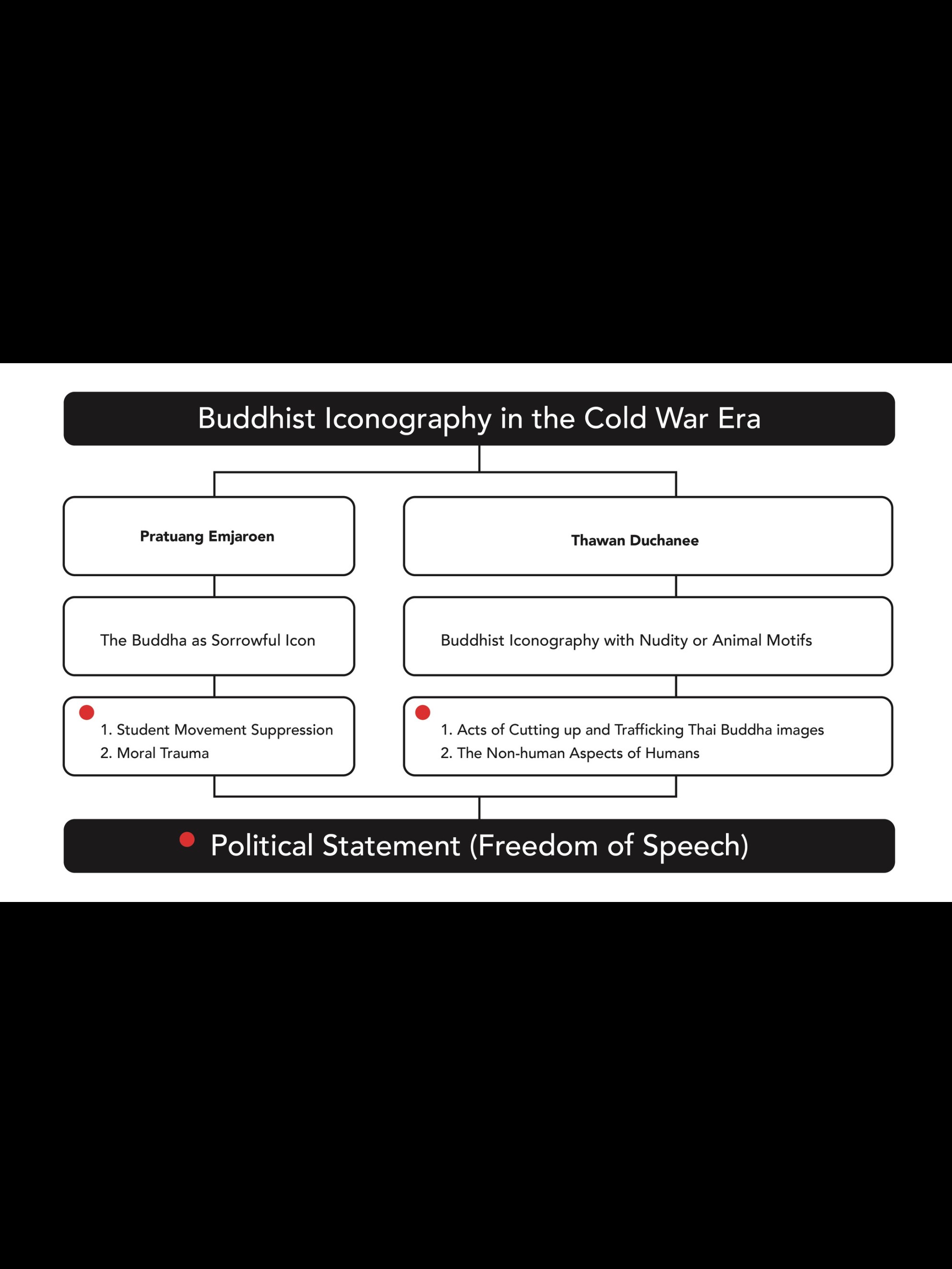
Main result: The paper articulates how Buddhist iconography in the Cold War era operated as a political statement with four following findings. Firstly, two keywords capture the socio-political landscape of society during the Cold War: tension and passion. “Tension” refers to the conflict between opposing ideologies, manifested in volatile social upheavals and transformations, while “passion” reflects grassroots claims and the political statement of people at the level of civic awakening. Secondly, the case of Pratuang Emjaroen reveals “tension” in the student movement (1973), while “passion” is the artist’s commitment to give voice to ordinary people, as seen in Dharma and Adharma (1973), Red Morning Glory and Rotten Gun (1976). These paintings show Pratuang Emjaroen’s indictment of violence, mourning of the dead, and express a hope for an inclusive society. Another work, the Fasting Buddha (Sacrifice) (1976), reflects his empathy for the people who were suffering from extreme political tension. This practice indicates a significant breakthrough as Buddhist iconography shifts from holy serenity to a social commentary that mirrors social agitations. More specifically, the Buddha is interpreted as an anguished sufferer (with bullet holes in the face and a severed head), symbolizing the moral ethic trauma. Thirdly, Thawan Duchanee’s works underscore the tension between the public’s deep-rooted recognition of Buddhist iconography and artists’ autonomy as Thawan engaged Buddhist iconography with nudity and animal motifs to highlight the human paradox between the transcendent side and the secular side. For example, to critique the acts of cutting up and trafficking Buddha images, his work Untitled (1970-1971) fuses temples and stupas with nude figures. This innovation provoked considerable backlash, and his works were vandalized. Lastly, this paper argues that the Cold War also brought new economic activity, which directly benefited the growth of art exhibitions with non-institutional art groups (e.g., Dharma Group), bank and entrepreneurled patronage systems, and the emergence of art foundations (e.g., BIMA), fostering artistic freedom. These networks address “tension and passion” as a cultural duality between Cold War tensions and artists’ individualized statements.
Relevance to Thai Studies: The study explored the interaction between artists, Buddhist iconography and Cold War influence in a Thai context, thereby refining studies of the Cold War’s socio-political transformation and offering a new perspective on the analysis of Buddhist iconography.
Conclusion: Cold War Thailand was a crucible in which multiple differences and tensions coexisted. Although the student demonstrations ended in brutal repression, the Buddhist iconography of Pratuang Emjaroen and Thawan Duchanee have become a lasting cultural legacy, testifying to the passions of Thai people who strove for freedom of speech in the 1970s. The wave was not only personal but also owed to the social structural transition as seen in private sponsorship from emerging capitalists and non-institutional art groups, signaling a trend to a more inclusive society.
Downloads
Article Details

This work is licensed under a Creative Commons Attribution-NonCommercial-NoDerivatives 4.0 International License.
Journal of Thai studies is licensed under a Creative Commons Attribution-Noncommercial-NoDerivatives4.0 Intenational (CC BY-NC-ND 4.0) licence, unless otherwise stated. Plese read our Policies page for more information on Open Access, copyright and permissions.
References
BACC Channel. (2020, May 28). Exhibition: PRATUANG EMJAROEN: Traces and Trails_Teaser 3 (2016). [Video]. YouTube. https://www.youtube.com/watch?v=1RiDR4l6_eo
Bae, M., Seng, Y. J., & Suzuki, K. (Eds.). (2019). Awakenings: Art in society in Asia, 1960s–1990s [Exhibition catalogue]. The National Museum of Modern Art, Tokyo; The National Museum of Modern and Contemporary Art, Korea; The National Gallery Singapore.
Bangkok Art and Culture Centre. (2016). Pratuang Emjaroen: Traces and trails. Bangkok: Bangkok Art and Culture Centre Foundation.
Béguin, G. (2009). Buddhist art: an historical and cultural journey (N. Chakrabongse, Trans.). Bangkok: River Books. (Original work published 2009).
Bhirasri Institute of Modern Art. (1975). First Anniversary Exhibition: May 14 [Exhibition catalogue]. Bangkok: Bhirasri Institute of Modern Art.
Bourdieu, P. (1984). Distinction: A social critique of the judgement of taste. New York: Routledge. (Original work published 1979).
Caruso, H. Y. C. (2005). Art as a Political Act: Expression of Cultural Identity, Self-identity, and Gender by Suk Nam Yun and Yong Soon Min. Journal of Aesthetic Education, 39(3), 71-87. http://www.jstor.org/stable/3527433
Chicarelli, C. F. (2018). Buddhism and Buddhist Art: An illustrated introduction. Chiang Mai: Silkworm Books.
Emjaroen, P. (1979). P. Emjaroen [Unpublished lecture handout for a lecture at Phra Nakhon Si Ayutthaya Teacher’s College].
Evans, F. (2019). Public art and the fragility of democracy: An essay in political aesthetics. New York: Columbia University Press.
Girling, J. L. S. (1981). Thailand: Society and politics. Ithaca, NY: Cornell University Press.
Gridthiya, G. (1996). An Alternative Space for the Arts in Thailand: Assessing the Feasibility. [Unpublished Independent Study]. School of the Art Institute of Chicago.
Griswold, A. B. (1974). What Is a Buddha image? (Thai Culture New Series No. 19). Bangkok: Fine Arts Department.
Henderson, V. (1997). The Social Production of Art in Thailand: Patronage and Commoditisation, 1980-1998. [Master’s thesis, Chulalongkorn University]. https://digiverse.chula.ac.th/Info/item/dc:81617
Hoskin, J. (1984). Ten Contemporary Thai artists. Bangkok: Graphis Co., Ltd.
Jin, J.-H. (2024). Buddhist Artwork as Political Symbolism: With a Focus on Buddhist Artwork Created in the 920s in Later Paekche. Sungkyun Journal of East Asian Studies, 24(2), 187-207. https://doi.org/10.1215/15982661-11361743
Marcus, R. (2013). Thawan Duchanee. Chiang Mai: Silkworm Books.
Mashadi, A. (2011). Framing the 1970s. Third Text, 25(4), 409-417. https://doi.org/10.1080/09528822.2011.587686
McMahon, R. J. (2000). What Difference Did It Make? Assessing the Vietnam War’s impact on Southeast Asia. In International perspectives on Vietnam (p. 197-214). L. C. Gardner & T. Gittinger (Eds.). College Station, TX: Texas A&M University Press.
Musikawong, S. (2010). Art for October: Thai Cold War State Violence in Trauma Art. positions: east asia cultures critique, 18(1), 19-50 https://doi.org/10.1215/10679847-2009-023
National Gallery of Thailand. (1975). The second Dharma Group exhibition of modern paintings: February 27–March 15 [Exhibition catalogue]. Bangkok: National Gallery of Thailand.
National Gallery of Thailand, & Art Auction Center. (2024). 200 years journey through Thai modern art history [Exhibition catalogue]. Bangkok: National Gallery of Thailand & Art Auction Center.
National Museum (Singapore). (1988). The Directory of the Museums of ASEAN. Singapore: National Museum.
Panofsky, E. (1972). Studies in Iconology: Humanistic Themes in the Art of the Renaissance. New York: Harper & Row. (Original work published 1939).
Peleggi, M. (2019). When Art Was Political: Historicising Decolonisation and the Cold War in Southeast Asia through Curatorial Practice. Journal of Southeast Asian Studies, 50(4), 645-654.
Phillips, H. P. (1992). The integrative art of modern Thailand [Exhibition catalogue]. Berkeley, CA: Lowie Museum of Anthropology, University of California at Berkeley.
Poshyananda, A. (1992). Modern art in Thailand. New York: Oxford University Press.
Poshyananda, A. (1996). Pratuang Emjaroen, Dharma and Adharma [ธรรม อธรรม] [Exhibition catalogue]. Bangkok: The Art Center, Centers of Academic Resources, Chulalongkorn University.
Queensland Art Gallery. (1993). The first Asia-Pacific triennial of contemporary art. Brisbane:Queensland Art Gallery.
Seankat, S. (2001). Thai Contemporary Painting in Surrealist Style: A Case Study of Thawan Duchanee’s Painting. [Master’s thesis, Srinakharinwirot University]. http://thesis.swu.ac.th/swuthesis/Vis_Art/Suwat_S.pdf
Seng, Y. J. (2017). Cultural Wars in Southeast Asia: The Birth of the Critical Exhibition in the 1970s. In Charting thoughts: Essays on art in Southeast Asia (p. 215-230). S. W. Low & P. D. Flores. (Eds.). Singapore: National Gallery Singapore. Simoniti, V. (2021). Art as Political Discourse. The British Journal of Aesthetics, 61(4), 559-574. https://doi.org/10.1093/aesthj/ayab018
Smithies, M. (2023). The Bangkok Art Scene in the Early 1960s: A Personal Souvenir. In The modern in Southeast Asian art: A reader (p. 572-577). T. K. Sabapathy & P. D. Flores (Eds.). Singapore: National Gallery Singapore. (Original work published 1978).
Su, B. (1991). Pingcheng shili de jiju he “Yun’gang moshi” de xingcheng yu fazhan [The concentration of Pingcheng’s strength and the formation and development of the “Yun’gang model”]. In Zhongguo shiku: Yun’gang shiku (yi) (p. 170-199). Yun’gang shiku wenwu baoguan suo (Ed.). Beijing: Wenwu Chubanshe.
Swearer, D. K. (2010). The Buddhist world of Southeast Asia. 2nd edition. Albany, NY: State University of New York Press.
Van Beek, S. (1999). Arts of Thailand. Singapore: Periplus.
Wenk, K. (1979). Die buddhistische Kunst Thawan Datchanis: Zeichnungen und Gemälde. Zürich: Iñigo von Oppersdorff Verlag.
