INTEGRATED BUDDHIST POLITICAL LEADERSHIP OF ADMINISTRATORS OF LOCAL GOVERNMENT ORGANIZATIONS IN LOEI PROVINCE
Keywords:
Political Leadership, Buddhist Integration, Local Administrative Organization ExecutiveAbstract
Objectives of this research article were: 1. study the political leadership of local administrative organization executives in Loei Province; 2. investigate the factors affecting the political leadership of local administrative organization executives in Loei Province; and 3. propose a Buddhist-integrated political leadership model for local administrative organization executives in Loei Province. This study employed a mixed-method research approach. The qualitative research involved 18 key informants who were academic experts or individuals with direct relevant experience. The research instrument was a structured interview form. The data were analyzed using descriptive content analysis. The quantitative research sample consisted of 395 eligible voters residing in the areas under the jurisdiction of Subdistrict Administrative Organizations with outstanding performance in 2025 at the provincial level in Loei Province. The research instrument was a questionnaire with a reliability coefficient of 0.933. The data were analyzed using descriptive statistics and inferential statistics.
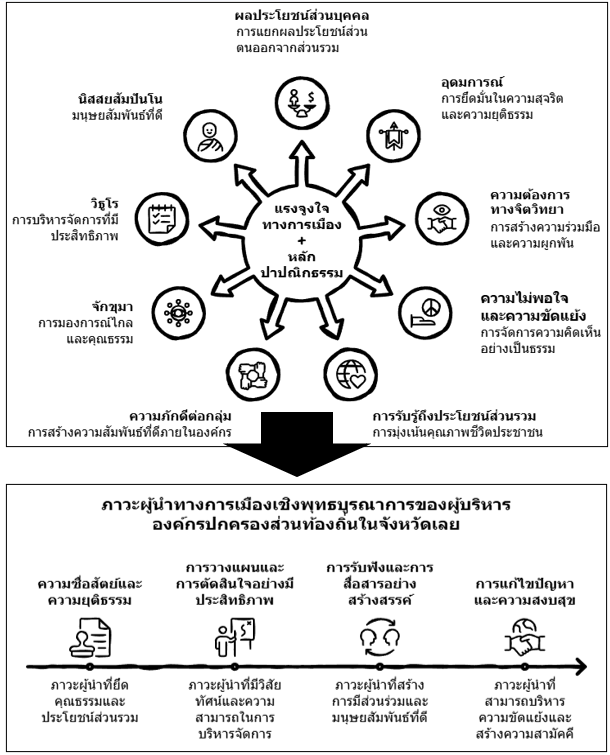
The research findings revealed that: 1. The overall level of political leadership among local administrative organization executives in Loei Province was high. 2. Political motivation factors and the principles of Papanikadhamma positively influenced the Buddhist-integrated political leadership of local administrative organization executives in Loei Province, with statistical significance at the 0.01 level. 3. The Buddhist-integrated political leadership model of local administrative organization executives in Loei Province consists of three components: 1. Cakkhuma (Visionary Leadership): Leaders possess vision and foresight, manage with transparency and fairness, place citizens at the center, and promote quality of life and community sustainability. 2. Vidhuro (Competent Management): Leaders demonstrate effective administrative skills, utilize information and moral principles, engage in proper planning, maintain transparency, prioritize public interests, and encourage citizen participation and 3. Nissayasampanno (Good Human Relations): Leaders have strong interpersonal skills, communicate constructively, listen attentively, solve problems with mindfulness and compassion, and promote cooperation and social harmony.
References
กรมการปกครอง กระทรวงมหาดไทย. (2568). โครงสร้างข้อมูลสถิติจำนวนประชากรไทยที่มีชื่ออยู่ในทะเบียนบ้านแยกรายอายุรายเดือน จังหวัดเลย. สืบค้นเมื่อ 17 มีนาคม 2568 จาก https://shorturl.asia/6UYLV.
กองยุทธศาสตร์และงบประมาณ องค์การบริหารส่วนจังหวัดเลย. (2568). ยุทธศาสตร์การพัฒนาขององค์กรปกครองส่วนท้องถิ่นในเขตจังหวัดเลย (พ.ศ. 2566 - 2570) แก้ไขครั้งที่ 1/2566 องค์การบริหารส่วนจังหวัดเลย. สืบค้นเมื่อ 14 กันยายน 2568 จาก https://shorturl.asia/vEQ3u.
ทองดี ปาโส. (2566). ภาวะผู้นำตามหลักปาปณิกธรรมของการบริหารองค์กรในยุคชีวิตวิถีใหม่. วารสารสหวิทยาการนวัตกรรมปริทรรศน์, 6(5), 145-157.
ธนาวัฒน์ วัฒทันต์ และไพรัช พื้นชมภู. (2567). แรงจูงใจของประชาชนในการเลือกตั้งนักการเมืองท้องถิ่น องค์การบริหาร ส่วนตำบลดงลาน อำเภอเมืองร้อยเอ็ด จังหวัดร้อยเอ็ด. วารสารเสฏฐวิทย์ปริทัศน์, 4(3), 264-273.
ธีรภัทร์ เสรีรังสรรค์. (2558). ปัญหาผลประโยชน์ทับซ้อนในการเมืองการปกครองท้องถิ่นไทย. วารสารมนุษยศาสตร์, 21(2), 1-16.
ประทาน คงฤทธิ์ศึกษากร. (2545). การปกครองท้องถิ่นไทย. กรุงเทพฯ: ธนศร เจริญเมือง.
พระครูรัตนสุตากร (ปราโมทย์ ล่องแก้ว). (2564). การประยุกต์หลักพุทธจริยธรรมเพื่อพัฒนามาตรฐานจริยธรรมของผู้นาทางการเมือง. วารสารชัยภูมิปริทรรศน์, 4(3), 20-30.
พระครูสังฆรักษ์เอกลักษณ์ อชิโต (นกทอง). (2566). การประยุกต์ใช้หลักทุติยปาปณิกธรรมเพื่อการพัฒนาภาวะผู้นำของนักการเมืองท้องถิ่นในจังหวัดสมุทรสงคราม (ดุษฎีนิพนธ์ปริญญาปรัชญาดุษฎีบัณฑิต สาขาวิชารัฐศาสตร์). พระนครศรีอยุธยา: มหาวิทยาลัยมหาจุฬาลงกรณราชวิทยาลัย.
พระธรรมโกศาจารย์ (ประยูร ธมฺมจิตฺโต). (2549). พุทธวิธีการบริหาร. กรุงเทพฯ: โรงพิมพ์มหาจุฬาลงกรณราชวิทยาลัย.
พระปลัดธันวา วิชฺชากโร (พ่วงกุล). (2567). พุทธบูรณาการเพื่อส่งเสริมภาวะผู้นำทางการเมืองของผู้บริหารงานองค์กรปกครองส่วนท้องถิ่นในจังหวัดนครศรีธรรมราช (ดุษฎีนิพนธ์ปริญญาปรัชญาดุษฎีบัณฑิต สาขาวิชารัฐศาสตร์). พระนครศรีอยุธยา: มหาวิทยาลัยมหาจุฬาลงกรณราชวิทยาลัย.
พระมหานิรุต ญาณวุฑฺโฒ (พยนต์ยิ้ม). (2566). พุทธบูรณาการเพื่อส่งเสริมภาวะผู้นำทางการเมืองของนักการเมืองท้องถิ่น ในจังหวัดสมุทรสงคราม (ดุษฎีนิพนธ์ปริญญาปรัชญาดุษฎีบัณฑิต สาขาวิชารัฐศาสตร์). พระนครศรีอยุธยา: มหาวิทยาลัยมหาจุฬาลงกรณราชวิทยาลัย.
พิชาภพ พันธุ์แพ. (2554). ผู้นำกับการจัดการการเปลี่ยนแปลง. กรุงเทพฯ: สำนักพิมพ์แห่งจุฬาลงกรณ์มหาวิทยาลัย.
เพ็ญภัค รัตนคำฟู และคณะ. (2567). พุทธบูรณาการเพื่อส่งเสริมภาวะผู้นำทางการเมืองของนักการเมืองท้องถิ่นในการสร้างความเข้มแข็งให้แก่ภาคประชาสังคมในจังหวัดลำปาง (ดุษฎีนิพนธ์ปริญญาปรัชญาดุษฎีบัณฑิต สาขาวิชารัฐศาสตร์). พระนครศรีอยุธยา: มหาวิทยาลัยมหาจุฬาลงกรณราชวิทยาลัย.
ไพเราะ มีภักดี. (2565). รูปแบบการพัฒนาภาวะผู้นำการเปลี่ยนแปลงของผู้บริหารสถานศึกษา ในศตวรรษที่ 21 สังกัดสำนักงานเขตพื้นที่การศึกษามัธยมศึกษา. วารสาร มจร สังคมศาสตร์ปริทรรศน์, 11(2), 69-81.
ภูมิ มูลศิลป์. (2565). การกระทำที่มีมูลเหตุจูงใจทางการเมือง. วารสาร มจร สังคมศาสตร์ปริทรรศน์, 11(1), 89–100.
มหาจุฬาลงกรณราชวิทยาลัย. (2539). พระไตรปิฎกภาษาไทย ฉบับมหาจุฬาลงกรณราชวิทยาลัย. กรุงเทพฯ: โรงพิมพ์มหาจุฬาลงกรณราชวิทยาลัย.
ฤาชุตา เทพยากุล. (2552). คุณลักษณะนายกรัฐมนตรีที่พึงประสงค์ในทัศนะของนักศึกษาระดับอุดมศึกษา กรณีศึกษา นักศึกษาสาขารัฐประศาสนศาสตร์ระดับปริญญาตรีในสถาบันอุดมศึกษาจังหวัดสงขลา (รายงานผลการวิจัย). สงขลา: มหาวิทยาลัยสงขลานครินทร์.
Yamane, T. (1973). Statistics: An Introductory Analysis (3rd ed.). New York: Harper and Row.
Downloads
Published
How to Cite
Issue
Section
License
Copyright (c) 2026 Journal of Interdisciplinary Innovation Review

This work is licensed under a Creative Commons Attribution-NonCommercial-NoDerivatives 4.0 International License.
In order to conform the copyright law, all article authors must sign the consignment agreement to transfer the copyright to the Journal including the finally revised original articles. Besides, the article authors must declare that the articles will be printed in only the Journal of interdisciplinary Innovation Review. If there are pictures, tables or contents that were printed before, the article authors must receive permission from the authors in writing and show the evidence to the editor before the article is printed. If it does not conform to the set criteria, the editor will remove the article from the Journal without any exceptions.