WISE REFLECTION AND GOVERNING THE TWO FACES OF ARTIFICIAL INTELLIGENCE IN THE PUBLIC
Keywords:
Yoniso-Manasikara, Artificial Intelligence Governance, Thai Public Sector, Buddhist Public Administration, Wise Reflective Governance FrameworkAbstract
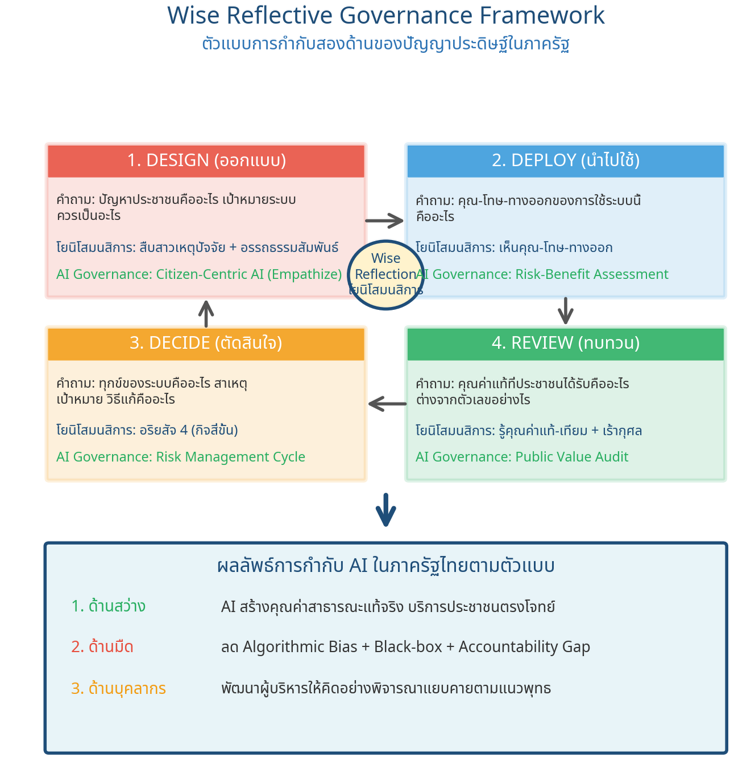
This article proposes a framework that pairs the Buddhist method of yoniso-manasikara reflection with wisdom with international AI governance components, to govern artificial intelligence in the public sector presents two faces at once. One improves service efficiency and data-driven decisions; the other produces algorithmic bias, accountability gaps, and the erosion of public trust. The author holds that the legal and technical instruments of international governance frameworks, while necessary, do not fully address the ethical values and cultural context of the Thai bureaucracy. This article pursues three objectives: 1. to analyse the two-faced phenomenon of AI in the public sector through documented cases; 2. to pair three modes of yoniso-manasikara (wise reflection) with international AI governance components; and 3. to propose the Wise Reflective Governance Framework for public administrators. The study finds that weighing benefits, harms, and alternatives corresponds to Risk-Benefit Assessment; the Four Noble Truths mode corresponds to the Risk Management Cycle; and the combined modes of tracing causal factors and relating means to ends correspond to Citizen-Centric AI Design at the Empathize stage of Design Thinking. The framework operates across four governance layers Design, Deploy, Decide, and Review enabling administrators to steer the bright side toward genuine public value and the dark side toward reduced risk, grounded in Buddhist reasoning. It extends Alberti's (2019) work from European administrative law to Buddhist public administration in Thailand and builds on Jayapattana and Wanhakit (2025), broadening their application from AI deepfake awareness to AI governance across the public sector.
References
ณัฐกริช เปาอินทร์ และดนุวัศ สาคริก. (2568). การใช้ประโยชน์จากปัญญาประดิษฐ์เพื่อเพิ่มประสิทธิภาพการทำงานของรัฐบาลอิเล็กทรอนิกส์: การวิเคราะห์ที่เน้นนโยบายโดยมุ่งเน้นที่ประสิทธิภาพการใช้จ่ายภาครัฐ. วารสารการเมือง การบริหาร และกฎหมาย, 17(2), 95-113.
ณัฐนรินทร์ เนียมประดิษฐ์ และสุปัญญดา สุนทรนนธ์. (2564). การประยุกต์ใช้กระบวนการความคิดเชิงออกแบบเพื่อเป็นเครื่องมือใหม่ในการบริหารการเปลี่ยนแปลงขององค์การในประเทศไทย: ทำอย่างไรและได้อะไร?. วารสารชัยพฤกษ์ภิรมย์ คณะมนุษยศาสตร์และสังคมศาสตร์ มหาวิทยาลัยราชภัฏนครราชสีมา, 3(1), 1-13.
ปิยะ ปะตังทา และคณะ. (2566). การพัฒนาสมรรถนะเชิงพุทธเพื่อการเรียนรู้เทคโนโลยีดิจิทัลของบุคลากรศาลปกครอง. วารสาร มจร สังคมศาสตร์ปริทรรศน์, 12(2), 1-13.
พระพรหมคุณาภรณ์ (ป.อ. ปยุตฺโต). (2559). พจนานุกรมพุทธศาสตร์ ฉบับประมวลธรรม (พิมพ์ครั้งที่ 34). กรุงเทพฯ: มูลนิธิการศึกษาเพื่อสันติภาพ พระธรรมปิฎก (ป.อ. ปยุตฺโต).
มหาจุฬาลงกรณราชวิทยาลัย. (2539). พระไตรปิฎกฉบับภาษาไทย ฉบับมหาจุฬาลงกรณราชวิทยาลัย. กรุงเทพฯ: โรงพิมพ์มหาจุฬาลงกรณราชวิทยาลัย.
ศุภกาญจน์ ชยาพัฒน์ และพูไทย วันหากิจ. (2568). รู้เท่าทัน “AI Deepfake” ด้วยหลักโยนิโสมนสิการ. วารสาร มจร พุทธปัญญาปริทรรศน์, 10(1), 785-798.
เศรษฐฐากรณ์ วงษ์อารยะสกุล และดาริณี ปันกันสกุล. (2568). การใช้ปัญญาประดิษฐ์ในการบังคับใช้กฎหมาย ขอบเขตของจริยธรรม ผลกระทบต่อสิทธิมนุษยชน. วารสารมนุษยศาสตร์และสังคมศาสตร์มหาวิทยาลัยเอเชียอาคเนย์, 9(2), 37-47.
สำนักงานพัฒนาธุรกรรมทางอิเล็กทรอนิกส์. (2564). ปัญญาประดิษฐ์ในการให้บริการของภาครัฐ. สืบค้นเมื่อ 4 พฤษภาคม 2569 จาก https://shorturl.asia/ZiFPH.
สุรพล สุยะพรหม และคณะ. (2567). แนวคิด ทฤษฎีและหลักพุทธธรรมทางการจัดการเชิงพุทธ รัฐศาสตร์ และรัฐประศาสนศาสตร์. พระนครศรีอยุธยา: โรงพิมพ์มหาจุฬาลงกรณราชวิทยาลัย.
Alberti, I. (2019). The Double Side of Artificial Intelligence in the Public Sector. ActaUniversitatis Sapientiae, Legal Studies, 8(2), 151-165.
Angwin, J. et al. (2016). Machine bias: There'ssoftware used across the country to predict future criminals. and it's biased against blacks. ProPublica. Retrieved May 4, 2026, from https://shorturl.asia/a9FTH.
Buolamwini, J. & Gebru, T. (2018). Gender Shades: Intersectional Accuracy Disparities in Commercial Gender Classification. Proceedings of Machine Learning Research, 81, 77-91.
Busuioc, M. (2020). Accountable Artificial Intelligence: Holding Algorithms to Account. Public Administration Review, 81(5), 825-836.
Ceva, E. & Jiménez, M. C. (2022). Automating anticorruption?. Ethics and Information Technology, 24(4), Article 48.
Kawtrakul, A. & Praneetpolgrang, P. (2014). A History of AI Research and Development in Thailand: Three Periods, Three Directions. AI Magazine, 35(2), 83-92.
Mannes, A. (2020). Governance, Risk, and Artificial Intelligence. AI Magazine, 41(1), 61-69.
Pheukhom, A. et al. (2024). Preparation for the Transition to Artificial Intelligence Technology (AI) Used to Provide Government Services. Journal of Spatial Development and Policy, 2(1), 47–64.
Ulnicane, I. et al. (2022). Governance of Artificial Intelligence: Emerging International Trends and Policy Frames. In M. Tinnirello (Ed.), The Global Politics of Artificial Intelligence (Chapter 2, pp. 29-55). USA: CRC Press/Routledge.
Downloads
Published
How to Cite
Issue
Section
License
Copyright (c) 2026 Journal of Interdisciplinary Innovation Review

This work is licensed under a Creative Commons Attribution-NonCommercial-NoDerivatives 4.0 International License.
In order to conform the copyright law, all article authors must sign the consignment agreement to transfer the copyright to the Journal including the finally revised original articles. Besides, the article authors must declare that the articles will be printed in only the Journal of interdisciplinary Innovation Review. If there are pictures, tables or contents that were printed before, the article authors must receive permission from the authors in writing and show the evidence to the editor before the article is printed. If it does not conform to the set criteria, the editor will remove the article from the Journal without any exceptions.