POLITICAL LEADERSHIP DEVELOPMENT ACCORDING TO BUDDHIST PRINCIPLES OF LOCAL ADMINISTRATIVE ORGANIZATION EXECUTIVES IN SURIN PROVINCE
Keywords:
Development, Political Leadership, Sappurisa Dhamma, Organization AdministratorsAbstract
This research aimed to: 1. study the political leadership; 2. identify factors affecting political leadership; and 3. propose guidelines for developing political leadership based on Buddhist principles among local government administrators in Surin Province. A mixed-methods approach was employed. Qualitative data were collected through structured in-depth interviews with 18 informants and a focus group of 10 experts, followed by descriptive content analysis. Quantitative data were gathered from a sample of 400 citizens using a questionnaire with a reliability of 0.991. The data were analyzed using frequency, percentage, mean, standard deviation, and stepwise multiple regression analysis.
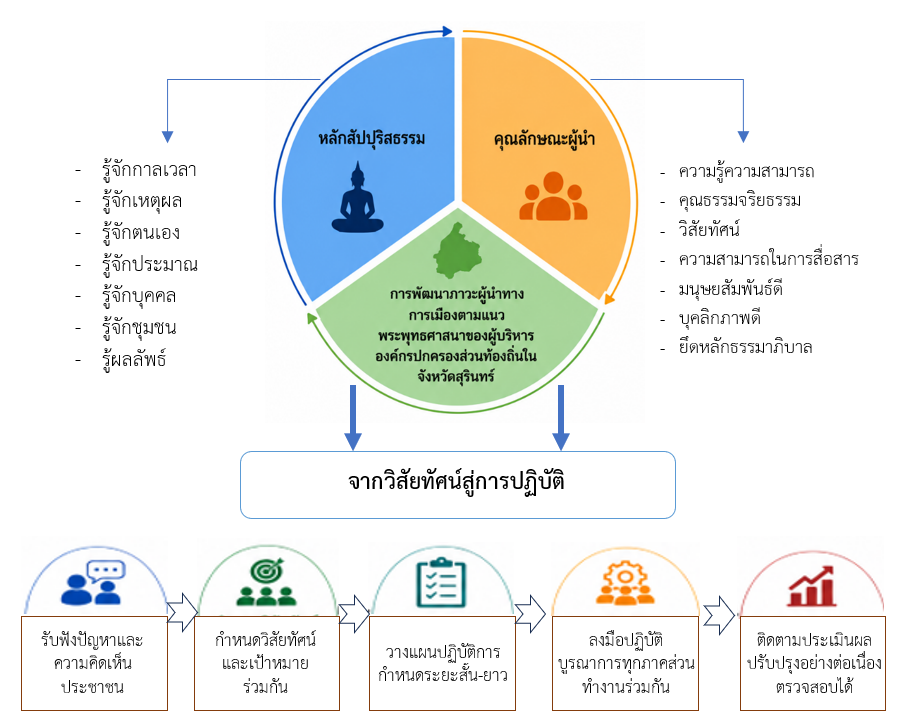
The research findings were as follows: 1. Political Leadership: The study found that the overall political leadership of the administrators was at a high level. All individual aspects were also rated high, ranked in descending order as follows: the ability to analyze major social challenges, act as a change leader, propose feasible visions for rapid problem-solving, and utilize intelligence to mobilize resources for solutions. 2. Affecting Factors: Leadership characteristics and the Buddhist principle of Sappurisadhamma (virtues of a good person) significantly affected the political leadership of the administrators. These factors accounted for 40.5% and 16.4% of the variance, respectively, at a statistical significance level of 0.01. and 3. Leadership Development Guidelines: The development of political leadership based on the seven principles of Sappurisadhamma was proposed as follows: 1. Knowing the cause: administrators analyzed problems and listened to all parties. 2. Knowing the effect: they realized policy goals and continuously monitored progress. 3. Knowing oneself: they avoided clinging to power and focused on the public interest. 4. Knowing moderation: they utilized budgets appropriately and worked systematically. 5. Knowing the proper time: they prioritized tasks and understood the right timing for communication. 6. Knowing the community: they understood local lifestyles and cultures and 7. Knowing individuals: they kept an open mind to listen and actively participated in community activities.
References
ตรีชฎา สุขเกษม และคณะ. (2567). บทบาทของผู้นำองค์กรปกครองส่วนท้องถิ่นต่อการพัฒนาท้องถิ่นในจังหวัดสุรินทร์. วารสารมนุษยศาสตร์และสังคมศาสตร์ มหาวิทยาลัยราชภัฏสุรินทร์, 26(1), 237-254.
ถวิลวดี บุรีกุล. (2548). การมีส่วนร่วม : แนวคิด ทฤษฎีและกระบวนการ. นนทบุรี: สถาบันพระปกเกล้า.
ปรัชญา บุตรสะอาด. (2566). ภาวะผู้นำตามคุณลักษณะของผู้นำที่ดี. วารสารปราชญ์ประชาคม, 1(4), 42-58.
พระครูวิโรจน์กาญจนเขต (นัทกฤต ปทุมมารัชเชปัณณ์). (2567). การประยุกต์หลักพุทธธรรมเพื่อส่งเสริมภาวะผู้นำของนักการเมืองท้องถิ่นในจังหวัดนนทบุรี (ดุษฎีนิพนธ์ปริญญาปรัชญาดุษฎีบัณฑิต สาขาวิชารัฐศาสตร์). พระนครศรีอยุธยา: มหาวิทยาลัยมหาจุฬาลงกรณราชวิทยาลัย.
พระครูศรีธรรมวิเทศ (ประเสริฐ ปญฺโญภาโส). (2566). การบูรณาการหลักพุทธธรรมเพื่อส่งเสริมจริยธรรมทางการเมืองในระบอบประชาธิปไตยของนักการเมืองท้องถิ่นใน จังหวัดชุมพร (ดุษฎีนิพนธ์ปริญญาปรัชญาดุษฎีบัณฑิต สาขาวิชารัฐศาสตร์). พระนครศรีอยุธยา: มหาวิทยาลัยมหาจุฬาลงกรณราชวิทยาลัย.
พระปลัดเอกชัย จนฺทโชโต (คงชีวะ). (2566). พุทธบูรณาการเพื่อส่งเสริมภาวะผู้นำของนักการเมืองท้องถิ่นในจังหวัดสระบุรี (ดุษฎีนิพนธ์ปริญญาปรัชญาดุษฎีบัณฑิต สาขาวิชารัฐศาสตร์). พระนครศรีอยุธยา: มหาวิทยาลัยมหาจุฬาลงกรณราชวิทยาลัย.
พระไพศาล วิสาโล. (2546). พระพุทธศาสนาไทยในอนาคต แนวโน้มและทางออกจากวิกฤติ. กรุงเทพฯ: มูลนิธิสดศรี-สฤษดิ์วงศ์.
เพ็ญภัค รัตนคำฟู. (2567). พุทธบูรณาการเพื่อส่งเสริมภาวะผู้นำทางการเมืองของนักการเมืองท้องถิ่นในการสร้างความเข้มแข็งให้แก่ภาคประชาสังคมในจังหวัดลำปาง (ดุษฎีนิพนธ์ปริญญาปรัชญาดุษฎีบัณฑิต สาขาวิชารัฐศาสตร์). พระนครศรีอยุธยา: มหาวิทยาลัยมหาจุฬาลงกรณราชวิทยาลัย.
มหาจุฬาลงกรณราชวิทยาลัย. (2539). พระไตรปิฎกภาษาไทย ฉบับมหาจุฬาลงกรณราชวิทยาลัย. กรุงเทพฯ: โรงพิมพ์มหาจุฬาลงกรณราชวิทยาลัย.
สาคร สุขศรีวงศ์. (2555). การจัดการ : จากมุมมองของนักบริหาร (พิมพ์ครั้งที่ 10). กรุงเทพฯ: บริษัท จี.พี.ไซเบอร์พรินท์.
สำนักงานคณะกรรมการการเลือกตั้งจังหวัดสุรินทร์. (2567). ประกาศบัญชีรายชื่อผู้มีสิทธิเลือกระดับจังหวัด (สว.จ.8). สืบค้นเมื่อ 4 กุมภาพันธ์ 2568 จาก https://shorturl.asia/VJsQw.
อภิชัย พิทยานุรักษกุล. (2566). การประยุกต์หลักพุทธธรรมเพื่อส่งเสริมความไว้วางใจของประชาชนที่มีต่อการลงคะแนนเลือกนายกเทศมนตรี ในจังหวัดชลบุรี (ดุษฎีนิพนธ์ปริญญาปรัชญาดุษฎีบัณฑิต สาขาวิชารัฐศาสตร์). พระนครศรีอยุธยา: มหาวิทยาลัยมหาจุฬาลงกรณราชวิทยาลัย.
Likert, R. (1967). The Method of Constructing an Attitude Scale. In M. Fishbein (Ed.), Readings in Attitude Theory and Measurement. (pp. 90-95). New York: Wiley & Son.
Yamane, T. (1973). Statistics: An Introductory Analysis (3rd ed.). New York: Harper and Row.
Downloads
Published
How to Cite
Issue
Section
License
Copyright (c) 2026 Journal of Interdisciplinary Innovation Review

This work is licensed under a Creative Commons Attribution-NonCommercial-NoDerivatives 4.0 International License.
In order to conform the copyright law, all article authors must sign the consignment agreement to transfer the copyright to the Journal including the finally revised original articles. Besides, the article authors must declare that the articles will be printed in only the Journal of interdisciplinary Innovation Review. If there are pictures, tables or contents that were printed before, the article authors must receive permission from the authors in writing and show the evidence to the editor before the article is printed. If it does not conform to the set criteria, the editor will remove the article from the Journal without any exceptions.