DEVELOPING LAWS TO PROMOTE THE DUTY OF THAI CITIZENS TO DEFENSE THE COUNTRY ACCORDING TO PROVISIONS OF THE CONSTITUTION OF THE KINGDOM OF THAILAND B.E. 2560
Keywords:
Law, Duties of Thai Citizens, National Defense, Constitution of the Kingdom of Thailand B.E. 2560 (2017), Mixed National ServiceAbstract
This research article aimed to: 1. study and analyze the problems, obstacles, and legal limitations in promoting the duties of the Thai people in national defense under the Constitution of the Kingdom of Thailand B.E. 2560 (2017); 2. examine legal measures in Thailand and foreign countries concerning the promotion of citizens’ duties in national defense; and 3. propose guidelines for legal development to promote such duties. This study employed a qualitative research methodology. The key informants consisted of 20 in-depth interviewees and 9 participants in a focus group discussion. The research instruments were semi-structured in-depth interview forms and focus group discussion guidelines. The data were analyzed through descriptive analysis and relational analysis based on relevant conceptual, theoretical, and legal frameworks.
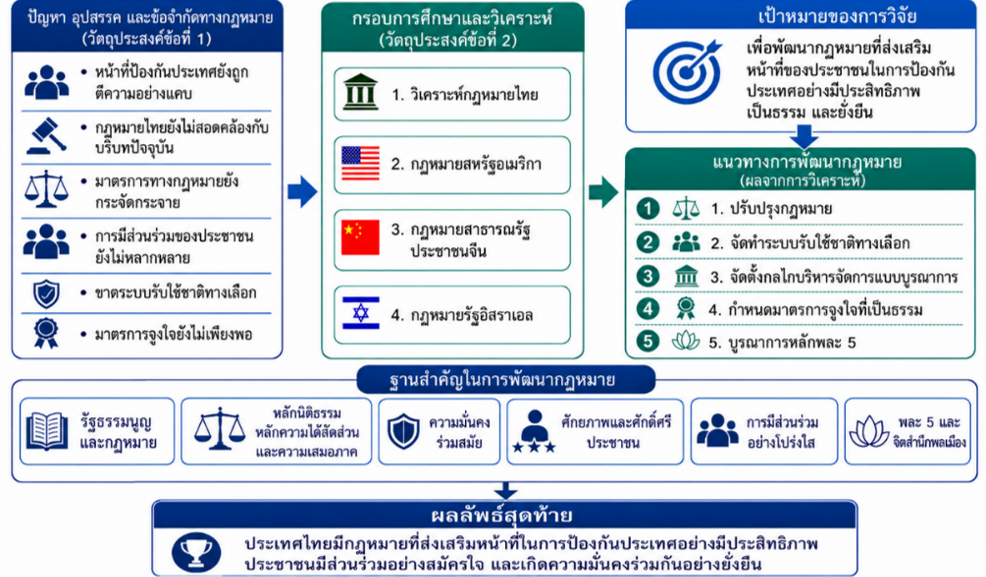
The research findings revealed that: 1. the promotion of the duties of the Thai people in national defense remains limited by the gap between constitutional provisions and implementing laws. The existing laws still emphasize military service and compulsory manpower recruitment rather than providing opportunities for public participation in security affairs. This has raised concerns regarding the rule of law, equality, proportionality, the capacity to respond to new forms of threats, as well as the lack of incentive measures and clear mechanisms for cultivating civic consciousness. 2. Legal measures in Thailand and foreign countries indicate that Thailand should move from the traditional conscription system toward a mixed national service system by opening various channels for public participation, such as military service, reserve forces, and security volunteers, in accordance with the Thai context. and 3. The guidelines for legal development should adopt the CPILB Model as a key framework, consisting of adherence to constitutional duties, the expansion of diverse channels for participation, the creation of incentives and support mechanisms, the protection of rights and legal fairness, and the integration of the Five Bala principles to strengthen civic consciousness in national security. These elements would enable national defense to become a concrete shared mission of the state and the people.
References
กษมา เดชรักษา และชุติพงศ์ สมทรัพย์. (2561). หน้าที่ของปวงชนชาวไทยในรัฐธรรมนูญ: สถานะและความผูกพันทางกฎหมาย. พิฆเนศวร์สาร, 14(2), 193–210.
ภัสวรรณ อุชพงศ์อมร และอารีรัตน์ โกสิทธิ์. (2556). ศาลปกครองกับการตรวจสอบการจำกัดสิทธิและเสรีภาพของประชาชนภายใต้หลักความได้สัดส่วน (รายงานผลการวิจัย). เชียงราย: มหาวิทยาลัยแม่ฟ้าหลวง.
สฤษดิ์ แผนสนิท และสมิหรา จิตตลดากร. (2563). การพัฒนาพลทหารกองประจำการของกองทัพเพื่อความมั่นคงของชาติ. วารสารมานุษยวิทยาเชิงพุทธ, 5(10), 301–314.
มหาจุฬาลงกรณราชวิทยาลัย. (2539). พระไตรปิฎกภาษาไทย ฉบับมหาจุฬาลงกรณราชวิทยาลัย. กรุงเทพฯ: โรงพิมพ์มหาจุฬาลงกรณราชวิทยาลัย.
รัฐธรรมนูญแห่งราชอาณาจักรไทย พุทธศักราช 2560. (2560, 6 เมษายน). ราชกิจจานุเบกษา. เล่ม 134 ตอนที่ 40 ก. หน้า 1–90.
พระราชบัญญัติรับราชการทหาร พ.ศ. 2497. (2497, 16 กุมภาพันธ์). ราชกิจจานุเบกษา. เล่ม 71 ตอนที่ 13 ก. หน้า 195-226.
Herzberg, F. et al. (1959). The motivation to work (2nd ed.). New York: John Wiley & Sons.
Maslow, A. H. (1943). A theory of human motivation. Psychological Review, 50, 370–396.
Vroom, V. H. (1964). Work and motivation. New York: Wiley.
Downloads
Published
How to Cite
Issue
Section
License
Copyright (c) 2026 Journal of Interdisciplinary Innovation Review

This work is licensed under a Creative Commons Attribution-NonCommercial-NoDerivatives 4.0 International License.
In order to conform the copyright law, all article authors must sign the consignment agreement to transfer the copyright to the Journal including the finally revised original articles. Besides, the article authors must declare that the articles will be printed in only the Journal of interdisciplinary Innovation Review. If there are pictures, tables or contents that were printed before, the article authors must receive permission from the authors in writing and show the evidence to the editor before the article is printed. If it does not conform to the set criteria, the editor will remove the article from the Journal without any exceptions.