CIRCLES OF CARE FOR DEATH PREPARATION AMONG PEOPLE WITHOUT CLOSE NETWORKS IN THAI SOCIETY
Keywords:
Circles of Care, Death Preparation, Compassionate Community, People Without Close Networks, Institutional ContextAbstract
This qualitative study 1. examines characteristics of circles of care for death preparation in Thai society; and 2. analyze gaps and propose development guidelines for people without close networks suitable for Thailand. Data was gathered by in-depth interview with 20 organization representatives involved in death preparation in state and quasi-state; academic and medical; civil society; and private sectors. Data was analyzed by the framework method with circles of care as initial framework.
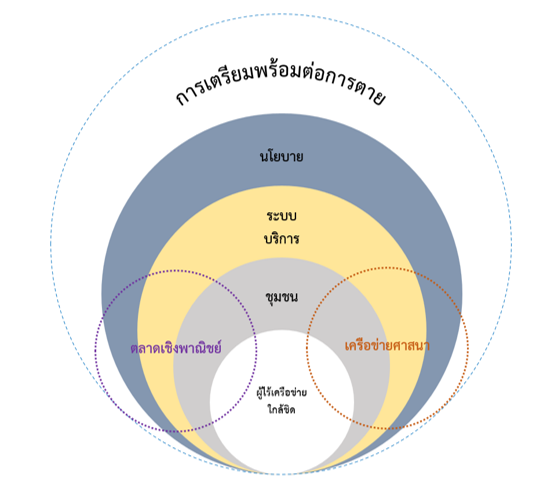
Because death preparation depends on entrusting personal wishes to a recipient who is usually in the inner circle, people without close networks lack a caregiver and recipient of advance wishes from the outset. Each outer circle accommodates them only partially and conditionally; the community circle provides planning devices but cannot itself store and enact the requests; the service circle admits only those already in the system; and the policy circle has only started building an electronic advance-directive registry (e-Living Will) with limited reach. Two further elements in Thailand include a commercial market circle filtered by purchasing power, and a religious-institution axis serving as backup in some areas. Those who are without networks or means lapse into a gap of all circles simultaneously. Therefore, a national mechanism should compile advance wishes, proactive case-finding, and preparedness options independent of purchasing power. In conclusion, the difficulty of death preparation among people without close networks in Thai society does not arise from a lack of organizations, networks, or services, but from each circle of care operating on its own, without a central policy to connect the existing institutional social capital so that the circles reinforce one another.
References
กมลชนก ขำสุวรรณ และภุชงค์ เสนานุช. (2565). สวัสดิการสังคมเพื่อการพัฒนาขีดความสามารถผู้สูงอายุหญิงอยู่คนเดียว: ข้อค้นพบจากจังหวัดนครปฐม. วารสารสังคมสงเคราะห์ศาสตร์, 30(2), 1-36.
จิรพรรณ นฤภัทร. (2569). การพัฒนารูปแบบ “ชุมชนกรุณา” ในบริบทการดูแลผู้ป่วยสูงอายุระยะท้ายและครอบครัวในระบบบริการแบบประคับประคองขององค์การปกครองส่วนท้องถิ่น กรณีศึกษาชุมชนกรุณาโดยเทศบาลเมืองกาฬสินธุ์. วารสารการบริหารการปกครองและนวัตกรรมท้องถิ่น, 10(1), e296682.
ฐิตินันทน์ ผิวนิล และคณะ. (2566). ทัศนคติต่อการอยู่ตัวคนเดียวและความกลัวต่อการเสียชีวิตตามลำพังของคนรุ่นใหม่ในกรุงเทพมหานคร. ใน การประชุมวิชาการประชากรศาสตร์แห่งชาติ 2566 (น. 153-172). กรุงเทพฯ: สมาคมนักประชากรไทย.
_____. (2567). บทบาทการจัดการความตายให้ศพผู้ป่วยยากไร้และไร้ญาติของมูลนิธิไม่แสวงหากำไรแห่งหนึ่งในกรุงเทพมหานคร. วารสารพุทธนวัตกรรมและการจัดการ, 7(4), 15-28.
ดิเรก ชัยชนะ และคณะ. (2567). การศึกษาการใช้สมุดเบาใจสำหรับการวางแผนสุขภาพล่วงหน้าในชุมชน. วารสารการสร้างเสริมสุขภาพไทย, 3(4), 335-347.
ดิเรก ชัยชนะ. (2567). กระบวนกรชุมชน: สมรรถนะและบทบาทการขับเคลื่อนชุมชนกรุณา. วารสารการสร้างเสริมสุขภาพไทย, 3(4), 374-383.
พศิน สินมา และคณะ. (2568). บทบาทของพระสงฆ์ในงานสาธารณสงเคราะห์: กรณีศึกษาวัดราษฎร์ประคองธรรม. วารสารเสียงธรรมจากมหายาน, 11(2), 20-33.
มิ่งสรรพ์ ขาวสะอาด และคณะ. (2565). อนาคตประเทศไทย พุทธศักราช 2585. เชียงใหม่: มูลนิธิสถาบันศึกษานโยบายสาธารณะ.
วริศรา ศุภาลัยวัฒน์ และไตรรัตน์ จารุทัศน์. (2567). รูปแบบที่อยู่อาศัยชุมชนคนเกษียณอายุที่มีระบบดูแลต่อเนื่อง: กรณีศึกษาโครงการสถาบันผู้สูงอายุแมคเคนและโครงการสวางคนิเวศ. สาระศาสตร์: วารสารสถาปัตยกรรมและการออกแบบ, 7(2), 453-467.
อารีย์ พีรพรวิพุธ. (2568). ภาวะความตายอย่างโดดเดี่ยว: สื่อสารภาพสะท้อนสังคมสูงวัย. วารสารศาสตร์, 18(2), 269-315.
เอกภพ สิทธิวรรณธนะ. (2565). วงล้อมแห่งการดูแล (Circles of Care). สืบค้นเมื่อ 6 มิถุนายน 2569 จากhttps://cocofoundationthailand.org/circles-of-care/.
Abel, J. et al. (2013). Circles of care: should community development redefine the practice of palliative care?. BMJ Supportive & Palliative Care, 3(4), 383-383.
Chan, H. H. & Thang, L. L. (2022). Active Aging through Later Life and Afterlife Planning: Shūkatsu in a Super-Aged Japan. Social Sciences, 11(1), 3.
Gale, N. K. et al. (2013). Using the framework method for the analysis of qualitative data in multi-disciplinary health research. BMC Medical Research Methodology, 13(1), 117.
Kellehear, A. (2020). Compassionate Cities: global significance and meaning for palliative care. Progress in Palliative Care, 28(2), 115–119.
Kelley, M. L. (2023). Developing a compassionate community: a Canadian conceptual model for community capacity development. Palliative Care and Social Practice, 17, 26323524231193040.
Kunakornvong, W. & Ngaosri, K. (2020). Public Awareness and Attitude toward Palliative Care in Thailand. Siriraj Medical Journal, 72(5), 424–430.
Mair, C. A. et al. (2023). End-of-Life Experiences Among “Kinless” Older Adults: A Nationwide Register-Based Study. Journal of Palliative Medicine, 26(8), 1056–1063.
Margolis, R. & Verdery, A. M. (2017). Older Adults Without Close Kin in the United States. The Journals of Gerontology: Series B, 72(4), 688–693.
Pewnil, T. et al. (2026). A scoping review of death preparation practices and sociocultural determinants in Thai society. Discover Social Science and Health, 6(1), 13.
Plick, N. P. et al. (2021). A national profile of kinlessness at the end of life among older adults: Findings from the Health and Retirement Study. Journal of the American Geriatrics Society, 69(8), 2143–2151.
Sallnow, L. et al. (2022). Report of the Lancet Commission on the Value of Death: bringing death back into life. The Lancet, 399(10327), 837–884.
Samutachak, B. et al. (2022). Future Scenarios for Thai Families in 2040. Nakhon Pathom: Institute for Population and Social Research, Mahidol University and National Research Council of Thailand.
Stonington, S. D. (2012). On ethical locations: The good death in Thailand, where ethics sit in places. Social Science & Medicine, 75(5), 836–844.
Verdery, A. M. et al. (2019). Kinlessness Around the World. The Journals of Gerontology: Series B, 74(8), 1394–1405.
Waldrop, D. P. (2011). Denying and Defying Death: The Culture of Dying in 21st Century America. The Gerontologist, 51(4), 571–576.
Walter, T. (2012). Why different countries manage death differently: a comparative analysis of modern urban societies. The British Journal of Sociology, 63(1), 123–145.
Downloads
Published
How to Cite
Issue
Section
License
Copyright (c) 2026 Journal of Interdisciplinary Innovation Review

This work is licensed under a Creative Commons Attribution-NonCommercial-NoDerivatives 4.0 International License.
In order to conform the copyright law, all article authors must sign the consignment agreement to transfer the copyright to the Journal including the finally revised original articles. Besides, the article authors must declare that the articles will be printed in only the Journal of interdisciplinary Innovation Review. If there are pictures, tables or contents that were printed before, the article authors must receive permission from the authors in writing and show the evidence to the editor before the article is printed. If it does not conform to the set criteria, the editor will remove the article from the Journal without any exceptions.