LEGAL MEASURES FOR THE DETENTION OF BUDDHIST MONKS ACCUSED OF COMMITTING CRIMINAL OFFENSES
Keywords:
Measures, Detention, Buddhist Monks, Criminal OffencesAbstract
This research article aimed to: 1. examine the legal measures governing the detention of persons accused of criminal offences; 2. analyze the legal measures applicable to the detention of Buddhist monks accused of criminal offences; and 3. propose an appropriate legal model for the detention of such monks. This qualitative research employed documentary research, in-depth interviews, and focus group discussion. The key informants for the in-depth interviews consisted of 25 participants purposively selected from five groups: Sangha administrators, Buddhist scholars, legal scholars, relevant government officials, and community leaders, with five participants from each group. In addition, a focus group discussion was conducted with 11 experts possessing knowledge and experience in law, Buddhism, criminal justice, and Sangha administration. The research instruments were semi-structured interview guidelines and focus group discussion guidelines, both of which were examined for content validity. The data were analyzed through content analysis, interpretation, and triangulation.
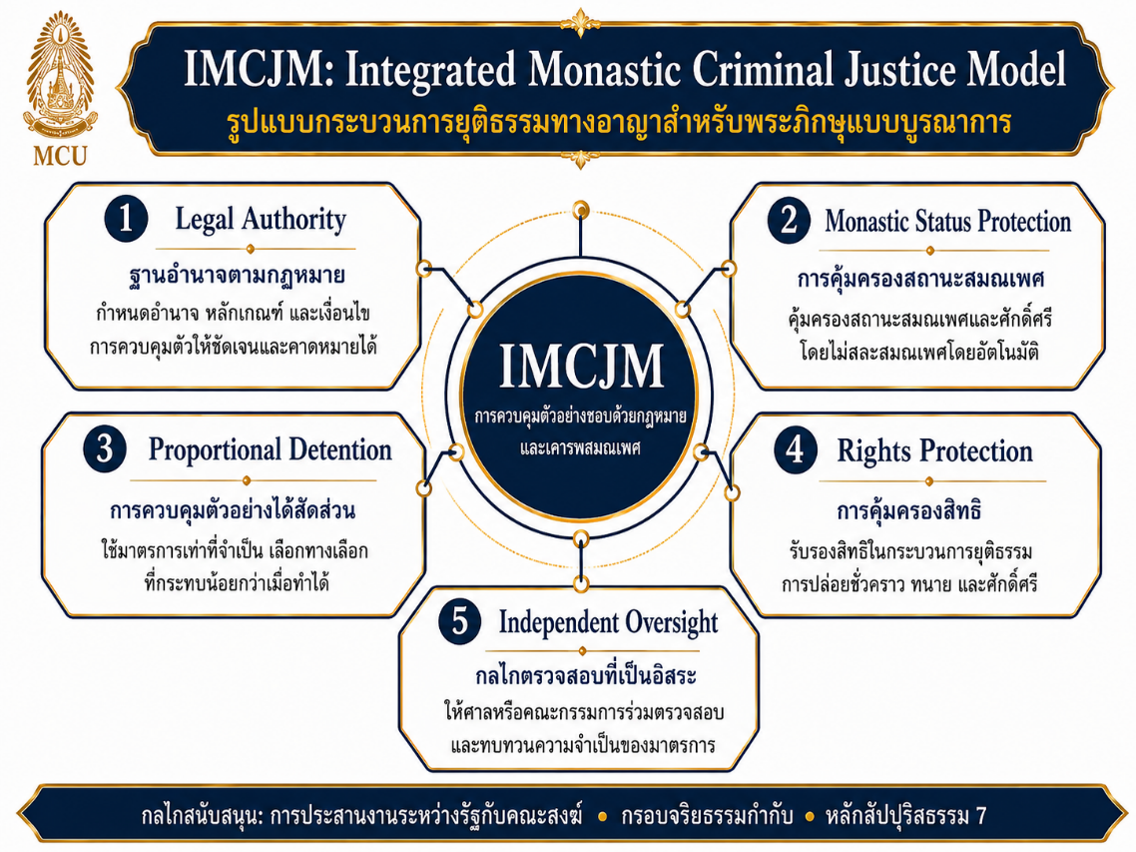
The findings revealed that: 1. the detention of persons in criminal proceedings must be based on lawful authority, necessity, proportionality, rights protection, and judicial oversight; 2. the detention of Buddhist monks has distinctive implications because it affects not only personal liberty, but also monastic status, religious dignity, and public confidence. Section 29 of the Sangha Act B.E. 2505 (1962) still contains gaps concerning clear criteria and review mechanisms prior to compulsory disrobing; and 3. the appropriate legal measure is the Integrated Monastic Criminal Justice Model (IMCJM), which establishes cooperation between state authorities and Sangha institutions. The model comprises five components: Legal Authority, Monastic Status Protection, Proportional Detention, Rights Protection, and Independent Oversight by courts or a joint review committee.
References
ณรงค์ ใจหาญ. (2568). หลักกฎหมายวิธีพิจารณาความอาญา เล่ม 1 (พิมพ์ครั้งที่ 16 แก้ไขเพิ่มเติม). กรุงเทพฯ: สำนักพิมพ์วิญญูชน จำกัด.
ติณเมธ วงศ์ใหญ่. (2569). ปัญหาการดำเนินอธิกรณ์ตามพระธรรมวินัยและการดำเนินกระบวนพิจารณาทางอาญากับพระสงฆ์ : กรณีศึกษาเปรียบเทียบคณะสงฆ์นิกายเถรวาท. วารสารนิติศาสตร์ มหาวิทยาลัยแม่ฟ้าหลวง, 9(1), 232-263.
ปัญม์ณิสาธ์ องค์ปรัชญากุล. (2566). ความสัมพันธ์ระหว่างกฎหมายทั่วไปกับพระราชบัญญัติคณะสงฆ์ พ.ศ. 2505. วารสารสมาคมรัฐประศาสนศาสตร์แห่งประเทศไทย, 5(9), 78–95.
พระพรหมคุณาภรณ์ (ป.อ. ปยุตฺโต). (2557). พจนานุกรมพุทธศาสตร์ ฉบับประมวลธรรม (พิมพ์ครั้งที่ 27). กรุงเทพฯ: โรงพิมพ์มหาจุฬาลงกรณราชวิทยาลัย.
มหาจุฬาลงกรณราชวิทยาลัย. (2539). พระไตรปิฎกฉบับภาษาไทย ฉบับมหาจุฬาลงกรณราชวิทยาลัย. กรุงเทพฯ: โรงพิมพ์มหาจุฬาลงกรณราชวิทยาลัย.
วราพงษ์ ฤทธิ์ศรี. (2562). มาตรการตามกฎหมายเกี่ยวกับกลไกการตรวจสอบพยานหลักฐานตามประมวลกฎหมายวิธีพิจารณาความอาญา. วารสารสหวิทยาการวิจัยและวิชาการ, 4(4), 713-726.
วัดบวรนิเวศวิหาร. (2564). สมเด็จพระมหาสมณเจ้ากรมพระยาวชิรญาณวโรรส กับการพัฒนาสยามประเทศ. กรุงเทพฯ: ห้างหุ้นส่วนจำกัด โรงพิมพ์สุรวัฒน์.
ศักดิ์มงคล เอื้อคณิต. (2567). การบังคับใช้กฎหมายในคดีอาญา ศึกษากรณีการใช้อำนาจในการสอบสวนและการดำเนินคดีของพนักงานสอบสวน. วารสารนิติสาร, 1(2), 63-92.
สำราญ ย่อยไธสงค์. (2569). การใช้อำนาจรัฐกับการสละสมณเพศ กรณีต้องคดีอาญา ศึกษาในเชิงประวัติศาสตร์และพัฒนาการของกฎหมาย. วารสารปัญญาปณิธาน, 9(1), 177-195.
อภิภัสร์ ปาสานะเก. (2568). กฎสามประเภทสำหรับภิกษุสงฆ์: การวิเคราะห์แนวคิดของสมเด็จพระมหาสมณเจ้ากรมพระยาวชิรญาณวโรรส. วารสารส่งเสริมและพัฒนาวิชาการสมัยใหม่, 3(5), 425-451.
Denzin, N. K. & Lincoln, Y. S. (2000). Handbook of Qualitative Research. Thousand Oaks, CA: Sage Publications.
Wynd, C. A. et al. (2003). Two Quantitative Approaches for Estimating Content Validity. Western Journal of Nursing Research, 25, 508-518.
Downloads
Published
How to Cite
Issue
Section
License
Copyright (c) 2026 Journal of Interdisciplinary Innovation Review

This work is licensed under a Creative Commons Attribution-NonCommercial-NoDerivatives 4.0 International License.
In order to conform the copyright law, all article authors must sign the consignment agreement to transfer the copyright to the Journal including the finally revised original articles. Besides, the article authors must declare that the articles will be printed in only the Journal of interdisciplinary Innovation Review. If there are pictures, tables or contents that were printed before, the article authors must receive permission from the authors in writing and show the evidence to the editor before the article is printed. If it does not conform to the set criteria, the editor will remove the article from the Journal without any exceptions.