BUDDHIST APPROACHES TO PUBLIC SERVICE MANAGEMENT FOR IMPROVING THE QUALITY AND EFFICIENCY OF LOCAL ADMINISTRATIVE ORGANIZATIONS IN KANCHANABURI PROVINCE
Keywords:
Buddhist Approaches, Public Service Management, Improving the Quality, Efficiency, Local Administrative OrganizationsAbstract
Objectives of this research were: 1. study public services focused on quality and efficiency development, 2. develop process innovations for public services focused on quality and efficiency development, and 3. evaluate Buddhist Approaches to Public Service Management for Improving the Quality and Efficiency of Local Administrative Organizations in Kanchanaburi Province. A mixed-methods research approach was employed, Data collection from 281 samples in Kanchanaburi Province. 18 individuals were interviewed, and nine individuals were evaluated using purposive sampling. The research tools was a questionnaire with a reliability value of 0.984, and interviews with key informants were used. Both descriptive and Statistics used for data analysis.
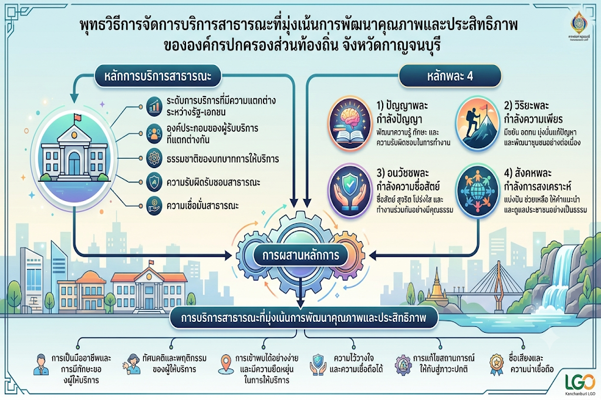
Findings were as follows: 1. Public services focused on quality and efficiency development have public service practices focused on quality and efficiency development. Overall, it was at a moderate level. 2. The innovation of public service processes that focus on quality and efficiency development was found to have 3 components: 1. Public service, with 5 indicators. 2. Applying the 4 principles of strength to promote innovation of public service processes, with 4 indicators. 3. Public service that focuses on quality and efficiency development, with 6 indicators and 3. The evaluation of Buddhist methods of managing public services that focus on quality and efficiency development of local administrative organizations in Kanchanaburi Province found that 1. Public service was found to be at the most appropriate level overall. 2. The 4 principles of strength were found to be at the most appropriate level overall. and 3. Public service that focuses on quality and efficiency development, was found to be at the most appropriate level overall. When considering each aspect, all aspects were found to be most appropriate.
References
กรมส่งเสริมการปกครองท้องถิ่น. (2550). สรุปสาระสำคัญมาตรฐานการบริการสาธารณะขององค์กรปกครองส่วนท้องถิ่น. กรุงเทพฯ: กรมส่งเสริมการปกครองท้องถิ่น.
ถนัด ไชยพันธ์. (2560). การประยุกต์ใช้หลักพุทธธรรมเพื่อการส่งเสริมประสิทธิผลในการบริหารงานขององค์กรปกครองส่วนท้องถิ่น จังหวัดอุบลราชธานี (ดุษฎีนิพนธ์ปริญญาพุทธศาสตรดุษฎีบัณฑิต สาขาวิชารัฐประศาสนศาสตร์). พระนครศรีอยุธยา: มหาวิทยาลัยมหาจุฬาลงกรณราชวิทยาลัย.
ภวัต นิตย์โชติ. (2561). การพัฒนาสมรรถนะตามหลักพละ 4 ของบุคลากรปกครองส่วนท้องถิ่น ในจังหวัดสงขลา (ดุษฎีนิพนธ์ปริญญาพุทธศาสตรดุษฎีบัณฑิต สาขาวิชารัฐประศาสนศาสตร์). พระนครศรีอยุธยา: มหาวิทยาลัยมหาจุฬาลงกรณราชวิทยาลัย.
รสคนธ์ รัตยเสริมพงศ์. (2557). ปัญหาและแนวทางแก้ไขปัญหาการจัดบริการสาธารณะของท้องถิ่น (เอกสารการสอนชุดวิชาการจัดบริการสาธารณะของท้องถิ่น หน่วยที่ 8-15). นนทบุรี: สำนักพิมพ์มหาวิทยาลัยสุโขทัยธรรมาธิราช.
สำนักงานคณะกรรมการกฤษฎีกา. (2542). พระราชบัญญัติกำหนดแผนและขั้นตอนการกระจายอำนาจให้แก่องค์กรปกครองส่วนท้องถิ่น พ.ศ. 2542. กรุงเทพฯ: สำนักงานกฤษฎีกา.
สำนักงานส่งเสริมการปกครองท้องถิ่นจังหวัดกาญจนบุรี. (2567). ข้อมูลพื้นฐานของ อปท. บุคลากร. สืบค้นเมื่อ 6 ธันวาคม 2567 จาก https://shorturl.asia/Z3N5r.
อุดมพร สุคนธฉายา. (2547). ศึกษาประสิทธิผลของการให้บริการประชาชนแบบศูนย์บริการจุดเดียวเบ็ดเสร็จ กรณีศึกษา ประชาชนผู้มาขอรับบริการ ณ สำนักงานเขตหลักสี่ กรุงเทพมหานคร (วิทยานิพนธ์ปริญญาบริหารธุรกิจมหาบัณฑิต สาขาวิชาบริหารธุรกิจ). กรุงเทพฯ: มหาวิทยาลัยราชภัฏพระนคร.
Yamane, T. (1973). Statistics: An Introductory Analysis (3rd ed.). New York: Harper and Row.
Downloads
Published
How to Cite
Issue
Section
License
Copyright (c) 2026 Journal of Interdisciplinary Innovation Review

This work is licensed under a Creative Commons Attribution-NonCommercial-NoDerivatives 4.0 International License.
In order to conform the copyright law, all article authors must sign the consignment agreement to transfer the copyright to the Journal including the finally revised original articles. Besides, the article authors must declare that the articles will be printed in only the Journal of interdisciplinary Innovation Review. If there are pictures, tables or contents that were printed before, the article authors must receive permission from the authors in writing and show the evidence to the editor before the article is printed. If it does not conform to the set criteria, the editor will remove the article from the Journal without any exceptions.