
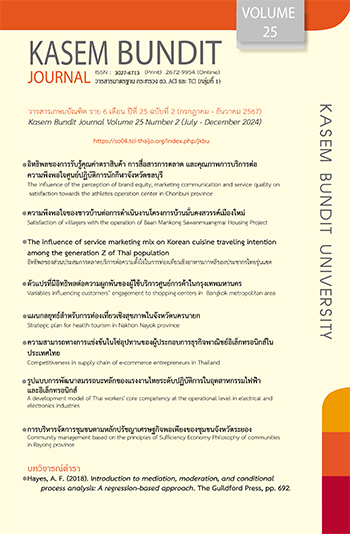
Hayes, A. F. (2018). Introduction to mediation, moderation, and conditional process analysis: A regression-based approach. The Guildford Press, pp. 692
Keywords:
Mediation, moderation, conditional processAbstract
PURPOSES: To present statistical methods for the analysis of mediation, moderation, and conditional process. METHODS: A documentary and critical analysis of a textbook. RESULTS: The textbook outlines and exemplifies statistical methods for the analysis of mediation, moderation, and conditional process among variables that can be applied in data analysis in social research. THEORETICAL/POLICY IMPLICATIONS: The textbook expands the frontier of statistical analysis of relations among variables and applicable in advanced social science research.
References
Baggozzi, R. P. (2010). Structural equation models are modelling tools with many ambiguities: Comments acknowledging the need for caution and humility in their use. Journal of Consumer Psychology, 20(210), 208–214.
Hair, J. F., Hult, G. T. M., Ringle, C. M., & Sarstedt, M. (2017). A primer on partial least squares structural equation modeling (2nd ed.). SAGE publications.
Hayes, A. F. (2018). Introduction to mediation, moderation, and conditional process analysis: A regression-based approach. The Guildford Press.
Hoyles, R. H. (Ed.). (1995). Structural equation modeling: Concepts, issues, and applications. SAGE Publications.
Downloads
Published
How to Cite
Issue
Section
License
Copyright (c) 2024 KASEM BUNDIT JOURNAL

This work is licensed under a Creative Commons Attribution-NonCommercial-NoDerivatives 4.0 International License.
ทัศนคติ ความคิดเห็นใด ๆ ที่ปรากฏในวารสารเกษมบัณฑิตฉบับนี้เป็นของผู้เขียน โดยเฉพาะ มหาวิทยาลัยเกษมบัณฑิตและบรรณาธิการ ไม่จำเป็นต้องมีความเห็นพ้องด้วย




