
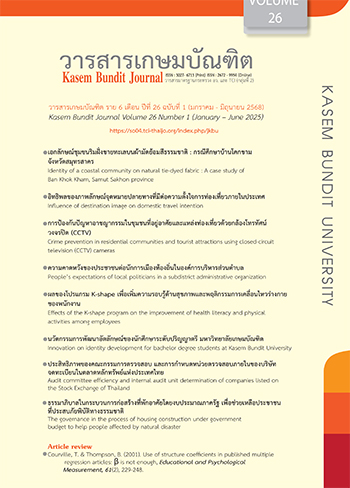
Audit committee efficiency and internal audit unit determination of companies listed on the Stock Exchange of Thailand
Keywords:
Effectiveness, audit committee, internal audit unit determinationAbstract
PORPOSES: To study and analyze the effect of financial risk factors on the effectiveness of the audit committee, the effectiveness of the audit committee on the determination of the internal audit unit, and the effect of financial risk on the determination of the internal audit unit through the effectiveness of the audit committee. METHODS: A quantitative research, the sample group being a specific selection of companies listed on the Stock Exchange of Thailand in the MAI group between 2018 and 2020, excluding companies with incomplete data and companies in the financial industry group. RESULTS: Financial risk was negatively related to the effectiveness of the audit committee, and the effectiveness of the audit committee was negatively related to the determination of the internal audit unit with statistical significance at p<0.01. THEORY/POLICY IMPLICATIONS: The study supports agency theory and expand the body of knowledge on internal audit of public companies, especially the audit committee.
References
Anderson, U. L., Christ, M. H., Johnstone, K. M., & Rittenberg, L. E. (2012). A post-SOX examination of factors associated with the size of internal audit functions. Accounting Horizons, 26(2), 167-191.
Asare, S. K., Davidson, R. A., & Gramling, A. A. (2008). Internal auditors' evaluation of fraud factors in planning an audit: The importance of audit committee quality and management incentives. International Journal of Auditing, 12(3), 181-203.
Beasley, M. S., Carcello, J. V., Hermanson, D. R., & Neal, T. L. (2009). The audit committee oversight process. Contemporary Accounting Research, 26(1), 65-122.
Bishop III, W. G., Hermanson, D. R., Lapides, P. D., & Rittenberg, L. E. (2000). The year of the audit committee. Internal Auditor, 57(2), 46-57.
Bradbury, M. E. (1990). The incentives for voluntary audit committee formation. Journal of Accounting and Public Policy, 9(1), 19-36.
Braiotta, L. (1999). The audit committee handbook. John Wiley & Sons.
Carcello, J. V., Hermanson, D. R., & Raghunandan, K. (2005). Factors associated with US public companies investment in internal auditing. Accounting Horizons, 19(2), 69-84.
Carey, P., Simnett, R., & Tanewski, G. A. (2000). Voluntary demand for internal and external auditing by family businesses. Auditing: A Journal of Practice & Theory, 19(s-1), 37-51.
Coram, P., Ferguson, C., & Moroney, R. (2008). Internal audit, alternative internal audit structures and the level of misappropriation of assets fraud. Accounting & Finance, 48(4), 543-559.
Dalton, D. R & Daily, C. M. (1999). What’s wrong with having friends on the board. Across the Board, 3(36), 28-32.
Ettredge, M., Simon, D., Smith, D., & Stone, M. (1994). Why do companies purchase timely quarterly reviews?. Journal of Accounting and Economics, 18(2), 131-155.
Gillan, S. L. (2006). Recent developments in corporate governance: An overview. Journal of Corporate Finance, 12(3), 381-402.
Goodwin‐Stewart, J., & Kent, P. (2006). Relation between external audit fees, audit committee characteristics and internal audit. Accounting & Finance, 46(3), 387-404.
Gramling, A., Maletta, M. J., Schneider, A., & Church, B. K. (2004). The role of the internal audit function in corporate governance: A synthesis of the extant internal auditing literature and directions for future research. Journal of Accounting Literature, 23(1), 194-244.
Ismael, H. R. H. (2013). Internal auditing in the UK: Factors affecting its use and its effectiveness [Unpublished doctoral dissertation]. University of Aberdeen.
Ismael, H. R., & Roberts, C. (2018). Factors affecting the voluntary use of internal audit: Evidence from the UK. Managerial Auditing Journal, 33(3), 288-317.
Jensen, M. C., & Meckling, W. H. (1976). Theory of the firm. managerial behavior, agency costs and ownership structure. Journal of Financial Economics, 3(4), 305-360.
Khongsawatkiat, K., Sirithanachiph, N., & Sirithanachiph, P. (2014). Risk management and derivatives. McGrew Hill Education.
Lewington, D. (1996). 2020 Vision. Managerial Auditing Journal, 11(7), 30-45.
Mangena, M., & Tauringana, V. (2008). Audit committees and voluntary external auditor involvement in UK interim reporting. International Journal of Auditing, 12(1), 45-63.
Patramontree, U. (2009). Modern internal auditing. Chamchuree Products Co.,Ltd.
Saardchom, N. (2007). Enterprise risk management. Than Books.
Sarens, G., & De Beelde, I. (2006). Internal auditors' perception about their role in risk management: A comparison between US and Belgian companies. Managerial Auditing Journal, 21(1), 63-80.
Sarens, G., De Beelde, I., & Everaert, P. (2009). Internal audit: A comfort provider to the audit committee. The British Accounting Review, 41(2), 90-106.
Sarisara, K. (2021). 101 Financial statements that new accountants must know. Dharmniti Press Co.,Ltd.,
Scarbrough, D. P., Rama, D. V., & Raghunandan, K. (1998). Audit committee composition and interaction with internal auditing: Canadian evidence. Accounting Horizons, 12(1), 51-72.
Selim, G., Woodward, S., & Allegrini, M. (2009). Internal auditing and consulting practice: A comparison between UK/Ireland and Italy. International Journal of Auditing, 13(1), 9-25.
Shleifer, A., & Vishny, R. W. (1997). A survey of corporate governance. The Journal of Finance, 52(2), 737-783.
Srijunpetch, S. (2008). Responsibilities of the board of directors, shareholder structure and economic value added. Journal of Accounting Professions, 4(10), 26-39. https://www.jap.tbs.tu.ac.th/files/Article/Jap10/Full/JAP10Sinlapaporn.pdf.
Srijunpetch, S. (2011). The role of internal auditors in creating value for the business. Journal of Business Administration Thammasat Business School, Thammasat University, 34(132), 1-5. https://www.jba.tbs.tu.ac.th/index.php?page=Article-List&sub=1&txt=405.
Taibanguay, S., Tansaenee, P., & Kraiyuth, A. (2019). The role of outsourced internal auditors in the borderless era. Academic Journal of Ramkhamhaeng University, 2(2), 48-63. https://so02.tci-thaijo.org/index.php/ibas/article/view/196565
The Institute of Internal Auditors. (2010). Internal audit. https://en.wikipedia.org/wiki/Internal audit.
The Institute of Internal Auditors. (2011). International standards for the professional practice of internal auditing. http://www.theiiat.or.th
The Securities and Exchange Commission of Thailand. (2017). Corporate governance code for listed companies 2017. https://www.sec.or.th/cgthailand/TH/Documents/Regulation/CGCode.pdf.
The Stock Exchange of Thailand. (2012). Corporate governance. https://www.set.or.th/th/about/overview/cg
The Stock Exchange of Thailand. (2020). Listing on the Stock Exchange of Thailand.
https://media.set.or.th/set/Documents/2022/Mar.pdf
Wallace, W. A., & Kreutzfeldt, R. W. (1991). Distinctive characteristics of entities with an internal audit department and the association of the quality of such departments with errors. Contemporary Accounting Research, 7(2), 485-512.
Weerananthawet, P., & Bosakoranut, S. (2020). Modern internal audit. Journal of Management and Development Ubon Ratchathani Rajabhat University, 7(1), 165-178. https://so06.tci-thaijo.org/index.php/JMDUBRU/issue/view/16729
Zaman, M., Hudaib, M., & Haniffa, R. (2011). Corporate governance quality, audit fees and non‐audit services fees. Journal of Business Finance & Accounting, 38(1-2), 165-197.
Downloads
Published
How to Cite
Issue
Section
License
Copyright (c) 2025 KASEM BUNDIT JOURNAL

This work is licensed under a Creative Commons Attribution-NonCommercial-NoDerivatives 4.0 International License.
ทัศนคติ ความคิดเห็นใด ๆ ที่ปรากฏในวารสารเกษมบัณฑิตฉบับนี้เป็นของผู้เขียน โดยเฉพาะ มหาวิทยาลัยเกษมบัณฑิตและบรรณาธิการ ไม่จำเป็นต้องมีความเห็นพ้องด้วย




