
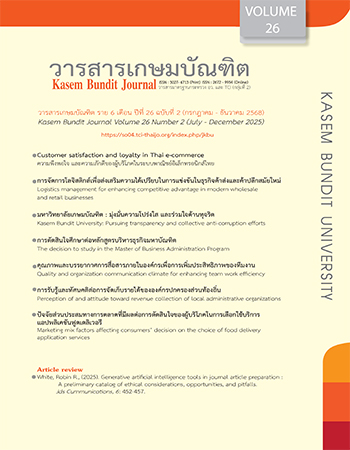
Customer satisfaction and loyalty in Thai e-commerce
Keywords:
Customer satisfaction, loyalty, e-commerce, online purchasingAbstract
PURPOSES: To investigate the influence of brand trust, AI service, self-convenience, personalized customization, and omnichannel marketing on customer satisfaction in online purchasing in Thai e-commerce and the relationship between customer satisfaction and e-loyalty in Thai e-commerce among customers in Bangkok. METHODS: Sample survey research of 400 customers in Thai e-commerce. Questionnaires were sent directly to respondents in Bangkok by google link, and all of them were returned. RESULTS: Omnichannel marketing, brand trust, and AI service were significantly related (p<0.05) with customer satisfaction. The customer satisfaction significantly influenced on e-loyalty (p<0.01). THEORETICAL/POLICY IMPLICATIONS: The retailers involved in e-commerce could use the research results as guidelines for management. The omnichannel marketing, brand trust, and AI service play a significant role in customer satisfaction that retailers could be concerned with.
References
Abu-Salim, T., Okey, P. O., Harrison, T., & Lindsay, V. (2017). Effects of perceived cost, service quality, and customer satisfaction on health insurance service continuance. Journal of Financial Services Marketing, 22(4), 173–186.
Afsar, A., Nasiri, Z., & Zadeh, M. O. (2013). E-loyalty model in e-commerce. Mediterranean Journal of Social Sciences, 4(9), 547–553.
Both, A., & Steinmann, S. (2023). Customer experiences in omnichannel retail environments: A thematic literature review. The International Review of Retail, Distribution and Consumer Research, 33(5), 445–478.
Chang, Y., & Geng, L. (2022). Planned or unplanned purchases? The effects of perceived values on omnichannel continuance intention. International Journal of Retail & Distribution Management, 50(12), 1535–1551.
Cheng, X., Bao, Y., Zarifis, A., Gong, W., & Mou, J. (2021). Exploring consumers’ response to text-based chatbots in e-commerce: The moderating role of task complexity and chatbot disclosure. Internet Research, 32(2), 496–517.
Cheng, X., Sun, J., & Zarifis, A. (2020). Artificial intelligence and deep learning in educational technology research and practice. British Journal of Educational Technology, 51(5), 1653–1656.
Chinomona, R. (2016). Brand communication, brand image, and brand trust as antecedents of brand loyalty in Gauteng Province of South Africa. African Journal of Economic and Management Studies, 7(1), 124–139.
Choi, E. K., Wilson, A., & Fowler, D. (2013). Exploring customer experiential components and the conceptual framework of customer experience, customer satisfaction, and actual behavior. Journal of Foodservice Business Research, 16(4), 347–358.
Gao, F., & Su, X. (2016). Omnichannel retail operations with buy-online-and-pick-up-in-store. Management Science, 63(8), 2478–2492.
Goebel, P., Moeller, S., & Pibernik, R. (2012). Paying for convenience—Attractiveness and revenue potential of time-based delivery services. International Journal of Physical Distribution & Logistics Management, 42(6), 584–606.
Gull, S., Tanvir, A., Zaidi, K. S., & Mehmood, Z. (2020). A mediation analysis of e-service quality and e-loyalty in the Pakistani e-commerce sector. Journal of the Research Society of Pakistan, 57(2), 66–73.
Han, S. H., Nguyen, B., & Lee, T. J. (2015). Consumer-based chain restaurant brand equity, brand reputation, and brand trust. International Journal of Hospitality Management, 50, 84–93.
Huang, M. H., & Rust, R. T. (2021). A strategic framework for artificial intelligence in marketing. Journal of the Academy of Marketing Science, 49(1), 30–50.
Kacprzak, A., & Hensel, P. (2023). Exploring online customer experience: A systematic literature review and research agenda. International Journal of Consumer Studies, 47(6), 2583–2608.
Khan, F. N., Arshad, M. U., & Munir, M. (2023). Impact of e-service quality on e-loyalty of online banking customers in Pakistan during the COVID-19 pandemic: Mediating role of e-satisfaction. Future Business Journal, 9(1), 2–12.
Khan, M. A., Zubair, S. S., & Malik, M. (2019). An assessment of e-service quality, e-satisfaction, and e-loyalty: Case of online shopping in Pakistan. South Asian Journal of Business Studies, 8(3), 283–302.
Kim, S., Connerton, T. P., & Park, C. (2022). Transforming the automotive retail: Drivers for customers’ omnichannel BOPS (buy online & pick up in store) behavior. Journal of Business Research, 139, 411–425.
Lee, C. Y. (2019). Does corporate social responsibility influence customer loyalty in the Taiwan insurance sector? The role of corporate image and customer satisfaction. Journal of Promotion Management, 25(1), 43–64.
Lie, D., Sudirman, A., Efendi, E., & Butarbutar, M. (2019). Analysis of mediation effect of consumer satisfaction on the impact of service quality, price, and consumer trust on consumer loyalty. International Journal of Scientific and Technology Research, 8(8), 421–428.
Lu, J., Ren, L., Zhang, C., Wang, C., Shahid, Z., & Streimikis, J. (2020). The influence of a firm’s CSR initiatives on brand loyalty and brand image. Journal of Competitiveness, 12(2), 106–124.
Nguyen, H. N., & Tran, M. D. (2023). Antecedents and outcomes of omnichannel retail customer experience. International Journal of Electronic Marketing and Retailing, 14(2), 171–189.
Nguyen, L., Nguyen, T. H., & Tan, T. K. P. (2021). An empirical study of customers’ satisfaction and repurchase intention on online shopping in Vietnam. Journal of Asian Finance, Economics, and Business, 8(1), 971–983.
Phang, G., Ng, J. E., & Fam, K. S. (2021). Customer engagement and loyalty issues in the omnichannel fast-food industry. International Journal of Business and Society, 22(3), 1429–1448.
Pooser, D. M., & Browne, M. J. (2018). The effects of customer satisfaction on company profitability: Evidence from the property and casualty insurance industry. Risk Management and Insurance Review, 21(2), 289–308.
Rahman, S. S., & Dekkati, S. (2022). Revolutionizing commerce: The dynamics and future of e-commerce web applications. Asian Journal of Applied Science and Engineering, 11(1), 65–73.
Rita, P., Oliveira, T., & Farisa, A. (2019). The impact of e-service quality and customer satisfaction on customer behavior in online shopping. Heliyon, 5(10), e02690. https://doi.org/10.1016/j.heliyon.2019.e02690
Sabri, L. H. B. A., Lim, A. H. L., & Goh, H. N. (2022). Click analysis: How e-commerce companies benefit from exploratory and association rule mining. Journal of System and Management Sciences, 12(6), 511–531.
Semadi, I. P., & Ariyanti, M. (2018). The influence of brand experience, brand image, and brand trust on brand loyalty of ABC-CASH. Asian Journal of Management Sciences & Education, 7(3), 12–23.
Tran, V. T., Nguyen, N. P., Tran, P. T. K., Tran, T. N., & Huynh, T. T. P. (2019). Brand equity in a tourism destination: A case study of domestic tourists in Hoi An City, Vietnam. Tourism Review, 74(3), 704–720.
Wan, J., Li, X., Dai, H. N., Kusiak, A., Martinez-Garcia, M., & Li, D. (2020). Artificial-intelligence-driven customized manufacturing factory: Key technologies, applications, and challenges. Proceedings of the IEEE, 109(4), 377–398.
Yang, K., Yang, H., Chang, W., & Chine, H. (2017). The effect of service quality among customer satisfaction, brand loyalty, and brand image. Journal of Business Social and Technology 4(2), 163-173.
https://doi.org/10.59261/jbt.v4i2.151.
Yang, N., & Yin, S. (2019). Research on the socialization path of virtual brand community members: A double intermediate perspective of satisfaction and identity. Journal of Xi’an University of Finance and Economics, 32(6), 103–110.
https://doi.org/10.19331/j.cnki.jxufe.2019.06.013.
Yi, S., & Liu, X. (2020). Machine learning-based customer sentiment analysis for recommending shoppers, shops based on customers’ reviews. Complex & Intelligent Systems, 6(3), 621–634.
Zhang, Q., Lu, J., & Jin, Y. (2021). Artificial intelligence in recommender systems. Complex & Intelligent Systems, 7(1), 439–457.
Zhu, T., Ye, D., Wang, W., Zhou, W., & Yu, P. (2020). More than privacy: Applying differential privacy in key areas of artificial intelligence. IEEE Transactions on Knowledge and Data Engineering.
Downloads
Published
How to Cite
Issue
Section
License
Copyright (c) 2025 KASEM BUNDIT JOURNAL

This work is licensed under a Creative Commons Attribution-NonCommercial-NoDerivatives 4.0 International License.
ทัศนคติ ความคิดเห็นใด ๆ ที่ปรากฏในวารสารเกษมบัณฑิตฉบับนี้เป็นของผู้เขียน โดยเฉพาะ มหาวิทยาลัยเกษมบัณฑิตและบรรณาธิการ ไม่จำเป็นต้องมีความเห็นพ้องด้วย




