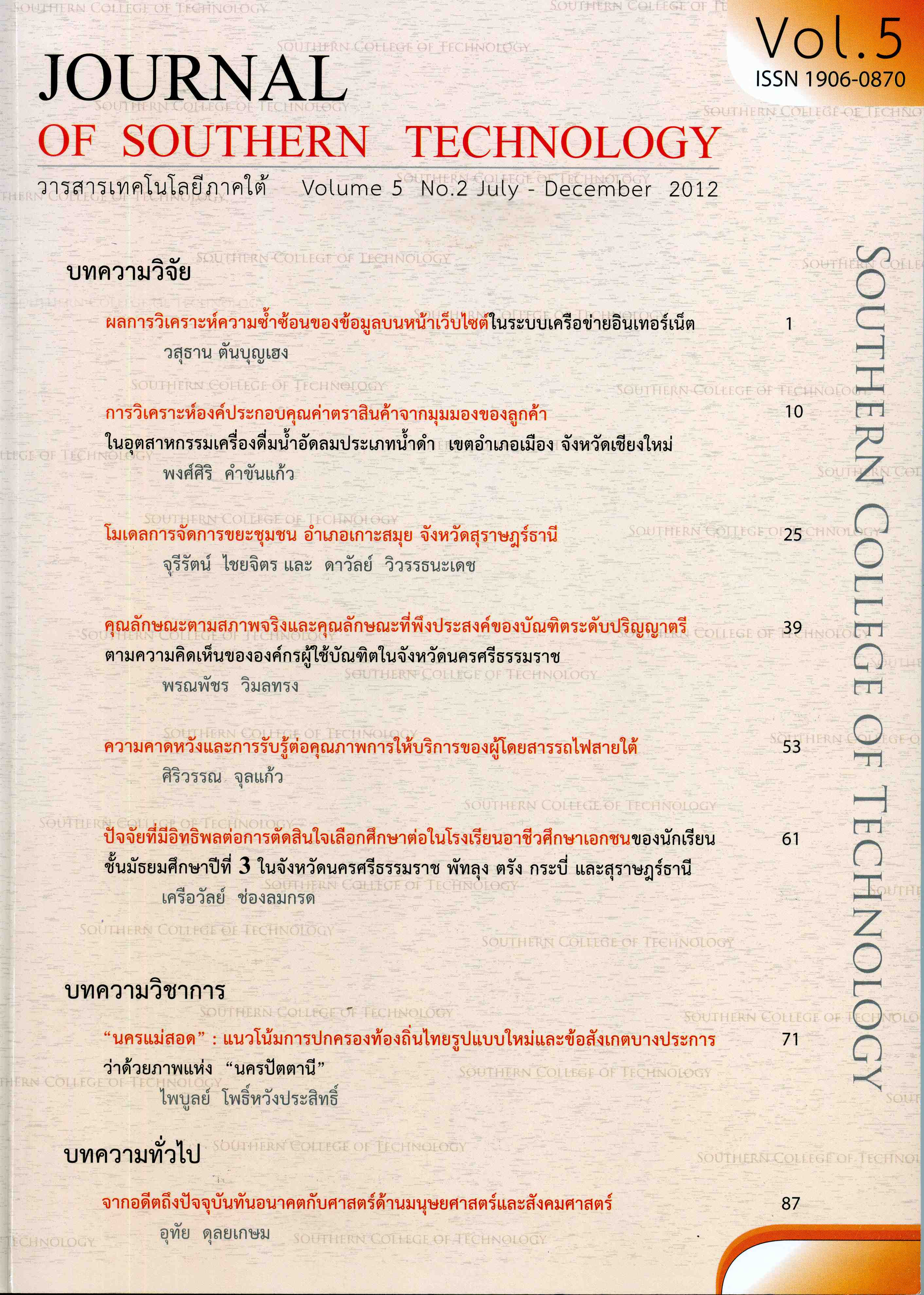
การวิเคราะห์องค์ประกอบคุณค่าตราสินค้าจากมุมมองของลูกค้า ในอุตสาหกรรมเครื่องดื่มน้ำอัดลมประเภทน้ำดำ เขตอำเภอเมือง จังหวัดเชียงใหม่
Article Sidebar
Main Article Content
บทคัดย่อ
งานวิจัยนี้มีวัตถุประสงค์เพื่อวิเคราะห์องค์ประกอบคุณค่าตราสินค้าจากมุมมองของลูกค้าในอุตสาหกรรมเครื่องดื่มน้ำอัดลมประเภทน้ำดำ กลุ่มตัวอย่างที่ใช้ในการวิจัยคือผู้บริโภคเครื่องดื่มน้ำอัดลมประเภทน้ำดำ ในเขตอำเภอเมือง จังหวัดเชียงใหม่ จำนวน 328 ราย มีแบบสอบถามเป็นเครื่องมือในการวิจัย โดยมีค่าความเชื่อมั่นเท่ากับ 0.939 และวิเคราะห์ข้อมูลโดยการวิเคราะห์องค์ประกอบ
ผลการวิจัยพบว่า องค์ประกอบคุณค่าตราสินค้าเครื่องดื่มน้ำอัดลมประเภทน้ำดำจากมุมมองของลูกค้ามี 4 องค์ประกอบ และ 32 ตัวแปร ได้แก่ ความภักดีต่อตราสินค้า การรับรู้คุณภาพของตราสินค้า ความเชื่อมโยงต่อตราสินค้า และการรู้จักตราสินค้า โดยมีค่าน้ำหนักองค์ประกอบระหว่าง 0.508 ถึง 0.808 การวิจัยได้ให้ข้อเสนอแนะหลายประการสำหรับผู้บริหารตราสินค้าเครื่องดื่มน้ำอัดลมประเภทน้ำดำ และผู้ที่สนใจศึกษาด้านองค์ประกอบคุณค่าตราสินค้าเพื่อเป็นแนวทางในการเสริมสร้างคุณค่าตราสินค้าจากมุมมองของลูกค้า และเสริมสร้างความได้เปรียบต่อการสร้างตราสินค้าต่อไป
Article Details
- ผู้เขียนต้องยินยอมปฏิบัติตามเงื่อนไขที่กองบรรณาธิการวารสารกำหนด และผู้เขียนต้องยินยอมให้บรรณาธิการ แก้ไขความสมบูรณ์ของบทความได้ในขั้นตอนสุดท้ายก่อนเผยแพร่
- ลิขสิทธิ์บทความเป็นของผู้เขียน แต่วารสารเทคโนโลยีภาคใต้คงไว้ซึ่งสิทธิ์ในการตีพิมพ์ครั้งแรก โดยเหตุที่บทความนี้ปรากฏในวารสารที่เข้าถึงได้จึงอนุญาตให้นำบทความไปใช้เพื่อประโยชน์ทางการศึกษา แต่มิใช่เพื่อการพาณิชย์
เอกสารอ้างอิง
ธนาคารแห่งประเทศไทย, สำนักงานภาคเหนือ. (2553). รายงานแนวโน้มธุรกิจ ฉบับ เดือนมิถุนายน. ค้นเมื่อ 16 กรกฎาคม 2554. จาก http://www.bot.or.th/Thai/Economic .
ผู้จัดการรายสัปดาห์. (2549). กลยุทธ์บริหารยักษ์ใหญ่ เป๊ปซี่ ต้องขยันสร้างความจงรักภักดี. ค้นเมื่อ 16 กรกฎาคม 2554,จาก http://www.gotomanager.com/ news/details.aspx?id=49932.
Aaker, D.A. (1991). Managing Brand Equity: Capitalization the Value of a Brand Name. New York : Free Press.
Aaker, D.A. (1996). Building Strong Brand. New York : the Free Press.
Aaker, D.A., & Mills, M. K. (2005). Strategic Market Management. Australia : John Wiley and Sons.
Chen, C.F., & Tseng, W. S. (2010). Exploring Customer-based brand Airline brand equity: Evidence from Taiwan. Transportation Journal, Winter. 49(1) , 24-34.
Cochran, L.J. (1977). Sampling Techniques. New York: Wiley.
Davis, D. F., Golicic, S. L & Marquardt, A. (2009). Measuring brand equity for logistics services. The International Journal of Logistics Management. 20(2), 201-212.
Hatch, M.J., & Schultz, M. (2001). Are the strategic signs aligned for your corporate brand?, Harvard Business review, February, 1-8.
Hair, Joseph F. Jr., Black, William C., Babin, Barry J. & Anderson, R. E. (2010). Multivariate Data Analysis: A Global Perspective. Pearson Education, Inc., Upper Saddle River, New Jersey, USA: Seventh Edition.
Helander, M.G., & Khalid, H.M. (2000). Modeling the customer in electronic commerce. Applied Ergonomics, 31(6), 609-619.
Jacoby, J. (1971). A model of multi-brand Loyalty. Journal of Advertising Research, 11 (3), 25-31.
Keller, K. L. (1993). Conceptualizing, Measuring., & Managing Customer-Based Brand Equity. Journal of Marketing. January, 57, 1-22.
Lee, G. C., Leh, F. C., & Yew. (2011). Dimensions of Customer-BasedBrand Equity: A Study on Malaysian Brands. Journal of Marketing Research and Case Studies.
Pappu, R., Quester, P. G., & Cooksey,
R. W. (2006). Consumer-based brand equity; improving the measurement –empirical evidence. The Journal of Product and Brand Management, 24, 143-154.
Peter, P. J. & Olson, J. C. (2008). Consumer Behavior and Marketing Strategy. (8 th ed.). New York: McGraw-Hill.
Thailand Food and Drink Report Q1. (2010). Business Monitor International Ltd.
Tong, X., & Hawley, T.M. (2009a). Creating brand equity in the Chinese clothing market: the Effect of selected marketing activities on brand equity dimensions. Journal of Fashion Marketing and Management, 13, 566-581.
Tong, X., & Hawley, T.M. (2009b). Measuring customer – based brand equity: empirical evidence from the sportswear market in China. Journal of Product and Brand Management. April, 18, 262 - 271.
Washburn, J., & Plank, R. E. (2002). Measuring Brand equity: an Evaluation of a Consumer-Based Brand Equity Scale. Journal of Marketing Theory and Practice, Winter, 10, 46-62.
Webster, F.E. Jr., & Keller, K.L. (2004). “A roadmap for branding in industrial markets”, Brand Management, 11 (5), 388-402.
Yoo, B., Donthu, N. & Lee, S. (2000). An Examination of selected marketing mix elements and brand equity. Academy ofMarketing Science. Journal, Spring, 28, 198-211.
Yoo, B., & Donthu, N. (2001). Developing and validating a multidimensional consumer-based brand equity scale. Journal of business Research, 25, 1-14.
