Preparation of activated carbon from agricultural waste hemp stalks using pyrolysis and microwave activation processes for the removal of methyl red dye
Article Sidebar
Main Article Content
Abstract
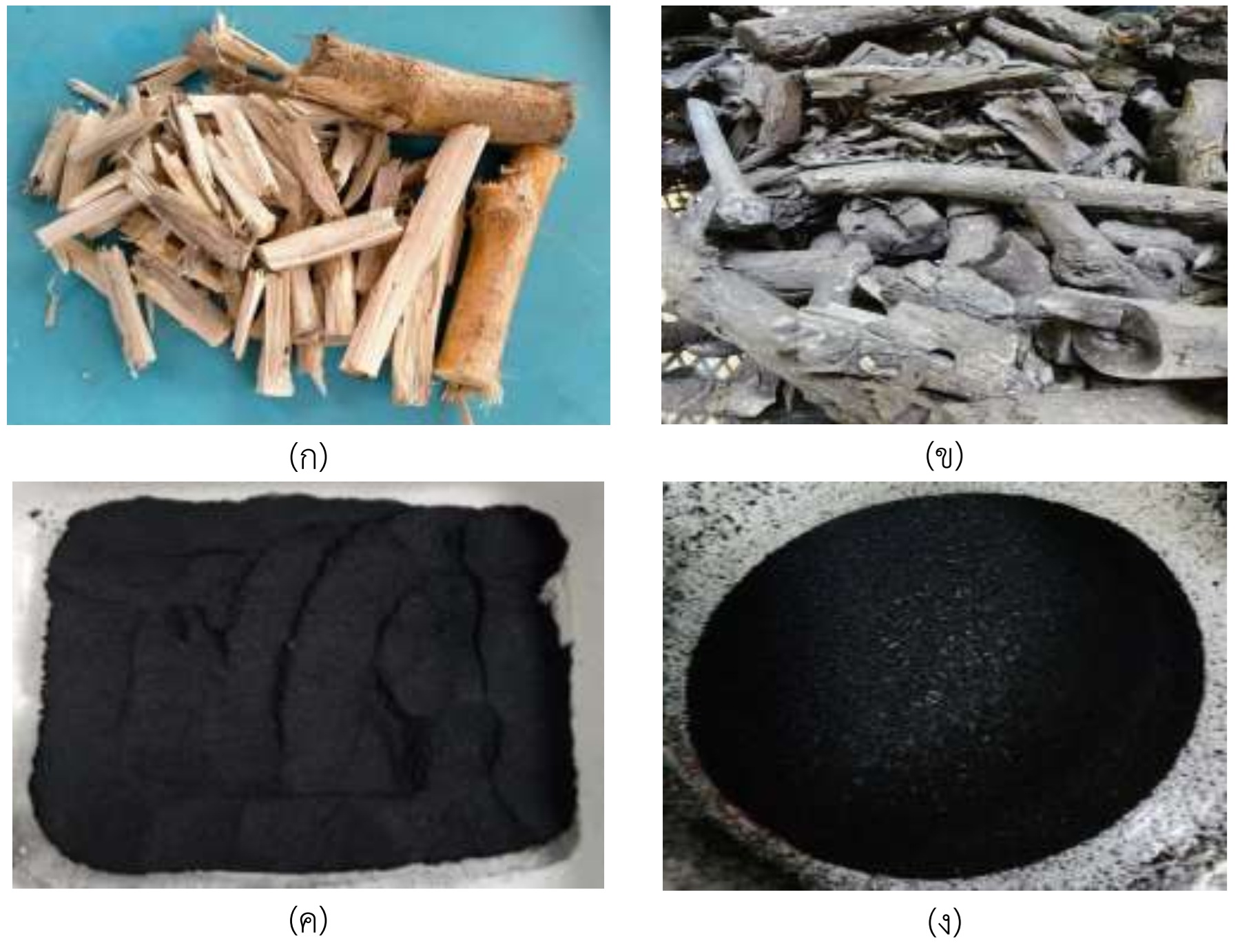
Activated carbon was prepared from agricultural waste derived from hemp stalks through a pyrolysis process using a traditional charcoal kiln. The resulting charcoal was subsequently activated using microwave irradiation. The study identified the optimal activation condition as microwave power of 800 Watt for a duration of 3 minutes. The activated carbon exhibited a highly porous microstructure with numerous micron-sized pores. Characterization by SEM-EDS and FTIR techniques revealed a significant increase in carbon content in the activated carbon compared to raw hemp stalks and unactivated biochar, with carbon content exceeding 92%. The adsorption performance of the activated carbon was investigated using a synthetic solution of methyl red (MR) dye at an initial concentration of 300 mg L-1 (100 mL volume). Adsorption was conducted under conditions of pH 3 at 30 °C, with 0.100 g of adsorbent, and agitation for 120 minutes. The activated carbon exhibited an MR removal efficiency of over 85%, with a maximum adsorption capacity (qₘ) of 270.27 mg g-1. The adsorption behavior was consistent with both the Langmuir and Freundlich isotherm models. Thermodynamic parameters demonstrated DG < 0 and DH⁰ of -31.0412 kJ mol-1K-1, indicating that the adsorption process was exothermic, multilayered, and characterized by a high density of adsorbed molecules on the surface of the adsorbent. Therefore, the microwave-activated carbon derived from hemp stalk waste exhibits excellent adsorption properties and can be effectively utilized for the removal of MR dye from aqueous solutions.
Article Details
References
Atkins, P. W., and De Paula, J., 2014, Atkins' physical chemistry. Oxford university press., 832-839.
Bouzid, T., Grich, A., Naboulsi, A., Regti, A., Tahiri, A. A., El Himri, M., and El Haddad, M. (2023). Adsorption of Methyl Red on porous activated carbon from agriculture waste: Characterization and response surface methodology optimization. Inorganic Chemistry Communications,
, 111544.
Christian, D., Gaekwad, A., Dani, H., Shabiimam, M. A., and Kandya, A. (2023). Recent techniques of textile industrial wastewater treatment: a review. Materials Today: Proceedings,
, 277-285.
Dawadi, K. B., Bhattarai, M., and Homagai, P. L., 2020, Adsorptive removal of methyl red from aqueous solution using Charred and Xanthated Sal (Shorea robusta) Sawdust. Amrit Res. J. 1(1): 37-44.
Du, C., Xue, Y., Wu, Z., and Wu, Z., 2017, Microwave-assisted one-step preparation of macadamia nut shell-based activated carbon for efficient adsorption of Reactive Blue. New. J. Chem. 41(24): 15373-15383.
Gul, S., Kanwal, M., Qazi, R. A., Gul, H., Khattak, R., Khan, M. S., and Krauklis, A. E., 2022, Efficient removal of methyl red dye by using bark of hopbush. Water, 14(18): 2831.
Hashmi, Z., Jatoi, A. S., Nadeem, S., Anjum, A., Imam, S. M., and Jangda, H. (2024). Comparative analysis of conventional to biomass-derived adsorbent for wastewater treatment: a review. Biomass Conversion and Biorefinery, 14(1), 45-76.
Hesas, R. H., Arami-Niya, A., & Daud, W. M. A. W. (2013). Preparation and Characterization of Activated Carbon from Apple Waste by Microwave-Assisted Phosphoric Acid Activation: Application in Methylene Blue Adsorption. BioResources, 8(2).
Meethai, S. Sikhamchin P., and Moonsri P., 2024, The effective removal of the metal ion Pb2+ from an aqueous solution by activated carbon prepared from macadamia nut shell: isotherm and thermodynamic studies. Journal of Vocational Education in Agriculture, 8(2): 32-47. (in Thai)
Moonsri, P., 2021, Properties of macadamia shell charcoal prepared by a small artificial furnace. Journal of Vocational Institute of Agriculture, 5(1): 28-39. (in Thai)
Staf, M., Šrámek, V., and Pohořelý, M. (2023). The Preparation of a Carbonaceous Adsorbent via Batch Pyrolysis of Waste Hemp Shives. Energies, 16(3), 1202.
Toptaş, Y., Yavuz, B., Aksoğan Korkmaz, A., and Önal, Y. (2024). Sustainable approach to dye adsorption: hemp-based activated carbon as an effective adsorbent. International Journal of Environmental Analytical Chemistry, 1-26.
