
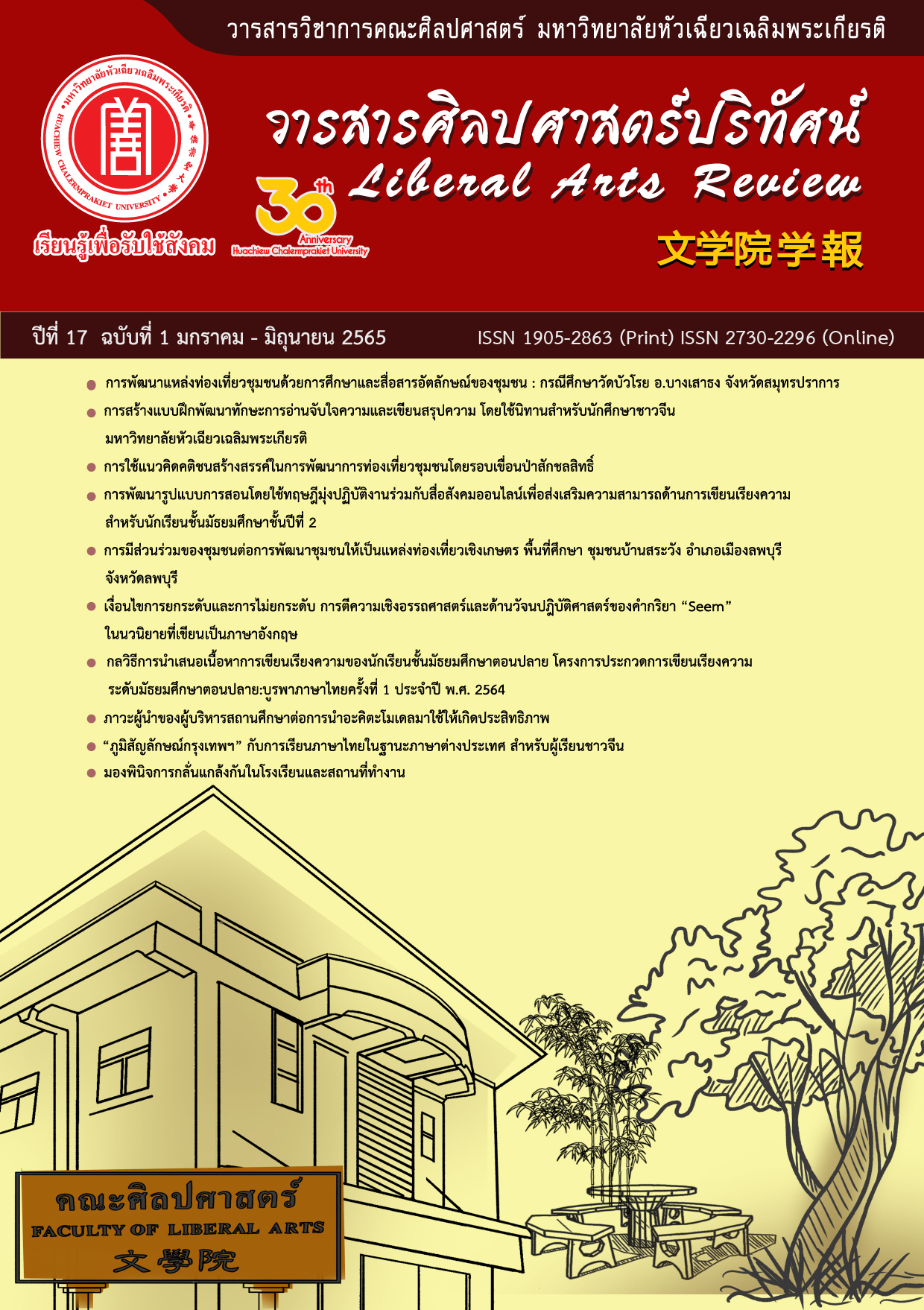
มองพินิจการกลั่นแกล้งกันในโรงเรียนและสถานที่ทำงาน
DOI:
https://doi.org/10.14456/lar.2022.10คำสำคัญ:
การกลั่นแกล้งกัน , การกลั่นแกล้งกันในโรงเรียนและสถานที่ทำงาน , เหตุผลของการกลั่นแกล้งกันบทคัดย่อ
บทความเรื่อง “มองพินิจการกลั่นแกล้งกันในโรงเรียนและสถานที่ทำงาน” มีจุดประสงค์เพื่อนำเสนอภาพรวมและวิเคราะห์เชิงลึกของการกลั่นแกล้งกันในโรงเรียนและสถานที่ทำงาน โดยครอบคลุมถึงประเด็นต่าง ๆ เช่น บทบาทของผู้ที่เกี่ยวข้องในกระบวนการกลั่นแกล้งกัน บุคลิกภาพที่ต่างกันของผู้กลั่นแกล้งและผู้ถูกกลั่นแกล้ง วิเคราะห์ลักษณะสำคัญของการกลั่นแกล้ง รูปแบบวิธีการและผลที่ตามมา รวมถึงเหตุผลซึ่งเป็นแรงผลักดันให้เกิดพฤติกรรมการกลั่นแกล้ง ประเด็นสำคัญที่พบในการมองพินิจการกลั่นแกล้งกันครั้งนี้ คือ บทบาทของบุคคลในกระบวนการกลั่นแกล้งมีการเปลี่ยนแปลงในบริบทใหม่ ผู้กลั่นแกล้งอาจไม่ใช่บุคคลที่แข็งแกร่งกว่าผู้ถูกกลั่นแกล้งในขณะเดียวกันผู้ถูกกลั่นแกล้งอาจไม่ใช่บุคคลที่มีข้อบกพร่องในชีวิต และมีหลายเหตุผลที่อยู่เบื้องหลังพฤติกรรมการกลั่นแกล้ง เช่น การเรียนรู้จากตัวแบบ ความต้องการอำนาจ การได้รับสิ่งที่ต้องการ ความอิจฉาริษยา การแก้แค้นเอาคืน และกลุ่มและการกระจายความผิดชอบ
เอกสารอ้างอิง
กรมสุขภาพจิต. (19 กุมภาพันธ์ 2564). บูลลี่ (Bully) คืออะไร มีกี่ประเภท วิธีที่จะรับมือจากการโดนบูลลี่. ค้นคืนจาก https://www.dmh.go.th/news-dmh/view.asp?id=30612.
ธันยากร ตุดเกื้อ, และมาลี สบายยิ่ง. (2560). รูปแบบ ผลกระทบ และวิธีการจัดการเมื่อถูกรังแกบนโลกไซเบอร์ของนักศึกษาวิทยาลัยแห่งหนึ่งในภาคใต้ของประเทศไทย. วารสารพฤติกรรมศาสตร์เพื่อการพัฒนา, 9(2), 220-236.
พิริยะ กิมาลี. (2563). การศึกษาสาเหตุและผลกระทบเชิงลึกของการตกเป็นเหยื่อการกลั่นแกล้งทางไซเบอร์ในที่ทำงาน. วารสารระบบสารสนเทศด้านธุรกิจ (JISB), 6(2), 6-19.
พลอยพัชชา แก้ววิเศษ, นันทรัตน์ มาตยาบุญ, ลาวัลย์ สมบูรณ์, และศลิษา โกดยี่. (2564). พฤติกรรมข่มเหงรังแกบนโลกไซเบอร์และปัจจัยที่เกี่ยวข้องของนักเรียนมัธยมในเขตอำเภอเมือง จังหวัดเชียงราย. วารสารสังคมศาสตร์และมานุษยวิทยาเชิงพุทธ, 6(5), 239-253.
ภูริฉัตร ปริยเมธานัยน์. (14 สิงหาคม 2563). ถูกบูลลี่ “ซานิ-หน้าหนอน” จนเคยคิดสั้น!! เผยมุมมืดเหตุผลที่คนวิจารณ์ “เสพติดศัลยกรรม”. ผู้จัดการออนไลน์, ค้นคืนจาก https://mgronline.com/live/detail/9630000083396.
วรรษา, เจ. (11 กุมภาพันธ์ 2565). ‘ฟ้าใส’ รับเคยถูกบูลลี่หนักจนเกือบซึมเศร้า ไม่อยากให้ใครต้องเจอแบบตน.เดอะ ไทเกอร์ นิวส์, ค้นคืนจาก https://thethaiger.com/th/news/528832/.
สถาบันวิจัยเพื่อความเสมอภาคทางการศึกษา (วสศ.). (10 มีนาคม 2564). เพราะการ ‘บูลลี่’ ไม่ใช่แค่เรื่องเด็ก ๆ. ค้นคืนจาก https://research.eef.or.th/bullying-in-thailand/.
สมโภชน์ เอี่ยมสุภาษิต. (2536). ทฤษฎีและเทคนิคการปรับพฤติกรรม. กรุงเทพฯ: สำนักพิมพ์แห่งจุฬาลงกรณ์มหาวิทยาลัย.
อมรินทร์ เทเลวิชั่น. (19 มีนาคม 2564). โผล่อีก! คลิป นร.หญิงโรงเรียนดัง สาดน้ำ บูลลี่ เพื่อนตั้งแต่ ม.1 เผยครูให้ปิดข่าว. อมรินทร์ทีวี, ค้นคืนจาก https://www.amarintv.com/news/detail/71493.
Analisah, C. D. C., & Indartono, S. (2018). Ecological Theory: Preventing Student Bullying To Promote Culture of Peace. Advances in Social Science, Education and Humanities Research, 323, 239-244.
Baillien, E., & De Witte, H. (2009). The Relationship between the occurrence of conflicts in the work unit, the conflict management styles in the work unit and workplace bullying. Psychologica Belgica, 49(4), 207-226.
Bandura, A. (1986). Social Foundations of Thought and Action: A Social Cognitive Theory. Englewood Cliffs, New Jersey: Prentice –Hall.
Bottin, S. M. B., Bottino, C. M. C., Regina, C. G.,Correia, A. V. L., & Ribeiro, W. S. (2015). Cyberbullying and adolescent mental health: systematic review. Cadernos de Saude Publica, 31, 463-475. DOI: 10.1590/0102-311x00036114.
Carney, A. G., & Merrell, K. W. (2001). Bullying in schools: Perspective on understanding and preventing an international problem. School Psychology International, 22(3), 364-382.
Cech, T., Kvintova, J., Cakirpaloglu, S. D. (2018). Causes of bullying in the workplace among primary school teachers of your paper. Global Journal of Guidance and Counseling in Schools Current Perspectives, 8(3), 173-181.
Cook, C., Williams, K. R., Guerra, N. G., Kim, T., & Sadek, S. (2010). Predictors of bullying and victimization in childhood and adolescence: A meta-analytic investigation. School Psychology Quarterly, 25, 65–83.
Creemers, B. P. M., & Kyriakides, L. (2012). Improving Quality in Education. NY: Routledge. Ditch The Label. (2021). Why do people bully? The Scientific Reasons. [cited 2021 Oct 14]. Retrieved from https://www.ditchthelabel.org/why-do-people-bully/.
Fodor, E. M. (2009). Power motivation. In Leary, M. R., & Hoyle, R. H. (Eds.), Handbook of individual differences in social behavior. New York: The Guilford Press.
Gordon, S. (2020). 8 Facts About Bullying Everyone Should Know. [cited 2021 Oct 20]. Retrieved from https://www.verywellfamily.com/facts-about-bullying-everyone-shouldknow-460492.
Gordon, S. (2021). 8 Reasons Why Teens Bully Others. [cited 2021 Oct 20]. Retrieved from https://www.verywellfamily.com/reasons-why-teens-bully-others-460532.
Greene, M. B. (2000). Bullying and harassment in schools. In Moser, R. S., & Frantz, C. E. (Eds.), Shocking violence: Youth perpetrators and victims—A multidisciplinary perspective. Charles C Thomas.
Griffin, R. S., & Gross, A. M. (2004). Childhood bullying: Current empirical findings and future directions for research. Aggression and Violent Behavior, 9(4), 379-400. DOI: org/ 10.1016/S1359-1789(03)00033-8.
Grille, R. (n.d.). Natural Born Bullies. [cited 2021 Feb 4]. Retrieved from https://www.naturalchild. org/ articles/robin_grille/natural_born_bullies.html.
Holt, M. K., Vivolo, K. A. M., Polanin, J. R., Holland, K. M., De Gue, S., Matjasko, J. L., & Reid, G. (2015). Bullying and suicidal ideation and behaviors: A meta-analysis. Pediatrics, 135, e496–e509.
Limbana, T., Khan, F., Eskander, N., Emamy, M., & Jahan, N. (2020). The Association of Bullying and Suicidality: Does it Affect the Pediatric Population?. Cureus, 12(8), e9691. DOI: 10.7759/ cureus.9691.
Menesini, E., Salmivalli., C. (2017). Bullying in schools: the state of knowledge and effective interventions. Psychology Health and Medicine, 22(1), 240-253. DOI: 10.1080/13548506. 2017.1279740.
Natvig, G. K., Albertson, G. & Quarnstrom, U. (2001). School-related stress experience as a risk factor for bulling behavior. Journal of Youth and Adolescence, 30(5), 561-575.
Nittle, N. (2021). Why Do People Bully? [cited 2021 Oct 2]. Retrieved from https://www. verywellmind.com/why-do-people-bully-5187244.
Olthof, T., & Goossens, F. A. (2008). Bullying and the need to belong: Early adolescents’ bullying related behavior and the acceptance they desire and receive from particular classmates. Social Development, 17, 24-46.
Olthof, Goossens, F. A., Vermande, M. M., Aleva, E. A., & Van der Meulen, M. (2011). Bullying as strategic behavior: Relations with desired and acquired dominance in the peer group. Journal of School Psychology, 49, 339-359.
Olweus, D. A. (1994). Annotation: Bullying at school: Basic facts and effects of a school based intervention program. Journal of Child Psychology and Psychiatry, 35(7), 1171-1190.
Olweus, (n.d.). Bullying in Schools: Facts and Intervention. [cited 2021 Sep 9]. Retrieved from
https://www.researchgate.net/publication/228654357_ Bullying_ in_ Schools_facts_and_ intervention.
Ouvrein, G., Vandebosch, H., De backer, C. J. (2017). Celebrity critiquing: hot or not? Teen girls’ attitudes on and responses to the practice of negative celebrity critiquing. Celebrity Studies, 8(3), 461-476.
Peterson, L., & Rigby, K. (1999). Countering bullying at an Australian secondary school with students as helpers. Journal of Adolescence, 22, 481-492.
Salimivalli, C., & Nieminen, E. (2002). Proactive and reactive aggression among school bullies, victims, and bully-victims. Aggressive Behavior, 28, 30-44.
Salimivalli, Voeten, M., & Poskiparta, E. (2011). Bystanders matter: Associations between reinforcing, defending, and the frequency of bullying behavior in classrooms. Journal of Clinical Child & Adolescent Psychology, 40, 668–676.
Slee, P.T., & Rigby, K. (1993). The relationship of Eysenck's personality factors and self-esteem to bully-victim behaviour in Australian schoolboys. Personality and Individual Differences, 14(2), 371-373.
Sockolov, E. (2017). Diffusion of Responsibility-Definition and example. [cited 2022 Jan 5]. Retrieved from https://onemindtherapy.com/social-psychology/diffusion-of-responsibility/.
Stoltz, P. G. (1997). Adversity Quotient Turning Obstacles into Opportunity. NY: John Wiley & Sons.
Toblin, R. L., Schwartz, D., Gorman, A. H., & Abou-ezzeddine, T. (2005). Social-cognitive and behavioral attributes of aggressive victims of bullying. Journal of Applied Developmental Psychology, 26, 329–346.
Trach, J., & Hymel, S. (2020). Bystanders' affect toward bully and victim as predictors of helping and non-helping behavior. Scand J Psychol, 61(1), 30-37. Doi: 10.1111/sjop.12516.
Vissing, Y. M., Straus, M. A., Gelles, R. J., & Harrop, J. W. (1991). Verbal aggression by parents and psychosocial problems of children. Child Abuse and Neglect, 15(3), 223-238.
Whitson, S. (2014). 6 Reasons Why Bystanders Choose Not to Intervene to Stop Bullying. [cited 2022 Jan 5]. Retrieved from: https://www.huffpost.com/entry/six-reasons-why-bystander_b_4295181.
Wolke, D., Copeland, W, E., Angold, A., & Costello, E. J. (2013). Impact of Bullying in Childhood on Adult Health, Wealth, Crime and Social Outcomes. Psychol Sci, 24(10), 1958–1970.DOI: 10.1177/0956797613481608.
ดาวน์โหลด
เผยแพร่แล้ว
รูปแบบการอ้างอิง
ฉบับ
ประเภทบทความ
สัญญาอนุญาต
ลิขสิทธิ์ (c) 2022 ศิลปศาสตร์ปริทัศน์

อนุญาตภายใต้เงื่อนไข Creative Commons Attribution-NonCommercial-NoDerivatives 4.0 International License.
บทความที่ได้รับการตีพิมพ์เป็นลิขสิทธิ์ของวารสารศิลปศาสตร์ปริทัศน์
ข้อความที่ปรากฏในบทความแต่ละเรื่องในวารสารวิชาการเล่มนี้เป็นความคิดเห็นส่วนตัวของผู้เขียนแต่ละท่านไม่เกี่ยวข้องกับมหาวิทยาลัยหัวเฉียวเฉลิมพระเกียรติ และคณาจารย์ท่านอื่นๆในมหาวิทยาลัยฯ แต่อย่างใด ความรับผิดชอบองค์ประกอบทั้งหมดของบทความแต่ละเรื่องเป็นของผู้เขียนแต่ละท่าน หากมีความผิดพลาดใดๆ ผู้เขียนแต่ละท่านจะรับผิดชอบบทความของตนเองแต่ผู้เดียว