DEVELOPMENT OF AN INTERDISCIPLINARY INTEGRATION MUSIC INSTRUCTIONAL MODEL IN THE DEVELOPMENT OF HIGHER ORDER MUSICAL THINKING SKILLS OF SECONDARY SCHOOL STUDENTS
Keywords:
Higher-Order Thinking Skills in Music, Music Learning Management Model, Interdisciplinary IntegrationAbstract
Background and Objectives: Higher Order Thinking Skills refer to a complex thought process that relies on Lower Order Thinking Skills: remembering, understanding, and applying. These Lower Order Thinking Skills are essential for developing Higher Order Thinking Skills, which include analyzing, evaluating, and creating. Such skills are crucial for individuals today who navigate a wealth of information from the Internet and various online social media platforms that spread information rapidly. This rapid dissemination makes it increasingly difficult to predict contemporary societal trends, which are characterized by high uncertainty and constant change. Consequently, there has been a growing body of research aimed at cultivating Higher Order Thinking Skills among youth, particularly high school students. It is undeniable that these skills are often associated with education in science and mathematics. Furthermore, it is evident that music is interconnected with knowledge across various disciplines, including the humanities and social sciences. This connection suggests that utilizing music content and skills as a central theme through processes of analysis, evaluation, and creation is particularly suitable for enhancing higher-order thinking skills among students. Therefore, this research aims to develop an integrated music learning model to promote higher-order musical thinking skills for high school students. The objectives of this research are as follows: 1) to study the integrated music teaching behaviors of high school music teachers; 2) to develop an interdisciplinary integrated music teaching model to promote Higher Order Thinking Skills among high school students; and 3) to evaluate the effectiveness of this model in enhancing Higher Order Thinking Skills.
Methods: The research methodology is a Research and Development, divided into four phases. Phase 1 involves examining the behaviors and conditions of integrated music learning among high school music teachers. This phase is divided into two steps: the first step entails quantitative research. It utilizes a behavioral measurement tool developed by the researcher to survey the current state of integrated music teaching practices among high school music teachers in Bangkok and its vicinity. The sample, obtained through simple random sampling, comprises 183 music teachers who responded to the behavioral measurement tool and were categorized into two groups based on their scores: 95 teachers exhibiting favorable behaviors and 88 teachers exhibiting less favorable behaviors. The second step involves qualitative research, entailing in-depth interviews with participants from the first step, using an interview guide designed by the researcher. Targeted samples of four teachers—two from the favorable behavior group and two from the less favorable group—were selected to identify key factors that support or hinder integrated music learning behaviors. Phase 2 focuses on developing an integrated music learning model to enhance Higher Order Thinking Skills among high school students. This involves document analysis and a review of research to create a learning model based on the findings of Phase 1. Phase 3 assesses the effectiveness of the developed learning model by applying it to an experimental group of 20 students from the fifth grade at Srinakharinwirot University Demonstration School (secondary) over 12 weeks in the second semester of 2023. This phase employs a One-Group Pretest-Posttest Design for the experimental research. Phase 4 aims to refine the integrated music learning model to ensure it effectively enhances Higher Order Musical Thinking Skills among high school students, culminating in a comprehensive version of the model.
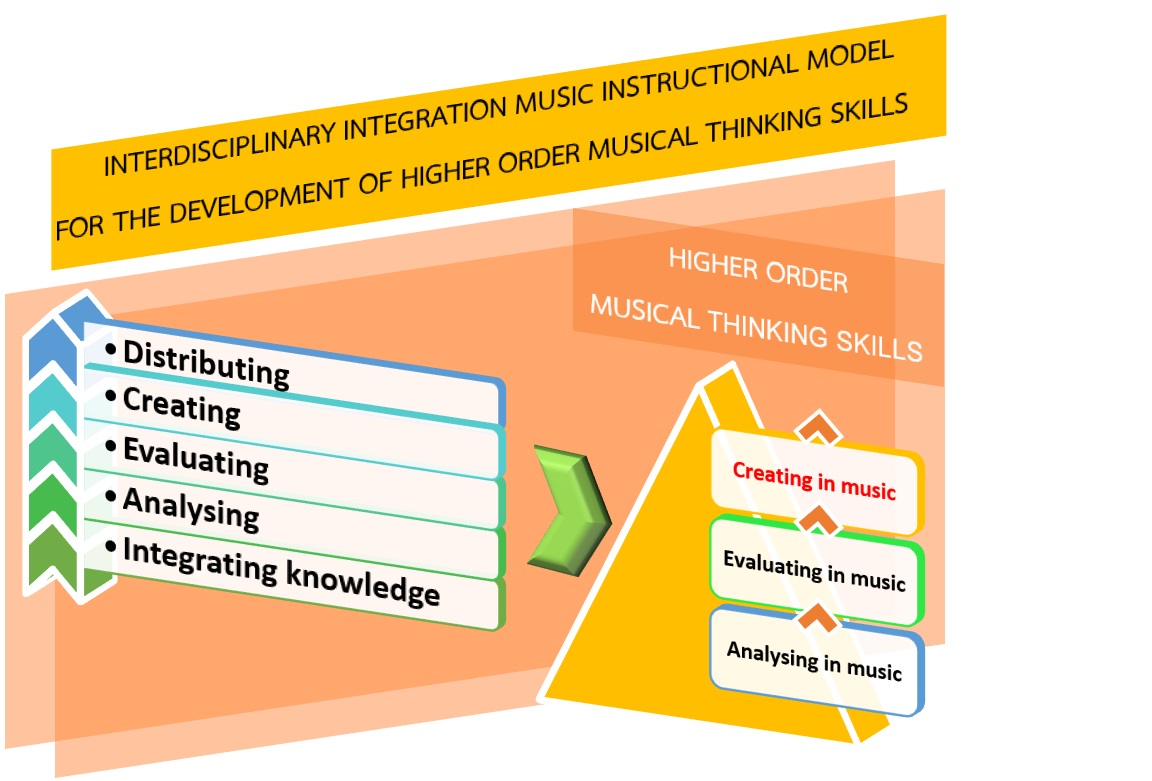
Results: The research results indicate that 1) the examination of music teaching behaviors reveals that supporting factors for integrated teaching include teachers' experience, their appreciation of curriculum integration, and their ability to organize content autonomously. Conversely, hindering factors involve teachers' lack of awareness regarding the importance of integration, discomfort with the content, limited class periods, unprepared materials and resources, excessive student numbers per classroom, and inadequate prior knowledge among students. 2) The developed model consists of five instructional steps: Step 1: Integrating Knowledge, Step 2: Analyzing, Step 3: Evaluating, Step 4: Creating, and Step 5: Distributing. 3) Effectiveness studies show significant increases in students' higher-order thinking skills in musical analysis and creativity at the 0.01 significance level; however, evaluative thinking scores did not reach statistical significance. In summary, this study indicates that music content and skills, when related to other fields, can be effectively integrated into interdisciplinary curricula. Coupled with the teaching model developed in this research, it can enhance Higher Order Thinking Skills among high school students.
Conclusions: Phases 1 and 2 of this research demonstrated that interdisciplinary integration can be effectively applied to teaching music content and skills because of music’s close relationship with the humanities, social sciences and arts. Most music teachers recognize the value of integrating music with other disciplines. However, time constraints, resource limitations, or insufficient content expertise make interdisciplinary music education challenging. The five-step learning management model, developed in phases 3 and 4, is adaptable to the specific contexts of educational institutions. The model aims to foster higher-level thinking skills, such as analytical, evaluative, and creative musical thinking, through diverse teaching and learning processes that prioritize active learning over lecturing. Assessment should employ a variety of methods. Teachers should act as facilitators, enhancing their knowledge and skills to effectively implement interdisciplinary learning.
References
Alam, Afroz. "Connectivism Learning Theory and Connectivist Approach in Teaching and Learning: A Review of Literature." Bhartiyam International journal of Education and Research 12, no. 2 (March 2023): 1-15.
Anderson, Lorin W., and David R. Krathwohl. A Taxonomy for Learning, Teaching, and Assessing. New York: Longman, 2001.
Bampenthan, Theeraphong. "Development of Thematic Interdisciplinary Supplementary Book: The Music Cultural Exchange in Franco - Thai Relations in the Reign of King Narai The Great." Research Report, Srinakharinwirot University Demonstration School (Secondary), 2022. (in Thai)
Cascio, Jamais. "Facing the Age of Chaos." Accessed June 25, 2024. https://medium.com/@cascio/facing-the-age-of-chaos-b00687b1f51d.
Chanchang, Jirachapan. "Integrated Teaching and Learning Management for the Development of Higher Order Thinking Skills: Learning to Practice." Journal of Education Studies 48, no. 3 (July-September 2020): 78-89. (in Thai)
Domrongchareon, Komtham. Baroque Music. Bangkok: Faculty of Music, Silpakorn University, 2010. (in Thai)
Heong, Yee Mei, Widad Binti Othman, Jailani Bin Md Yunos, Tee Tze Kiong, Razali Bin Hassan, and Mimi Mohaffyza Binti Mohamad. "The Level of Marzano Higher Order Thinking Skills among Technical Education Students." International Journal of Social Science and Humanity 1, no. 2 (July 2011): 121-125.
Jitchayavanich, Kulisara. Learning Management. Bangkok: Chulalongkorn University Press, 2018. (in Thai)
Kanchana, Boobphan, boonchan Sisan, and Pariyaporn Tungkunanan. "Higher Order Thinking Skills of Students in Bangkok, Thailand." Revista Espacios 41, no. 48 (2020): 331-340.
Khemmani, Tisana. Science of Teaching. Bangkok: Chulalongkorn University Press, 2018. (in Thai)
Kruger, Jaco, and Liesl van der Merwe. "Learning About the World: Developing Higher Order Thinking in Music Education." Journal for Transdisciplinary Research in Southern Africa 8, no. 1 (July 2012): 63-80.
Ministry of Education. The Basic Education Core Curriculum B.E. 2551 (A.D. 2008). Bangkok: The Agricultural Co-operative Federation of Thailand Press, 2008. (in Thai)
Miri, Barak, Ben-Chaim David, and Zoller Uri. "Purposely Teaching for the Promotion of Higher-order Thinking Skills: A Case of Critical Thinking." Research in Science Education 37, no. 4 (October 2007): 353-369.
Na Bangchang, Yanyong. "Development of a Creative Learning Management Model to Promote Creative Products for Students in Grades Four to Six." PhD diss., Srinakharinwirot University, 2019. (in Thai)
Posrithong, Arethit. "The Teacher Professional Development Program for Developing the Competencies of Music Teachers in the 21st Century." PhD diss., Srinakharinwirot University, 2016. (in thai)
Pumin, Prapansak. "Guidelines for the Development of Music Education in Primary Schools under the Bangkok Metropolitan Administration." Research Report, Srinakharinwirot University, 2014. (in Thai)
Sitthichaiyakarn, Sawitree, and Laddawan Petroj. "Academic Administration Model According to Stem Education Concept of Network Schools in Regional Stem Education Center." Journal of Research and Curriculum Development 9, no. 1 (January-June 2019): 17-32. (in Thai)
Srisuk, Apinya. "Effect of Using the 5E Learning Cycle Modified and Active Learning Techniques on Higher-Order Thinking Skills and Learning Motivation among Seventh Grade Students." Master's thesis, Srinakharinwirot University, 2019. (in Thai)
Susaoraj, Prapansiri. Development of Thinking. Bangkok: Technic Printing, 2013. (in Thai)
Suthasinobon, Kittichai. "The Development of Integrated Instructional Model base on Buddhist Principles Reflects Sufficiency Economy Philosophy in Context of Modern Thai Society." Research Report, Srinakharinwirot University, 2012. (in Thai)
The Institute for the Promotion of Teaching Science and Technology. PISA 2018 Assessment Result on Reading, Mathematics, and Science. Bangkok: The Institute for the Promotion of Teaching Science and Technology, 2021. (in Thai)
Thongpanit, Pratya. "Instructional Paradigm to Promote Twenty First - Century Higher Order Thinking Skills of Grade 9 Students by NSW Model." Journal of Buddhist Anthropology 6, no. 7 (July 2021): 18-32. (in Thai)
Westrup, Jack. An Introduction to Musical History. London: Hutchinson University Library, 1973.
World Economic Forum. "The Fourth Industrial Revolution." Accessed June 27, 2024. https://www.weforum.org/.
Yimpluem, Santi. "A Study of Music Teaching Conditions in the Basic Education Curriculum Level 3 of Schools under the Office of the Surat Thani Educational Service Area 3." Master's thesis, Bansomdejchaopraya Rajabhat University, 2013. (in Thai)
Downloads
Published
How to Cite
Issue
Section
License
Copyright (c) 2025 College of Music

This work is licensed under a Creative Commons Attribution-NonCommercial-NoDerivatives 4.0 International License.
The copyright of the article belongs to the author. Published articles represent the views of the authors. The editorial team neither necessarily agree with nor take any responsibility for the article.