ANALYSIS OF THE POPULAR MUSIC “ROCKSTAR” BY LISA LALISA MANOBAL APPLYING ALLAN F. MOORE'S APPROACH
Keywords:
Lisa, Lalisa Manobal, Popular Music Analysis, Rockstar, Allan F. MooreAbstract
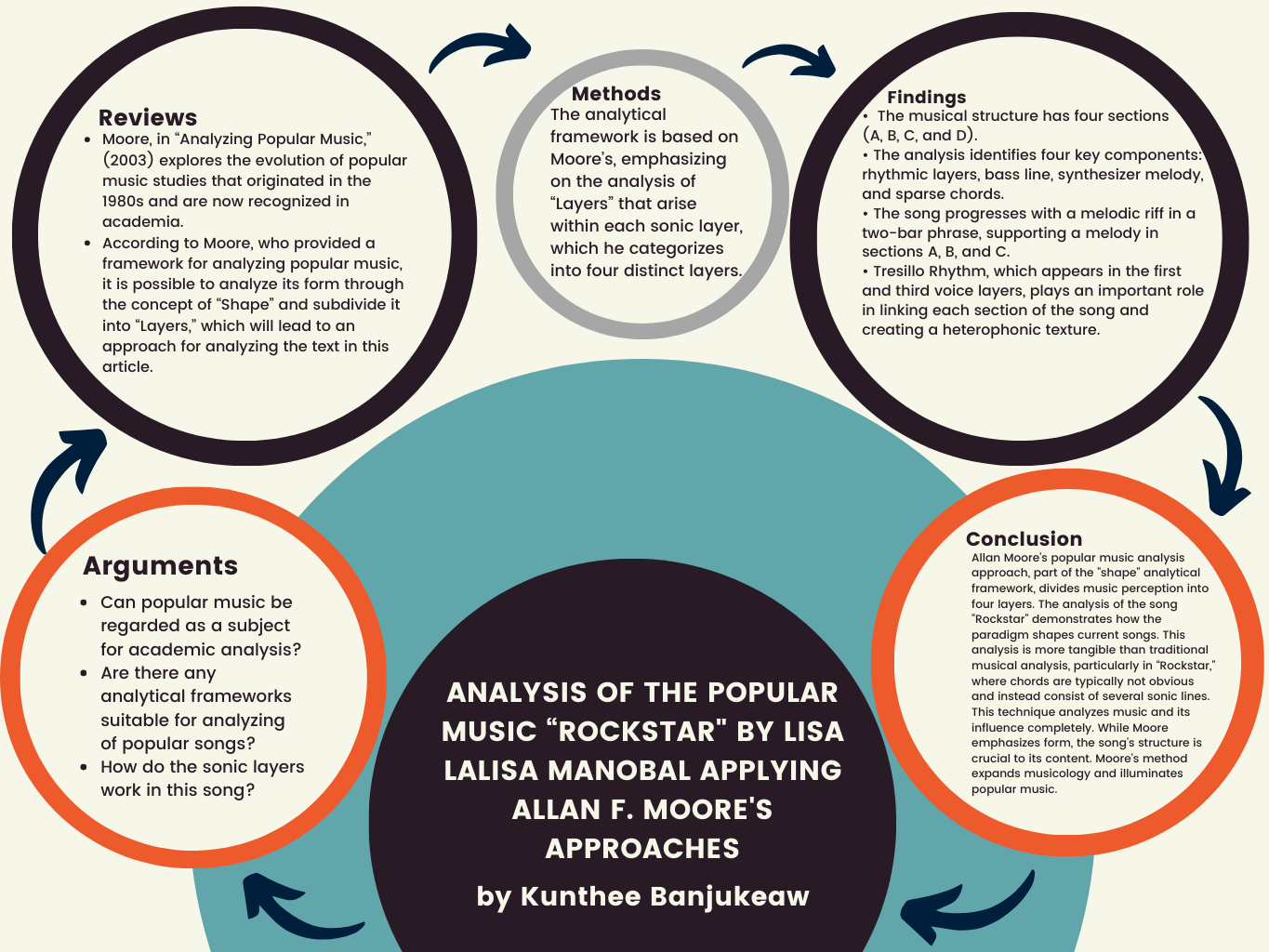
Background and Objectives: This article proposes to analyze the popular song “Rockstar” by Lalisa Manoban (Lisa) through the music content analysis methodology of Allan F. Moore, an English musicologist specializing in popular music analysis. He has proposed a paradigm for studying songs based on their structure, highlighting the various layers of sound that contribute to their significance for listeners. Furthermore, it offers an innovative perspective or instrument for music analysis, shifting from the conventional emphasis on harmonic analysis. Modern popular songs, such as the one examined in this article, frequently utilize chords sparingly and lack sufficient significance to constitute the primary explanation of the song. This article employs a framework to analyze the phenomenon of sound layers, since Moore posited that popular songs generally comprise four sound layers. This article presents three key points: The importance of popular music as an object of study 2) The notion of examining the auditory strata of Moore's work and 3) An analysis of the song “Rockstar.”
Methods: The method of analyzing this song employs Moore's theoretical framework to analyze the issue of “layers,” which consists of four components: 1) rhythmic sound layer, 2) bass sound layer, 3) melodic sound layer, and 4) harmonic sound layer. This approach helps in understanding the sonic meaning and the dynamics of change in popular music, as evident in the structure of “Rockstar.”
Results: “Rockstar” is a song with four distinct layers of sound. The first layer consists of electronic drums, characterized by the “Tresillo” rhythm, which blends the rhythm with the first phrase of the synthesizer sound at 140 BPM. This ostinato, rooted in Cuban music, runs alongside the rhythm of the bass drum and snare drum at a speed of 70 BPM. The second layer, the bass component, follows a progression starting with note C and a bass drum sound at low frequency. The bass has minimal variation in pitch and rhythmic patterns. The third layer creates additional melodies using synthesized sounds, introducing two bars short phrases defined by pitch and main rhythm. The pitches are repeated in groups of C-Eb-E and Db-Eb-E in a “Tresillo” rhythm pattern. Each section showcases distinct sound characteristics, while the key phrase remains consistent throughout the piece. The fourth layer, the harmonic filler layer, enriches the song with only the D section using chords. The D1 section features only two repeating chords, Cm7 and Dbmaj7, while the extended section shifts the original chord from Cm7 to C major, retaining the Dbmaj7 chord.
Conclusions: In conclusion, the analysis of “Rockstar” using Moore's “layers” analysis approach is as follows: The first layer of sound is rhythm, aiming to create an illusion of rhythm between the acceleration of 140 BPM from mid-high percussion sounds and the acceleration in the low-frequency range of 70 BPM. This aligns with the general structure of the “Trap” music genre, where the song seems neither fast nor slow, making the listener feel caught in between the two accelerations of the rhythm. The second layer, bass level, determines the fundamental note and compensates for missing chord layers by replacing the bass sound with a solid tone. The third layer, enhanced by melodic synthesized sounds, serves as the core and essence of the song, with repeated phrases acting as a glue between vocals and bass sounds. The final layer, characterized by harmony, appears only in section D and the extension of the song. It serves as a point of relaxation from the repetitive texture of the main phrase (in the third layer) and provides relief to the listener's ears from the overlapping layers of the melody throughout the song.
References
Adorno, Theodor W. "On Popular Music." Studies in Philosophy and Social Science 9 (1941): 17-48.
Frith, Simon. The Sociology of Rock. London: Constable and Company, 1978.
Hamm, Charles. Yesterdays: Popular Song in America. New York: Norton, 1979.
Hoggart, Richard. The Uses of Literacy: Aspects of Working-Class Life. London: Penguin Modern Classics, 2009.
Keil, Charles. Urban Blues. Chicago, IL: University of Chicago Press, 1991.
Mellers, Wilfrid H. Twilight of the Gods: The Music of The Beatles. New York: Viking, 1973.
Middleton, Richard. Studying Popular Music. London: Open University Press, 1990.
Moore, Allan F. Analyzing Popular Music. New York: Cambridge University Press, 2003.
Moore, Allan F. Song Means: Analysing and Interpreting Recorded Popular Song. Surrey: Ashgte Publishing Limited, 2012.
Vazquez, Alexandra T. Listening in Detail: Performances of Cuban Music. Durham, NC: Duke University Press, 2013.
Downloads
Published
How to Cite
Issue
Section
License
Copyright (c) 2025 College of Music

This work is licensed under a Creative Commons Attribution-NonCommercial-NoDerivatives 4.0 International License.
The copyright of the article belongs to the author. Published articles represent the views of the authors. The editorial team neither necessarily agree with nor take any responsibility for the article.