A STUDY OF THE TRANSMISSION PROCESS IN PI NAI SOLO OF KRAW NAI SAM CHAN PERFORMANCE OF SUWAT ATTAKRIT
Keywords:
Transmission Process, Solo Pi Nai in the Kraw Nai Sam Chan Song, Suwat AttakritAbstract
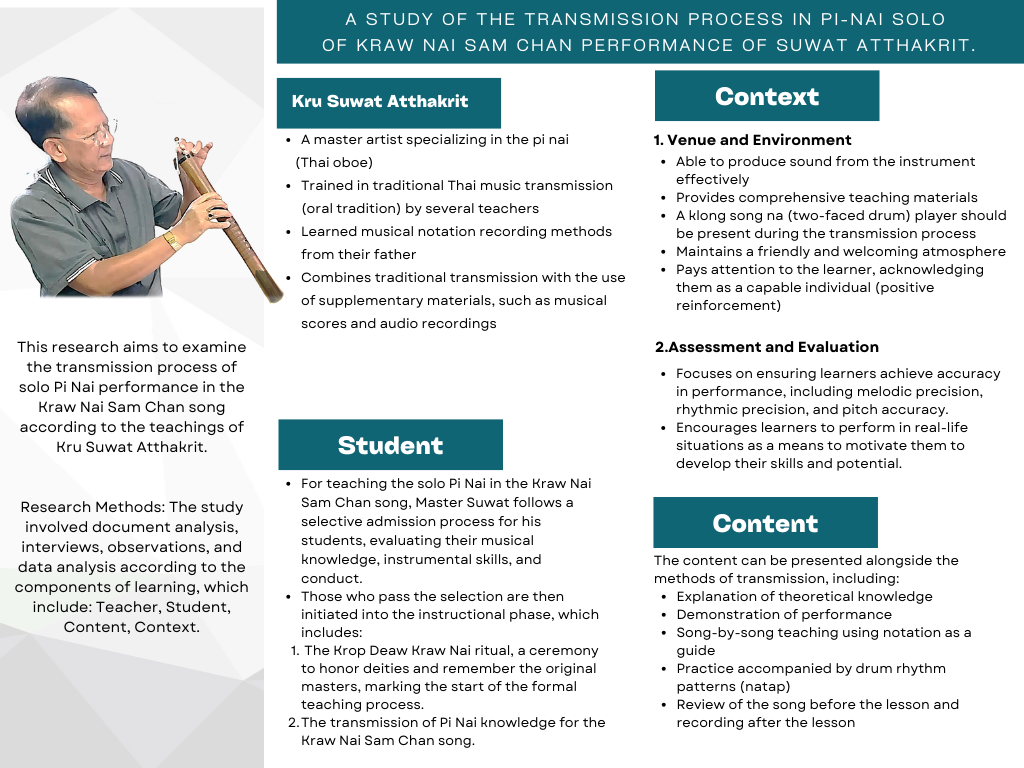
Background and Objectives: Thai music reflects the wisdom of ancestors who created it through the beauty of sound and aesthetics. It serves as a cultural medium playing a significant role in the way of life and the hearts of Thai people. It has been developed and passed down from the past to the present through musical instruments, songs, and various related knowledge. The styles of Thai music performance are divided into two main types: 1) Ensemble Performance. This refers to playing music collectively as a group, emphasizing synchronization and harmony. It is further categorized into Phleng Thang Phuen (basic melodies), Phleng Bangkhap Thang (prescribed melodies), and Phleng Luk Lo Luk Khat (Improvised Melodies). 2) Solo Performance. This involves playing a single melodic instrument with specialized techniques and unique melodic creativity that surpasses ensemble performance. However, additional instruments like Ching (small cymbals), Klong Song Na (two-faced drum), or Thon Rammana (goblet drum) may be used to enhance the rhythm. Solo performances in Thai music can be categorized into three main groups as follows: 1) Basic Solo Pieces: These include fundamental solo pieces such as Phaya Sok and Khaek Mon. 2) Performance Solo Pieces: These are solo pieces specifically used in performances, such as Cherd Nok. 3) Advanced Solo Pieces: These include highly sophisticated pieces like Kraw Nai, which is considered the pinnacle of solo performance. Such pieces require exceptional strength, skill, and mastery. Their transmission follows established traditions, and those who can perform them flawlessly are regarded as having completed their education in Thai solo music. For string instruments, Kraw Nai is typically performed in a two-layer tempo (Song Chan), while for Piphat ensemble instruments, a three-layer tempo (Sam Chan) is preferred. The Pi Nai is one of the instruments in the Piphat ensemble that is commonly performed as a solo to showcase skill in the piece Kraw Nai. The performance involves both wailing and rapid note passages. The performer must coordinate the fingers, breath, and tongue in harmony. It is a delicate instrument that should be taught directly by a master teacher. In the past, experts in Pi Nai included figures such as Phaya Sano Duriyang (Chaem Suntharawathin) and Kru Thiap Khonglaithong. Today, Kru Suwat Attakrit is regarded as one of the most important teachers of Pi Nai. For the solo Pi nai performance of the Kraw Nai Sam Chan composition by Kru Suwat Attakrit, which was passed down from Kru Monthian Samarnmit, the melody has been documented in Thai musical notation and recorded in audio form after being transmitted. This has ensured the completeness of the melodic information while also preserving the traditional methods of transmission. This effort is considered a valuable contribution to Thai music heritage, deserving to be preserved as an academic record to prevent its loss over time. From the study of documents and research related to the process of transmitting Thai music, it has been found that various aspects have been explored, including: 1) The study of transmission processes. 2) The analysis of solo Kraw Nai performances on different musical instruments. However, in reviewing the existing research, studies focusing on the complete process of transmitting solo Kraw Nai performances, from start to finish, have not yet been encountered by the researcher. Given the reasons mentioned above, the researcher recognizes the importance of studying the transmission process of the solo Pi Nai performance in the Kraw Nai Sam Chan composition according to the approach of Kru Suwat Attakrit. This study aims to enhance understanding of the unique identity of Thai music transmission in advanced solo performances and to serve as a model for future teaching and learning practices. The objective of this research is to examine the transmission process of the solo Pi Nai performance in the Kraw Nai Sam Chan composition following Kru Suwat Attakrit's methodology.
Methods: This research employs qualitative methods, focusing on key educational components: the teacher, the learner, the content, and the educational context. Data is collected through document analysis, interviews, and observations. The findings are synthesized inductively and presented in essay format.
Results: The research findings revealed that Kru Suwat Attakrit, an expert in the Pi Nai, acquired his knowledge of traditional Thai music through oral transmission from various teachers and learned Thai musical notation from his father. This background enabled him to develop a teaching approach that blends traditional oral transmission with supplementary teaching aids. For the solo Pi Nai performance of Kraw Nai Sam Chan, Kru Suwat transmitted the knowledge to selected students within his circle. The selection process considered the students' knowledge, performance skills, and good conduct. Once selected, the transmission process began with two main stages: 1) The Ritual of Initiation for Kraw Nai Solo Performance: This ritual involved paying homage to guardian spirits and honoring the lineage of teachers. 2) The Transmission of Solo Pi Nai Knowledge for Kraw Nai Sam Chan: This included theoretical knowledge, performance demonstrations, step-by-step song transmission using musical notation, practice with drum rhythms, review of the piece before each session, and Digital media (MP3 file of Pi Nai solo in Kraw Nai Sam Chan, in the style by Kru Suwat Attakrit). The teaching environment and resources were crucial, requiring a setting conducive to the sound of musical instruments and complete teaching aids, such as the Pi Nai, Klong Song Na, Ching, musical notation, audio playback devices, and a skilled drummer for accompaniment. The content emphasized precision in performance and the ability to perform in real-life situations.
Conclusions: Based on the research study, it can be concluded that the transmission process of solo Pi Nai performance in the piece Kraw Nai Sam Chan, following the approach of Kru Suwat Attakrit, remains rooted in the traditional Thai music teaching methods as he had been taught. This includes adherence to customary rituals in the transmission process, which requires direct instruction from a teacher. While some adjustments in the sequence of teaching steps may be made to align with the contemporary social context, additional teaching aids have also been incorporated, such as notation and digital media (MP3 files of the solo Pi Nai performance in Kraw Nai Sam Chan as passed down by Kru Suwat Attakrit). Furthermore, Kru Suwat Attakrit has dedicated his life to the dissemination of Thai music by ensuring an appropriate learning environment, fostering a conducive atmosphere, and providing complete musical instruments and teaching materials to effectively impart knowledge to interested learners. His teaching approach focuses on both theoretical and practical aspects of the piece. Additionally, his assessment emphasizes accuracy in performance and encourages students to participate in real-life performance situations, thereby motivating them to continuously develop their skills and potential.
References
Abdulloh, Wisana, and Wuttichai Niemted. “Arrangement of Learning Environment to Promote Learning Skills in the 21st Century ‘Concept Theory and Practice.’” Princess of Naradhiwas University Journal of Humanities and Social Sciences 7, no. 2 (July-December 2020): 227-246. (in Thai)
Attakrit, Suwat, Direk Attakrit, and Vitool Attakrit. Pi Nai Musical Notes. N.p., 2020. (in Thai)
Chaiseri, Phichit. The Composition of Thai Classical Cusic. Bangkok: Chulalongkorn University Press, 2013. (in Thai)
Charoen, Nottanunti. “A Musical Analysis of Krawnai for Ranadthum Solo: A Case Study of Kru Uthai Keolaiad.” Master’s thesis, Chulalongkorn University, 2009. (in Thai)
Hunsuwan, Keattirat. “A Musical Analysis of Krawnai Sam Chan for Jakhay Solo Mr. Siwasit Nilsuwan.” Master’s thesis, Chulalongkorn University, 2011. (in Thai)
Khemmani, Tisana. The Science of Teaching. Bangkok: Darnsutha, 2009. (in Thai)
Kosol, Chaiwut. The Essence and Practice of the Pi Nai. Songkhla: Faculty of Fine Arts, Songkhla Rajabhat University, 2006. (in Thai)
Kottunti, Sakolput. “A Musical Analysis of Krawnai for Jakhay’s Solo by Kru Nipa Apaiwong.” Master’s thesis, Chulalongkorn University, 2011. (in Thai)
Kumut, Pravet. “Behavior of Thai Musicians.” In The 11th Thai Music in Higher Education at Thammasat University on December 23, 1978, 65-69. Bangkok: Ruenkaew Printing, 1978. (in Thai)
Maithong, Ronnarit. “Transmission of Ranad Ek Performance by Kru Boontham Khongsap.” Master’s thesis, Chulalongkorn University, 2018. (in Thai)
Noinit, Samarn. Understanding Thai Rhythm, Understanding the Heart of Music. Nonthaburi: Infinite Media, 2010. (in Thai)
Numpranee, Nuttida. “The Process of Teaching Khim ‘Lao Phaen Song’ of Lhuang Praditpirho (Sorn Silapabunleng): A Case Study of Chanok Sagarik.” Master’s thesis, Mahidol University, 2016. (in Thai)
Phairoh, Phuwadet. “Models of Thai Music Transmission.” Interview by Sarawut Chungwatkhet, June 30, 2024.
Phatthanaruangrak, Nattarin. “Transmission of Thai Music by Kru Samruay Premjai.” Master’s thesis, Chulalongkorn University, 2018. (in Thai)
Piamdontree, Sumnoua. “Peenai: Pipe Teaching Process of Master Thiap Konglaithong School.” Master’s thesis, Mahidol University, 2009. (in Thai)
Promsombat, Patanee, ed. Thai Musicology Lecture Notes. Bangkok: Chuan Phim Publishing, 2002. (in Thai)
Sanitsanthia, Chatchawan. “A Musical Analysis of Kru Jumniean Srithaipan’s Kraw Nai Sam Chan for Pi Nai Solo.” Master’s thesis, Chulalongkorn University, 2010. (in Thai)
Sobrerk, Anan. “Roles and Functions of the Pi in Thai Music Ensembles.” In History and Development of the Thai Pi, Edited by Sugree Charoensook, 43-45. Nakhon Pathom: Por Samphan Printing Services, 1990. (in Thai)
Sowat, Boonchuay. “How to Play the Pi Effectively.” In History and Development of the Thai Pi, Edited by Sugree Charoensook, 46-57. Nakhon Pathom: Por Samphan Printing Services, 1990. (in Thai)
Srisakon, Prachakon. “Six-Baht Ritual Fee: Six Virtues of Dhamma.” Journal of Fine and Applied Arts, Chulalongkorn University 4, no. 2 (September 2017 - February 2018): 30-37. (in Thai)
Suttachitt, Narutt. Music Education: Principles and Essence. 10th ed. Bangkok: Chulalongkorn University Press, 2018. (in Thai)
Suwannakam, Mano, ed. Rajamangala Journal for 33th Graduation Ceremony on August 19-23, 2019. Pathum Thani: Rajamangala University of Technology Thanyaburi, 2019. (in Thai)
Thamviharn, Sangobseuk. Thai Music. 3rd ed. Bangkok: Chulalongkorn University Press, 2002. (in Thai)
Tramot, Montri, and Wichian Kultan. Listening and Understanding to Thai Song. Bangkok: Thai Kasem, 1980. (in Thai)
Tramot, Montri. Musical Terminology. Phra Nakhon: Phrachan, 1964. (in Thai)
Tramot, Montri. Thai Music by Montri Tramot. Bangkok: Thai Watana Panich, 1995. (in Thai)
Downloads
Published
How to Cite
Issue
Section
License
Copyright (c) 2025 College of Music

This work is licensed under a Creative Commons Attribution-NonCommercial-NoDerivatives 4.0 International License.
The copyright of the article belongs to the author. Published articles represent the views of the authors. The editorial team neither necessarily agree with nor take any responsibility for the article.