THE INFLUENCE OF GUANGDONG FOLK MUSIC ELEMENTS ON THE OVERALL STYLE OF CHINESE CHORAL WORKS
Keywords:
Guangdong Folk Music, Musical Elements, Chinese Choral Works, Stylistic InfluenceAbstract
Background and Objectives: The development of Chinese choral music has seen continuous integration of regional folk music elements, enriching its stylistic diversity and cultural depth. Among these, Guangdong folk music—with its distinct melodic, rhythmic, and linguistic characteristics—plays an increasingly influential role. As a region with a profound musical tradition and cultural heritage, Guangdong offers a unique repository of folk music that enhances the expressive potential of modern Chinese choral works. However, while northern folk music and ethnic minority musical styles have received substantial academic attention, systematic studies on the use and impact of Guangdong folk music elements in choral music remain limited. This research aims to address this gap by examining how Guangdong folk music elements are integrated into Chinese choral compositions and how they influence musical style, performance practices, and cultural transmission. The study also seeks to explore the educational and cross-cultural value of incorporating these elements into contemporary music-making.
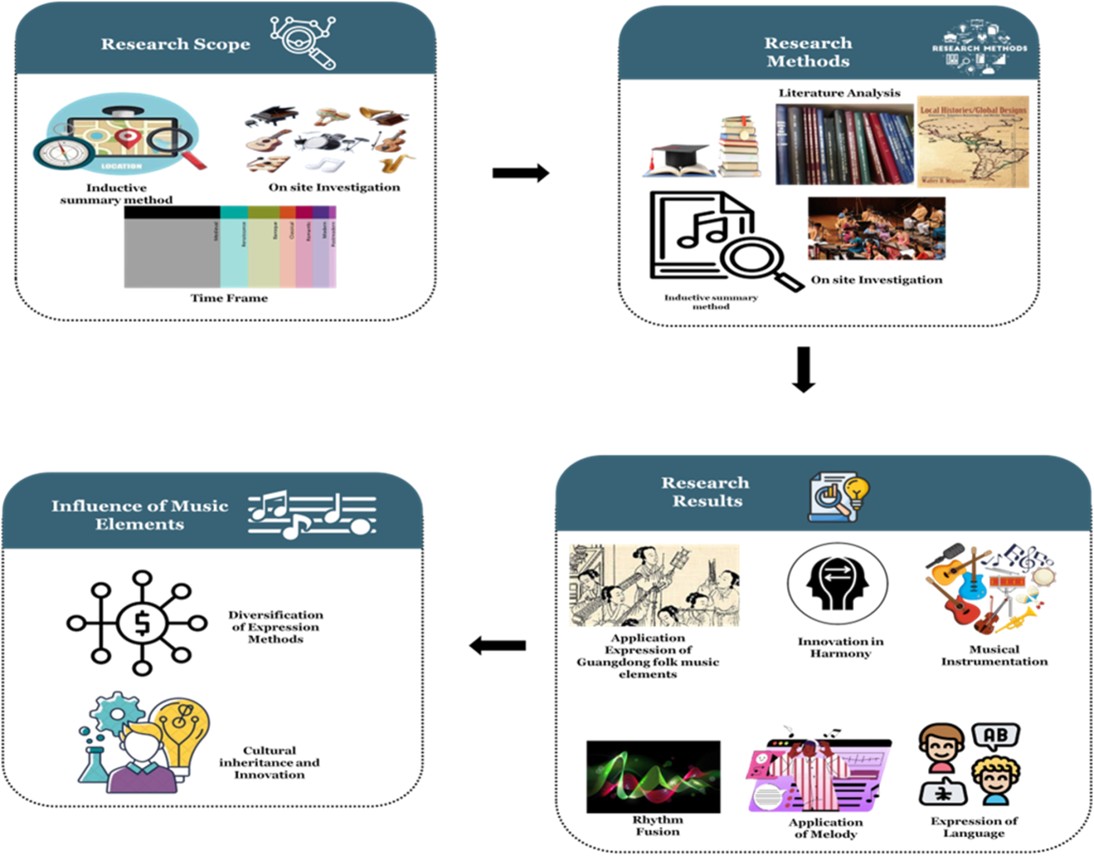
Methods: The study employs literature analysis, on-site investigation, interviews, and inductive summarization. The research analyzed academic journals, theses, and local histories related to Guangdong folk music and its cultural background. Interviews with composers, conductors, music educators, and folk musicians were conducted, as well as discussions with various choral groups to assess their knowledge and attitudes toward Guangdong folk music elements.
Results: The research identified five key musical features of Guangdong folk music that have a significant impact on choral works: melody and pitch, rhythm and beat, harmony and tonality, instrumentation, and language. The integration of pentatonic scales, lyrical ornamentation, and expressive melodic lines enriches the musical expressiveness of choral pieces. Complex rhythmic patterns, such as mixed meters and syncopations, add vibrancy and depth. Harmonically, Guangdong music contributes to innovative choral textures through polyphony and chromatic progression. Traditional instruments like the erhu, pipa, and gaohu enhance regional color and authenticity, while the use of Cantonese and other Lingnan dialects deepens the emotional resonance and cultural identity of the works. These elements not only elevate the artistic quality of the compositions but also serve important cultural functions. They help preserve regional traditions, promote educational engagement, and facilitate intercultural exchange. The case studies of works like Flowers Morning and Moonlight, Liwan Lullaby, and Yongqingfang vividly demonstrate how Guangdong folk music breathes new life into Chinese choral compositions.
Conclusions: This study reveals that the incorporation of Guangdong folk music elements significantly enhances the artistic and cultural dimensions of Chinese choral works. By integrating melodic, rhythmic, harmonic, instrumental, and linguistic features unique to Guangdong, these choral compositions gain distinctive stylistic identities rooted in regional tradition. Moreover, they contribute to the cultural inheritance of Guangdong folk music, transforming it into a living, evolving practice that resonates with both local and global audiences. The research underlines the value of cross-disciplinary approaches—including ethnomusicology and cultural communication—in understanding and promoting regional music within modern artistic frameworks. It also points toward the potential of Guangdong folk music to serve as a bridge between tradition and innovation, education and performance, and local identity and global cultural exchange.
References
Bukofzer, Manfred F. “The Beginnings of Choral Polyphony.” In Studies in Medieval and Renaissance Music, 176-189. New York: W.W. Norton, 1950.
Chen, Guohuan. “Development and Prospects of Guangdong Choral Art.” Music Research 29, no. 2 (2015): 45-50. (in Chinese)
Chen, Jiahai. Conducting Design for Famous Choral Pieces. Zhengzhou: Henan University Press, 2000. (in Chinese)
Cooper, Martin. Beethoven. Oxford: Oxford University Press, 2008.
Grout, Donald Jay, and Claude V. Palisca. A History of Western Music. 5th ed. New York: W.W. Norton, 1996.
Li, Fubin. “Characteristics and Applications of Guangdong Folk Music Elements.” Music Research 21, no. 2 (2007): 60-65. (in Chinese)
Liu, Zaisheng. “Li Shutong and the Early Choral Art in China.” Music Exploration 25, no. 4 (2009): 33-37. (in Chinese)
Ren, Xiulei. 20th Century Chinese Choral Creative Thinking. Beijing: Central Conservatory of Music, 2010. (in Chinese)
Sun, Jiaguo. “Research on the Application of Guangdong Folk Music in Choral Creation.” Journal of Musicology 4, no. 3 (2015): 45-50. (in Chinese)
The Hong Kong Children's Choir. A Tribute to The Hong Kong Children's Choir Volume IV. Hong Kong: Hong Kong Sanlian Bookstore, 2007.
Tian, Xiaobao. “The Diversified Development of Chinese Choral Music Nowadays.” Chinese Music 23, no. 4 (2009): 173-183. (in Chinese)
Wan, Shanshan. “Artistic Characteristics Analysis of Lai Guangyi’s Choral Work ‘Heavy Rain.’” Choral Art 51, no. 4 (2017): 28-32. (in Chinese)
Wang, Sen. “From Communication to Music Communication.” Huang Zhong: Journal of Wuhan Conservatory of Music 1, no. 2 (2005): 121-124. (in Chinese)
Weixin. “Chanting of Youth, the Charm of Xiguan.” Last modified October 12, 2022. https://mp.weixin.qq.com/s/rEffwH-Eqv60Zr5VCuWyvw.
Xie, Ji. “Thoughts on the Innovative Development of Guangdong Music.” New Sounds of Yuefu: Journal of Shenyang Conservatory of Music 28, no. 3 (2010): 125-127. (in Chinese)
Yang, Baoxiong. “The Ideological Function of Hakka Nursery Rhymes: A Cultural Interpretation of the Hakka Nursery Rhyme ‘Moonlight’ in Hezhou.” Journal of Hezhou College 24, no. 1 (2008): 14-18. (in Chinese)
Yu, Qiwei. “Overview of Guangdong Music.” China Music 18, no. 2 (1998): 25-29. (in Chinese)
Zeng, Suijin. “From Natural Communication to Technical Communication of Music (Above): One of the Explorations of Contemporary Music Communication Theory.” Huang Zhong: Journal of Wuhan Conservatory of Music 15, no. 3 (2003): 29-36. (in Chinese)
Zhang, Xinmei. Nationalization of Chinese Piano Art: A Study of Pentatonic Modal Harmonization Techniques in Contemporary Piano Music. Xi'an: Shaanxi Normal University Publishing House, 2020. (in Chinese)
Downloads
Published
How to Cite
Issue
Section
License
Copyright (c) 2025 College of Music

This work is licensed under a Creative Commons Attribution-NonCommercial-NoDerivatives 4.0 International License.
The copyright of the article belongs to the author. Published articles represent the views of the authors. The editorial team neither necessarily agree with nor take any responsibility for the article.