AN INCLUSIVE MUSIC LEARNING FOR AN UNDERSTANDING DEVELOPMENT OF MULTICULTURE AND MULTIETHNIC: A CASE OF CAKLEMPONG MUSIC TEACHING ON A SHORT-COURSE PROGRAMME FOR EXCHANGE STUDENTS
Keywords:
Inclusive Learning, Multiculture, Caklempong, Short-course Programme, Exchange StudentsAbstract
Background and Objectives: The emergence of multicultural and multiethnic characteristics in Malaysia is clearly evident from the period of Malaya under Western colonization in Southeast Asia. This phenomenon likely began concurrently with the nation-building process that took place when Malaysia gained independence in 1957. As the nation developed, Malaysia was formed through its diversity and differences in languages, religions, ethnicities, and cultural aspects. Moreover, the diverse elements of Malaysia are primarily anchored in the Malay culture and Islam, which form the majority among the populace. Music serves as an intangible cultural heritage with dynamic influence. It is essential to manage culture effectively, ensuring that diversity coexists harmoniously in a cultural, social, and peaceful manner. Music possesses a unique ability to adapt and is capable of blending with other evolving musical traditions. This academic article aims to examine the utilization of local music plays a vital role in encouraging an inclusive learning environment. In Malaysia, Caklempong serves as an example of how music can be used to promote cultural awareness, embracing both multiculturalism and multiethnicity. Furthermore, an educational management approach that incorporates mobility programme was introduced in Europe during the 19th century due to the expansion of the European population and the increasing number of Europeans pursuing higher education. Additionally, the mobility programme has been effectively implemented in education, facilitating collaboration across institutions and nations.
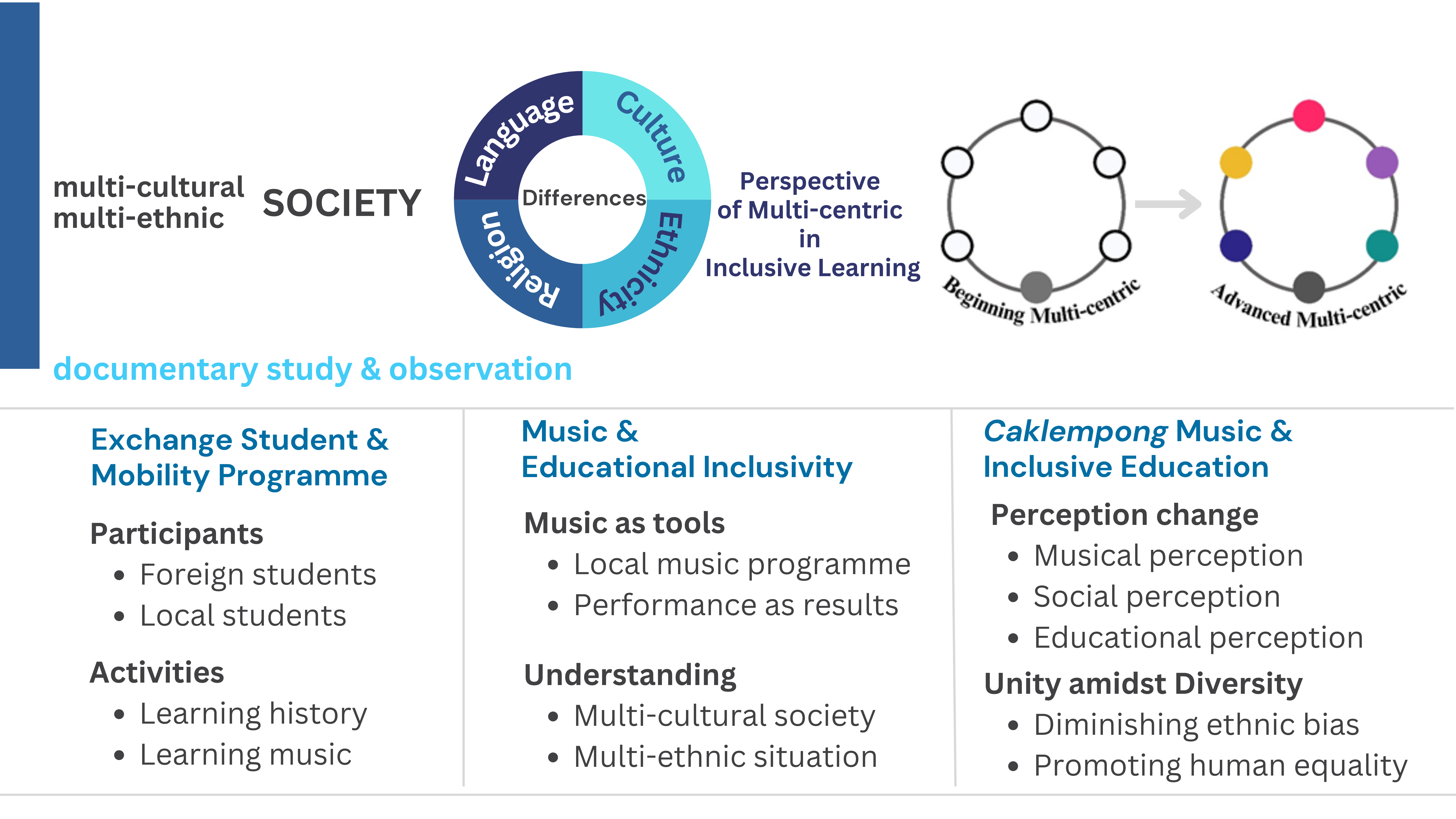
Methods: This academic paper explored Malay history through a documentary study, utilizing various books, articles, and sources, while also reviewing numerous documents focused specifically on Caklempong music. The paper has been composed in a narrative style to illustrate the social and cultural aspects of Malaysia, along with its multicultural society. It also addressed the conditions and variations among different ethnic groups. The music, originating from ethnic traditions, is presented as a means of enhancing the understanding of both internal and external music cultures. Furthermore, this paper included data collection through observational methods. The analysis was conducted by applying a framework of inclusive learning and adapting conceptual components with a non-centric cultural approach, transitioning from a beginning multi-centric view to a more advanced multi-centric perspective.
Results: Organizing a short-course programme on music for exchange students offers a valuable experience, allowing participants from diverse cultures to come together in a practical way. Engaging in music serves as an effective means for students to connect, regardless of their musical experience. The hands-on approach enables students to immerse themselves in the intricate cultural aspects of music by engaging with instruments, different musical forms, and songs. Additionally, new understanding and knowledge are developed by organizing musical activities that are outside their usual cultural context. Caklempong is not so hard to learn since it consists of both membranophone and idiophone instruments in an ensemble. The various elements of cultural components in a performance, such as costumes and accessories, are also crucial for understanding culture. The ceremonial process of performing music is significant in learning about diverse musical cultures.
Conclusions: The paper explored the use of Caklempong music as a resource for educational design in inclusive learning, focusing on music as a medium for learning. The participants in the program are expected to cultivate self-awareness and gain insights into various cultures within different social contexts. Utilizing music in the teaching of inclusive learning effectively helps Malaysian students appreciate their multicultural society. On the other hand, international students also gain a deep understanding of the distinctiveness of multicultural and multiethnic issues in Malaysia. The implementation of a short-course program for music education in an inclusive learning offers two key advantages: the opportunity for most Malaysian students, both majority and minority, to learn music collaboratively, and the chance for foreign exchange students to engage with Malaysian culture through music, thereby gaining insight into the country's diverse values and multicultural society. The traditional music known as Caklempong assists in fostering understanding and recognition of differences through 3 phases; musical perception, social perception, and educational perception. Moreover, this educational framework is rooted in multicultural music education. Incorporating local music into inclusive learning may enhance the understanding of unity amidst diversity within the nation. Additionally, the integration of local music stimulates efforts to diminish ethnic biases and promote human equality.
References
Bhatti, Ghazala. “Social and Educational Inclusion in Schools and Their Communities.” In Education for Democratic Intercultural Citizenship, edited by Wiel Veugelers, 61-80. Leiden: Brill, 2019.
Collins, Megan. “Bongai in Tanjong Ipoh, Negari Sembilan.” Journal of the Malaysian Branch of the Royal Asiatic Society 75, no. 1 (282) (2002): 91-114.
DeLuca, Christopher. “Toward an Interdisciplinary Framework for Educational Inclusivity.” Canadian Journal of Education 36, no. 1 (2013): 305-348.
Florian, Lari, and Kristine Black-Hawkins. “Exploring Inclusive Pedagogy.” British Educational Research Journal 37, no. 5 (October 2011): 813-828.
Goh, Daniel P. S. “10. Arrested Multiculturalisms: Race, Capitalism, and State Formation in Malaysia and Singapore.” In Multiculturalism in the British Commonwealth: Comparative Perspectives on Theory and Practice, edited by Richard T. Ashcroft and Mark Bevir, 191-211. Berkeley: University of California Press, 2019.
Groemer, Gerald. “The music of Malaysia: The Classical, Folk, and Syncretic traditions by Patricia Matusky and Tan Sooi Beng.” Asian Folklore Studies 63, no. 2 (2004): 346-348.
Jokinen, Markku. “Inclusive Education—A Sustainable Approach?” American Annual of the Deaf 163, no. 1 (Spring 2018): 70-77.
Markus, Andrew. “Attitudes to Multiculturalism and Cultural Diversity.” In Multiculturalism and Integration: A Harmonious Relationship, edited by Michael Clyne and James Jupp, 89-100. Canberra: ANU Press, 2011.
Messer, Dolores, and Stefan C. Wolter. “Are Student Exchange Programs Worth It?” Higher Education 54, no. 5 (October 2007): 647-663.
Navarro, Silvia Baldiris, Panagiotis Zervas, Ramon Fabregat Gesa, and Demetrios G. Sampson. “Developing Teacher’s Competences for Designing Inclusive Learning Experiences.” Educational Technology & Society 19, no. 1 (January 2016): 17-27.
Palkki, Joshua. “Inclusivity in Action: Transgender students in the Choral Classroom.” The Choral Journal 57, no. 11 (June-July 2017): 20-35.
Sagawa, Noriyuki. “Malaysia's 1996 Education Act: The Impact of a Multiculturalism-type Approach on National Integration.” Sojourn: Journal of Social Issues in Southeast Asia 22, no. 1 (April 2007): 30-56.
Sanrattana, Unchalee. “An Implementation of Inclusive Education.” International Journal of Education 33, no. 2 (April-June 2010): 80-85.
Santhiram, R. “Chapter Nine: Educational Research in Multiethnic School Settings: A Malaysian Experience.” Counterpoints 112 (2001): 137-154.
Simon, Artur. “Southeast Asia: Musical Syncretism and Cultural Identity.” Fontes Artis Musicae 57, no. 1 (January-March 2010): 23-34.
Soodak, Leslie C. “Classroom Management in Inclusive Settings.” Theory into Practice 42, no. 4 (Autumn 2003): 327-333.
Sooi Beng, Tan. Bangsawan: A Social and Stylistic History of Popular Malay Opera. Singapore: Oxford University Press, 1997.
Soon Lee, Tong. “The Music of Malaysia: The Classical, Folk, and Syncretic Traditions SOAS Musicology Series by Patricia Matusky and Tan Sooi Beng.” The World of Music 47, no. 2 (2005). 167-169.
Tammasaeng, Maliwan. “Inclusive Education.” Accessed February 19, 2025. https://www.deafthai.org/knowledge-center/. (in Thai)
Tassanawongwara, Chayuti. “Integrity on Diversity: the Malaysia’s Cultural Pluralistic Music.” Journal of Music and Performing Arts, Khon Kaen University 5, no. 3 (September-December 2023): 45-66. (in Thai)
Waitoller, Federico R., and Alfredo J. Artiles. “A Decade of Professional Development Research for Inclusive Education: A Critical Review and Notes for a Research Program.” Review of Educational Research 83, no. 3 (September 2013): 319-356.
Welsh, Bridget. “Malaysia’s Political Polarization: Race, Religion, and Reform.” In Political Polarization in south and southeast Asia: Old Divisions, New Dangers, edited by Thomas Carothers and Andrew O’Donohue, 41-52. Washington DC: Carnegie Endowment for International Peace, 2020.
Downloads
Published
How to Cite
Issue
Section
License
Copyright (c) 2025 College of Music

This work is licensed under a Creative Commons Attribution-NonCommercial-NoDerivatives 4.0 International License.
The copyright of the article belongs to the author. Published articles represent the views of the authors. The editorial team neither necessarily agree with nor take any responsibility for the article.