A SCOPING REVIEW OF CREATIVE RESEARCH AMONG WESTERN MUSIC STUDENTS AT CHANDRAKASEM RAJABHAT UNIVERSITY
DOI:
https://doi.org/10.65824/mmj.v9.281127Keywords:
Scoping Review, Creative Research, Artistic Research, Undergraduate, Western MusicAbstract
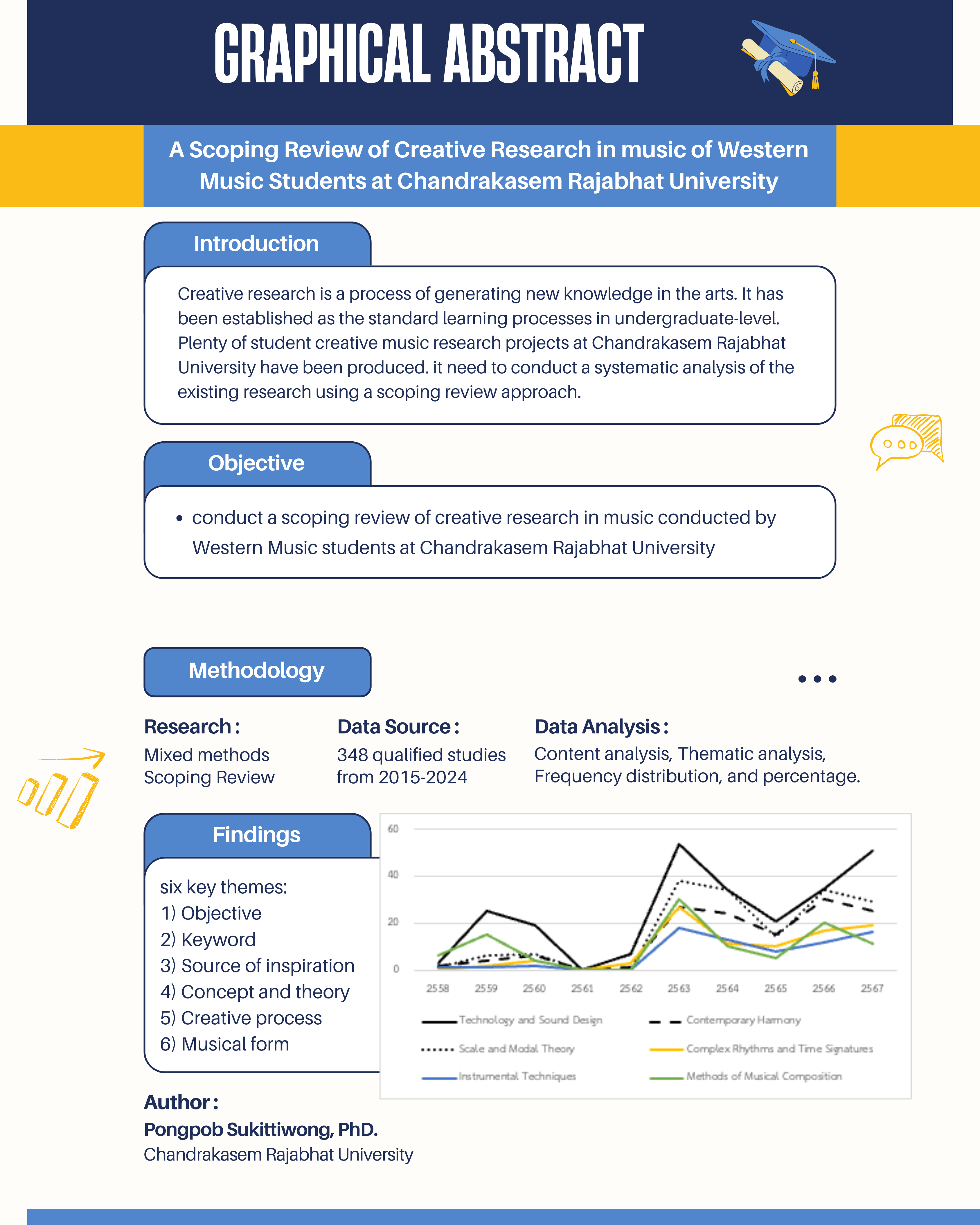
Background and Objectives: Creative research is a process of generating new knowledge in the arts through creative practice as a key method. It has been established as one of the standard learning processes in undergraduate-level art curricula. The Bachelor of Music program in Western Music at Chandrakasem Rajabhat University has continuously implemented creative music research as part of its curriculum. The program focuses on knowledge and experience that students have developed from the course of their studies and gives them an opportunity to freely create their work and publish it. As a result, a large number of student creative music research projects have been produced. Conducting a systematic analysis of the existing research using a scoping review approach allows for the mapping of the knowledge landscape and identification of research gaps, which can serve as a foundation for clearer and more effective educational processes. The aim of this study is therefore to conduct a scoping review of creative research in music conducted by Western Music students at Chandrakasem Rajabhat University.
Methods: This research was a descriptive study employing the scoping review methodology, following the steps: identifying relevant studies, analyzing the studies, organizing the data, and comparing and synthesizing the findings. A total of 348 qualified studies from the academic years 2015-2024 (B.E. 2558-2567) were selected. The research instrument was a document analysis record form. Data collection involved recording document files in electronic format for analytical reading based on the specified issues. Data analysis techniques include content analysis, thematic analysis, and frequency counting and distribution.
Results: The findings revealed six key themes: 1) Most works primarily focused on composing and publishing musical pieces. Secondary goals included telling stories, conveying personal emotions, blending or preserving cultural elements, analyzing musical ideas, and developing innovative technologies; 2) The most common keywords related to technology, music styles, and techniques. Gaps in the research included areas such as health and psychology, sound theory and art, virtual media technology, contemporary music, and environmental or soundscape studies; 3) Main sources of inspiration included personal life experiences and emotions, reference artists and musical styles, and pop culture media. Alternative inspirations included sound design and innovation, environment, nature and travel, culture, local traditions, and history, society, well-being and psychology, mythology, religion, fantasy, and war; 4) Primary concepts and theories included music technology and sound design, contemporary harmony, scale and modal theory, complex rhythms and time signatures, instrumental techniques, and methods of musical composition; 5) Key creative processes included music production, sound design, mixing and mastering, composing melody, chords, and song structure, live performance, multimedia video presentation, and using music technology tools; 6) The main musical forms included verse–chorus, progressive forms, through-composed forms, and strophic forms.
Conclusions: The scoping review highlights students’ key interests in applying music technology, fusion and contemporary music characterized by diverse integration and experimentation, and film score, media music, and experimental music. The findings support recommendations for developing course content and curricula that align with student aspirations for advanced studies. Additionally, the findings identified gaps in both research focus and methodology, especially the need to clarify and strengthen research objectives, enhance analytical approaches to support the creative process, document procedures more clearly and systematically, and adopt more challenging theoretical frameworks and musical forms. These findings contribute to recommendations for improving instruction and advancing creative research at the graduate level to better address these gaps.
References
Arksey, Hilary, and Lisa O’Malley. “Scoping Studies: Towards a Methodological Framework.” International Journal of Social Research Methodology 8, no. 1 (February 2005): 19-32. DOI: https://doi.org/10.1080/1364557032000119616
Barlindhaug, Gaute. “Performing with Sonic Tools: An Approach to Designing and Analysing New Instruments.” Journal for Artistic Research, no. 31 (2023). https://www.researchcatalogue.net/view/1282234/1938920/0/0.
Braun, Virginia, and Victoria Clarke. “Using Thematic Analysis in Psychology.” Qualitative Research in Psychology 3, no. 2 (2006): 77-101. DOI: https://doi.org/10.1191/1478088706qp063oa
Candy, Linda. “Practice-Based Research: A Guide.” Creativity & Cognition Studios. 2006. https://www.creativityandcognition.com/wp-content/uploads/2011/04/PBR-Guide-1.1-2006.pdf.
Chandrakasem Rajabhat University. Bachelor of Music Program in Western Music: Revised Curriculum 2021. Bangkok: Chandrakasem Rajabhat University, 2021. (in Thai)
Chitkul, Krailas, and Athitaya Piwkhum. “Practice as Research in Performing Arts.” In King’s Philosophy for Sustainable Development: A Collection of Research and Academic Articles, Chiang Mai Rajabhat University, 2017, edited by Kaltima Phichai, Pathamarat Nakanitanon, Vilaiporn Luksameevanish, and Sutthinan Chuenchom, 145-154. Chiang Mai: Somporn Printing, 2017. (in Thai)
Culture Action Europe. “Vienna Declaration on Artistic Research.” Accessed January 15, 2025. https://cultureactioneurope.org/news/vienna-declaration-on-artistic-research.
De Moraes, Tharcisio Vaz, “Creative Processes Applied in the Musical Composition of the Audio Game BREU: Shadow Hunt in Light of Concepts Related to Game Design and Embodied Cognition.” Journal of Sound and Music in Games 6, no. 3 (Summer 2025): 25-46. DOI: https://doi.org/10.1525/jsmg.2025.6.3.25
Diegert, Joel, and Adrián Artacho. “Aubiome: A Collaborative Method for the Production of Interactive Electronic Music.” Journal for Artistic Research, no. 25 (2021). https://www.researchcatalogue.net/view/643746/652150/0/0.
Levac, Danielle, Heather Colquhoun, and Kelly K. O’Brien. “Scoping Studies: Advancing the Methodology.” Implementation Science 5 (2010): 69. DOI: https://doi.org/10.1186/1748-5908-5-69
Ministry of Education. “Announcement of the Ministry of Education on Bachelor's Degree Qualification Standards in Fine Arts, B.E 2558.” In Royal Thai Government Gazette 133, Special Section 26D (January 29, 2016): 7. (in Thai)
Mukdamanee, Vichaya. “Practice-led Research: Research for Learning.” Silpa Bhirasri Journal of Fine Arts 2, no. 2 (March 2015): 19-30. (in Thai)
Nelson, Robin. Practice as Research in the Arts: Principles, Protocols, Pedagogies, Resistances. Hampshire: Palgrave Macmillan, 2013. DOI: https://doi.org/10.1057/9781137282910
Piccini, Angela. “An Historiographic Perspective on Practice as Research.” Studies in Theatre and Performance 23, no. 3 (2004): 191-207. DOI: https://doi.org/10.1386/stap.23.3.191/3
Power, Nigel. “You Can’t Get There from Here: Discovering Where to Begin a Practice-Led Inquiry Notes and Reflections from Thailand.” Revista GEMInIS 13, no. 3 (2022): 58-70. DOI: https://doi.org/10.53450/2179-1465.RG.2022v13i2p58-70
Ruiz-Perez, Isabel, and Dafina Petrova. “Scoping Reviews: Another Way of Literature Review.” Medicina Clínica (English Edition) 153, no. 4 (August 2019): 165-168. DOI: https://doi.org/10.1016/j.medcle.2019.02.026
Smith, Hazel, and Roger T. Dean, eds. Practice-Led Research, Research-Led Practice in the Creative Arts. Edinburgh: Edinburgh University Press. 2009. DOI: https://doi.org/10.1515/9780748636303
Sukittiwong, Pongpob, Thanach Chawawisuttikoon, and Wittada Phaokhum. “Developing a Library Music to Promote the Corporate Identity of Chandrakasem Rajabhat University.” Mahidol Music Journal 6, no. 2 (September 2023 - February 2024): 158-175. https://so04.tci-thaijo.org/index.php/mmj/article/view/269933.
Downloads
Published
How to Cite
Issue
Section
License
Copyright (c) 2026 College of Music

This work is licensed under a Creative Commons Attribution-NonCommercial-NoDerivatives 4.0 International License.
The copyright of the article belongs to the author. Published articles represent the views of the authors. The editorial team neither necessarily agree with nor take any responsibility for the article.